Wednesday, December 20, 2023

Vince Guaraldi - A Charlie Brown Christmas (Super Deluxe Edition)


A Charlie Brown Christmas - what else need be said about this beloved perennial holiday favorite?  I mentioned in an earlier post what an unexpected smash hit the initial airing of this program was in 1965, and how the soundtrack is not only one of the top ten best-selling Christmas albums of all time, but also the second-best selling jazz album of all time (behind Miles Davis' Kind Of Blue) (It was also voted into the Grammy Hall of Fame in 2007, and in 2012 added to the National Recording Registry of the Library of Congress for being "culturally, historically, or aesthetically significant").  Any other superlatives I can present here will do little to convey the near-universal adoration of this program and its music, with many of its original Vince Guaraldi compositions (including "Christmas Time Is Here"and "Skating") becoming popular holiday standards.

The soundtrack album was originally released on Fantasy Records in December 1965.  In 2022, Craft Recordings, which now owns the legacy Fantasy label, issued a four-disc deluxe edition of this album, featuring a new stereo mix (remastered from the original 3-track and 2-track sources), the original 1965 stereo mix, and up to 50 previously unreleased outtakes from five separate recording sessions conducted by Guaraldi and his group at various locations in California in the fall of 1965. Here's the song lineup by disc:

 Disc 1 - New and Original Stereo Mix

1     O Tannenbaum (2022 Stereo Mix)
2     What Child Is This (2022 Stereo Mix)
3     My Little Drum (2022 Stereo Mix)
4     Linus and Lucy (2022 Stereo Mix)
5     Christmas Time Is Here (Instrumental / 2022 Stereo Mix)
6     Christmas Time Is Here (Vocal / 2022 Stereo Mix)
7     Skating (2022 Stereo Mix)
8     Hark, the Herald Angels Sing (2022 Stereo Mix)
9     Christmas Is Coming (2022 Stereo Mix)
10     Fur Elise (2022 Stereo Mix)
11     The Christmas Song (2022 Stereo Mix)
12     A Charlie Brown Christmas (Original Stereo Mix)
13     O Tannenbaum (Original Stereo Mix)
14     What Child Is This (Original Stereo Mix)
15     My Little Drum (Original Stereo Mix)
16     Linus and Lucy (Original Stereo Mix)
17     Christmas Time Is Here (Instrumental / Original Stereo Mix)
18     Christmas Time Is Here (Vocal / Original Stereo Mix)
19     Skating (Original Stereo Mix)
20     Hark, the Herald Angels Sing (Original Stereo Mix)
21     Christmas Is Coming (Original Stereo Mix)
22     Fur Elise (Original Stereo Mix)
23     The Christmas Song (Original Stereo Mix)
 Disc 2 - The Recording Sessions (September 17, 1965)
1     Christmas Is Coming (#1, Take 1)
2     Christmas Is Coming (#1, Take 2)
3     Christmas Is Coming (#1, Take 3)
4     Christmas Is Coming (#1, Takes 4-5)
5     Christmas Is Coming (#1, Take 6)
6     Christmas Is Coming (#1, Take 7)
7     Christmas Time Is Here (Instrumental) (#2, Takes 1-2)
8     Christmas Time Is Here (Instrumental) (#2, Take 3)
9     Skating (Unnumbered)
10     Skating (#3, Takes 1-2)
11     Skating (#3, Take 3)
12     Skating (#3, Takes 4-6)
13     Skating (#3, Take 7)
14     Linus and Lucy (#4, Take 1)
15     Christmas Is Coming (#5, Take 1)
16     Christmas Is Coming (#5, Take 2)
17     Christmas Is Coming (#5, Take 3)
18     Christmas Is Coming (#5, Take 4)
19     Christmas Time Is Here (Instrumental) (#6, Take 1)
20     Christmas Time Is Here (Instrumental) (#6, Take 2)
 Disc 3 - The Recording Sessions (September 21-22, 1965_Unknown Session Date)
1     Christmas Is Coming (#1, Take 1)
2     Christmas Is Coming (#1, Take 2)
3     Christmas Is Coming (#1, Take 3)
4     Christmas Is Coming (#1, Takes 4-6)
5     Christmas Is Coming (#1, Take 7)
6     O Tannenbaum (#2, Take 1)
7     O Tannenbaum (#2, Take 2)
8     O Tannenbaum (#2, Takes 3-4)
9     O Tannenbaum (#2, Take 5)
10     Jingle Bells (#3, Takes 1-4)
11     Goin' Out of My Head (Unnumbered)
12     Christmas Time Is Here (Instrumental) (#6, Take 3)
13     Skating (#7, Take 1)
14     Skating (#7, Take 2)
15     FÜR Elise (Takes 1-2)
16     Christmas Time Is Here (Vocal) (#1, Take 1)
17     Christmas Time Is Here (Vocal) (#1, Takes 2-3)
18     Christmas Time Is Here (Vocal) (#1, Take 4)
19     Christmas Time Is Here (Vocal) (#1, Take 5)
20     Christmas Time Is Here (Vocal) (Rehearsal)
21     Christmas Time Is Here (Vocal) (#1, Take 6)
22     Christmas Time Is Here (Vocal) (#1, Take 7)
 Disc 4 - The Recording Sessions (October 28, 1965)
1     Greensleeves (Take 1)
2     Greensleeves (Takes 2-4)
3     Greensleeves (Take 5)
4     Greensleeves (Take 6)
5     Greensleeves (Take 7)
6     Greensleeves (Take 8)
7     Greensleeves (Takes 9-10)
8     Greensleeves (Take 11)
9     Greensleeves (Take 12)
10     The Christmas Song (Take 1)
11     The Christmas Song (Takes 2-3)
12     The Christmas Song (Takes 4-7)
13     The Christmas Song (Take 8)
14     The Christmas Song (Take 9)
15     The Christmas Song (Take 10)
16     The Christmas Song (Take 11)

Hearing the session recordings, it's almost like you're there in the studio with Guaraldi & Co., as the musicians work through their arrangements.  For me, it's a fascinating view of the development of a classic work!

So here for your holiday pleasure is the expanded Deluxe edition of the A Charlie Brown Christmas soundtrack, originally released on Fantasy in late 1965, and rereleased on Craft Recordings on August 22nd, 2022.  Enjoy, and as always, let me know what you think.  Merry Christmas!

Please use the email link below to contact me, and I will reply with the download link(s) ASAP:

Send Email

Thursday, November 2, 2023

The Grateful Dead - Workingman's Dead: The Angel's Share


This being the Day Of The Dead, I figured why not commemorate the day by posting some Grateful Dead?  I don't have any especial love for GD... but that hasn't stopped me from collecting hundreds of hours of their recordings over the years.  They're an essential American band, and as such deserve honor and respect - even from an obsessive music collector like myself!

Here's Workingman's Dead: The Angel's Share, a digital-only 2020 release of studio rehearsals and outtakes from The Grateful Dead's classic and celebrated 1970 album.  I don't have much else to say about it here, but Rolling Stone magazine had plenty to comment upon regarding it when this album was put out three years ago; here's their write-up, if you're interested.  

This is for all the Deadheads out there, and music fans in general.  Have a listen, and let me know what you think.  Happy November 2nd!

Please use the email link below to contact me, and I will reply with the download link(s) ASAP:

Send Email

Saturday, October 28, 2023

Various Artists - No Alternative


Holy smokes - this seminal compilation is THIRTY YEARS OLD this week!

To understand why this disc is so essential, and so celebrated, I direct you to Stereogum's writeup on it from ten years ago, on No Alternative's twentieth anniversary - can't add a word to this superb summation.

I'll just save my breath, and instead provide you all with possibly the best and timeliest collection of then-rarities and unreleased songs by some of the giants of alternative music of that period.  Here's No Alternative, released on Arista Records on October 26th, 1993.  Enjoy this great throwback to an interesting and exciting era in modern music, and, as always, let me know what you think.

Please use the email link below to contact me, and I will reply with the download link(s) ASAP:

Send Email

Thursday, October 26, 2023

Vince Guaraldi - It's The Great Pumpkin, Charlie Brown: Music From The Soundtrack

In the early 1960s, Charles Schulz's comic strip Peanuts was entering into a long period of enormous international popularity, which others in the entertainment industry were eager to capitalize on.  Television producer Lee Mendelson was keen to produce a documentary featuring Schulz and the success of his strip, and by 1964 had established a good working relationship with the cartoonist which also morphed into a fast friendship.  The documentary Mendelson envisioned would be mostly live action, with only a couple of minutes of animation included.  For that, Schulz recommended an animator named Bill Melendez, who he had earlier worked with for several years on a series of commercials for Ford vehicles featuring the characters.  


But despite his efforts, and the acclaim for the strip, Mendelson couldn't interest any of the then-existing networks in funding and airing a Charlie Brown & Charles Schulz documentary of the type he had in mind.

However, Peanuts-mania continued unabated; in the spring of 1965, the Peanuts gang was featured on the cover of Time magazine.  Shortly after the release of that issue, Mendelson was contacted by representatives of McCann Erickson, a New York-based ad agency whose biggest client was the Coca-Cola Company.  He was told that Coca-Cola was looking for a Christmas holiday special to sponsor, envisioning a half-hour animated program to air on the CBS Television network, and wanted to know if he and Charles Schulz were interested.  The two completed and forwarded to Coke executives a show outline from scratch in a single day, and after belated approval from the corporation, completed the production of that first special, A Charlie Brown Christmas, in just six months.  

Many of those involved in the making of A Charlie Brown Christmas and corporate and network executives were convinced that the program would be a disaster, due to its relatively slow pacing, flat animation, odd jazz-influenced music score, no laugh track and the inclusion of the reading of a Bible verse in the middle of it.  But for the fact that the special was completed only ten days before its air date, it might not have aired at all ("I really believed, if it hadn't been scheduled for the following week, there's no way they were gonna broadcast that show," Mendelson later said).  But CBS was left with practically no alternative but to show it.

Instead of being a disaster, the first showing of A Charlie Brown Christmas, on the evening of Thursday, December 9th, 1965, was a smash hit, with almost half of the TVs on that night tuned in to the program.  The special ended up being the #2 show for the week (behind Bonanza), garnering considerable critical acclaim as well, and during the following year's awards season winning not only an Emmy but a Peabody award as well (the show is also credited with killing off the decade-long aluminum Christmas tree fad; within two years of its airing, the ornamental trees were no longer being regularly manufactured).  It also set the template for the subsequent tradition of half-hour animated television specials (Mr. Magoo's Christmas Carol and Rudolph The Red-Nosed Reindeer had begun airing in the years prior to the Schulz special, but both were full hour-long programs).

Eager to exploit what they saw as a winning formula, Coca-Cola immediately commissioned another Charlie Brown special, Charlie Brown's All Stars, to air during the summer of 1966.  That show was also a huge hit, the top-rated show for that week, with ratings and audience share rivaling that of the Christmas special.

With the added success of the second special, Mendelson, Schulz and Melendez figured they were in a pretty good place with the network.  But that impression soured with the very next meeting, held the week after All Stars aired.  From Mendelson's recollection of the conference:

Network Exec:  Congratulations.  The ratings [last week] were great - two in a row!  ...What do you have in mind for the NEXT one?

Mendelson:  Well, we really haven't discussed it...

Network Exec:  We want you to come up with a BLOCKBUSTER like Christmas... something we can run every year, sometime between October and February.  ...If we don't get a blockbuster, we may not pick up the option [for additional Peanuts shows}.  Can you do it? 

On the spot, Mendelson agreed to do it, although at that point he had no clue as to what sort of story idea and setting the production team could come up with in which to place this anticipated "blockbuster".  However, going back to Schulz and Melendez, within a week the trio had hashed out an outline focusing around the Halloween holiday, based upon a series of strips printed in October, 1959, where Linus, confusing the traditions of Halloween and Christmas, began believing in the Great Pumpkin, a magical being who was claimed to bring toys and gifts to deserving children every October 31st.  The "Great Pumpkin" stories became an annual theme in the comic strip for every October afterwards, so there was a wealth of input and gags for the team to mine.  Other now-iconic elements and scenes, such as Lucy pulling the football away from Charlie Brown, and Snoopy as a World War I flying ace, were added, along with scenes involving Schroeder and his piano so the team could once again engage the services of jazz musician Vince Guaraldi, whose score for the Christmas special was widely celebrated.

Guaraldi was enthusiastic about scoring another Peanuts-related project, his fourth after ...Christmas, ...All Stars and the unsold Schulz documentary.  In his excitement and interest regarding the many scene and mood changes in the Great Pumpkin script, he composed twenty original songs for the program in the basement of his San Francisco home, and expanded his regular recording trio to a sextet to include a flutist to accentuate the loneliness and isolation of scenes with Linus sitting in the pumpkin patch.  He also re-utilized the song "Linus and Lucy" from the Christmas show, establishing it as the signature tune for all subsequent Peanuts specials.
 

The time allotted for production of the Peanuts Halloween special was even shorter than that for A Charlie Brown Christmas - just four months this time, rather than the previous six.  But with a solid story and chops honed from the previous specials, the show was completed and ready to air far ahead of time. The initial broadcast of It's The Great Pumpkin, Charlie Brown occurred on Thursday, October 27th, 1966 on CBS.  It was an even huger hit than A Charlie Brown Christmas, scoring a 49 share in the Nielsen ratings (meaning almost half of all TVs on that night were tuned into the program) and tied for the #1 show of that week.  Although it was nominated for Emmys in the next year for "Outstanding Children's Program" and "Special Classifications of Individual Achievements", it did not win (in the former category, both Great Pumpkin and All Stars were nominees, which I think split the Peanuts votes, allowing some forgotten Jack & The Beanstalk cartoon from NBC to walk away with the award).

However, the show was immediately hailed as a classic, and celebrated for its artistic style; unlike the first special, It's The Great Pumpkin utilized much more camera movement.  And artist Dean Spille went the extra mile, and hand-painted the backgrounds of the French countryside during Snoopy's flying ace sequence, utilizing a linear perspective rather than the regular flat design of the earlier shows.  To this day, those scenes are recognized as a major achievement, and influenced several other animated specials for years to come.  The show was also the first Halloween-related special, establishing that holiday as a television genre.  And the execs got what they asked for: It's The Great Pumpkin, Charlie Brown was rebroadcast annually on network TV (on CBS until 2001, then on ABC) for the next fifty-three years, until Apple TV+ purchased the rights in 2020.

I adore both A Charlie Brown Christmas and It's The Great Pumpkin, Charlie Brown - but if I had to chose between the two, I'd go for the latter, every time.  The Great Pumpkin just hits me different...  And I'm not alone; the program is regarded to this day as the best of all the Peanuts specials.  When I was a kid, I couldn't WAIT until the night this program aired!  It was the perfect way to get into the anticipatory mood for upcoming trick-or-treating and other Halloween shenanigans.  It's sort of sad now that kids today don't really have the chance to see it as their parents and grandparents viewed the show, as a widely anticipated annual network event and tradition - somehow, watching it on Apple TV+ just doesn't feel the same to me.  Despite the program's now-wide availability and easy access, to this day I REFUSE to watch it at any time other than the Halloween season.

Although the soundtrack to A Charlie Brown Christmas was released immediately after the show's first airing (on Fantasy Records in December 1965 - it is still the second-best selling jazz record (behind Miles Davis's Kind Of Blue) and top-ten best selling Christmas album of all time), it took decades for the Great Pumpkin soundtrack to see the light of day.  Concord Music announced that it would be releasing the long-awaited soundtrack in 2018, but discovered that the original studio master recordings were missing.  So instead, the label released music culled directly from the special's audio track, removing any dialogue and most of (but not all) extraneous sound effects, a move that Concord Music was heavily criticized for.

After Lee Mendelson's death in 2019, his children combed through his basement archives, searching for any Peanuts-related music he might have retained.  In mid-2021 they finally found some of the original monaural analog session reels recorded for the show in 1966.  The tapes included nearly all of the music cues recorded by Guaraldi, along with several alternate takes.  Concord utilized these masters to rerecord and reissue the soundtrack album the following year, although some songs remained missing, forcing the label to one again use some selections from the audio track, albeit 'cleaner' versions.

So here for your perusal is the reissued It's The Great Pumpkin, Charlie Brown: Music From The Soundtrack, recorded by the Vince Guaraldi Sextet in Hollywood on October 4th, 1966, and released by Concord subsidiary Craft Recordings on August 26th, 2022.  I hope that this selection gets you and your family into the Halloween mood!  Have a happy October 31st... and as always, let me know what you think.

Please use the email link below to contact me, and I will reply with the download link(s) ASAP:

Send Email

Tuesday, April 4, 2023

T.R.A.C. (Top Risk Action Company) - Nice Up The Nation: The First Demos


Of Schulz... and Strummer... and second acts.

(Just read this over; this is a pretty meandering post... but it gets to the main point soon enough.  Just bear with me...)

I read a lot - that's my thing.  I rarely if ever watch TV; I'd much rather spend the evening with a book in my lap and a drink at my elbow, especially on these warm and fleeting summer nights up here when I can do so on my front porch.  

My tastes are pretty eclectic; in the past couple of months, I've gone through Patti Smith's Just Kids, F. Scott Fitzgerald's first three novels (This Side Of Paradise, The Beautiful and Damned (the ending of which I HATED) and The Great Gatsby (for the first time in more than twenty years)), David McCullough's final book (before his death last year) The Pioneers (which frankly in my opinion wasn't as compelling as any of his previous histories - no offense, but I think he should have hung it up after his second-to-last one, the brilliant The Wright Brothers), Barbara Tuchman's Stilwell and the American Experience In China (superb, although sometimes hard to keep track of all the Chinese names), Nathaniel Philbrick's Battle of the Little Bighorn history The Last Stand, and all three volumes of Edmund Morris' comprehensive biography of Theodore Roosevelt's life and presidency.  While taking in these larger tomes, I usually read other shorter/less-serious books for "dessert", such as obscure Jim Thompson hardboiled crime novels I didn't get through the first time (like A Swell-Looking Babe and Pop. 1280), Wild and Crazy Guys (documenting the rise of comedy mavericks like Steve Martin and Eddie Murphy in the '80s and '90s), and a recent compilation of Shary Flenniken's raunchy and insightful Trots and Bonnie comics from the old National Lampoon magazine.

I buy new books practically every other weekend, and have what I think is a pretty decent home library.  But I rarely if ever buy books just to "buy" them - I read everything I purchase, because something looks interesting and informative to me.

With that being said, there's really only one series that I collect just to "have", due to one of my childhood obsessions - the Charlie Brown cartoon reprints.  In 2004, Fantagraphics Books published the first in a series of books containing the entire print run of Peanuts, Charles Schulz's beloved, long-running and internationally famous comic strip.  Starting with the first strip published in 1950, Fantagraphics released two volumes a year, each volume containing two years of strips.  Over the next twelve years, the publisher put out what ended up being a total of 26 volumes capturing every comic printed between 1950 and 2000, along with a final volume containing collection of Schulz strips, cartoons, stories, and illustrations that appeared outside of the daily newspaper strip.

It's my personal feeling that Peanuts, and Charles Schulz, peaked in the Seventies.  By that time, the cartoonist had been drawing the strip for over two decades, and had all but perfected the complicated interplay of relationships between the characters.  And most importantly during that period, the character Snoopy had yet to take over and dominate the strip - the dog still interacted somewhat with the other characters, and his activities complemented those of (ostensible main character) Charlie Brown and the gang.  

But by the end of that decade, Snoopy's fantasy lives (the WWI flying ace, Joe Cool, novelist, etc.) began to be the focus of the comic.  He no longer needed any of the other strip characters to "be" - he just needed his imagination.  In support of this new focus on Snoopy, Schulz began constructing a entire side life for him existing apart from that of the other Peanuts characters, beginning with the 1970 introduction of Snoopy's bird friend Woodstock... and in the years that followed with beagle members of Snoopy's immediate family, including Spike, Belle, Olaf and the like.  In my opinion, this shift of focus dragged the entire strip down and completely screwed up the overall dynamic.  I was a huge fan of Peanuts when I was a kid, but after around 1980 I ceased to pay very much attention to it.

With that said, over the years I've collected every volume of the Fantagraphics Peanuts series up through the first thirty years or so of the strip, through the early 1980s run - the initial fifteen books.  But I've never felt quite "right" about stopping there.  As you can probably determine from my music posts, I'm a completist, and I like having a full set, whether that's the total discography of a band I like or all the books in a particular collection.  So last year I began a search for the remaining volumes, and found what I thought was the next in the series for sale at a discount on eBay, The Complete Peanuts: 1981 to 1982.  When it arrived the next week, I took the new book down to the section of my library containing the other Peanuts volumes... only to find that I ALREADY had a copy of that particular one, which I must've purchased unconsciously in years prior.

I couldn't return it, and I wouldn't just throw it out, so I did the next best thing; there's a really good used bookstore across town from where I live, which has thousands of volumes in various genres on sale and also runs a decent book-buying program.  I figured I could take my unneeded tome over to the shop and get a few bucks out of it, or possibly swap it out for something on sale there that I might be more interested in.

That weekend, I went over to the bookstore and made a deal with the proprietor for a reasonable price for my book; it was in almost-new condition, so I did pretty well.  Instead of taking the money and running, I took the time to look around while I was there, to see if there was anything that semi-struck my fancy.  And I found it in the "Popular Music" section - Redemption Song: The Ballad of Joe Strummer, a 2007 biography of the Clash frontman, written by his longtime friend, music journalist Chris Salewicz.  As I've mentioned before, The Clash are one of my all-time favorite bands, so I couldn't buy this book fast enough...
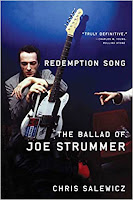
...And I found it well worth the acquisition.  Salewicz's excellent book goes through Strummer's life in intricate detail.  I found the following review on the GoodReads.com site - I heartily concur with every word, and can add nothing to this succinct and superb review:

The Clash was--and still is--one of the most important groups of the late 1970s and early 1980s. Indebted to rockabilly, reggae, Memphis soul, cowboy justice, and '60s protest, the overtly political band railed against war, racism, and a dead-end economy, and in the process imparted a conscience to punk. Their eponymous first record and London Calling still rank in Rolling Stone's top-ten best albums of all time, and in 2003 they were officially inducted into the Rock and Roll Hall of Fame. Joe Strummer was the Clash's front man, a rock-and-roll hero seen by many as the personification of outlaw integrity and street cool. The political heart of the Clash, Strummer synthesized gritty toughness and poetic sensitivity in a manner that still resonates with listeners, and his untimely death in December 2002 shook the world, further solidifying his iconic status.
Music journalist Chris Salewicz was a friend to Strummer for close to three decades and has covered the Clash's career and the entire punk movement from its inception. With exclusive access to Strummer's friends, relatives, and fellow musicians, Salewicz penetrates the soul of an icon. He uses his vantage point to write the definitive biography of Strummer, charting his enormous worldwide success, his bleak years in the wilderness after the Clash's bitter breakup, and his triumphant return to stardom at the end of his life. In the process, Salewicz argues for Strummer's place in a long line of protest singers that includes Woody Guthrie, John Lennon, and Bob Marley, and examines by turns Strummer's and punk's ongoing cultural influence.

One of the main areas of Strummer's life I was eager to get to in reading this book was the circumstances behind the dissolution of The Clash in late August 1983, when Mick Jones was summarily dismissed from the group.  Over the years, there have been various conjectures, claims and counterclaims surrounding who exactly pulled the trigger on Mick and why - was it Bernie Rhodes, who reentered the band's orbit as manager in 1981, after being dismissed from that role three years earlier?  Was it a decision by Joe alone, or a joint one with fellow band member Paul Simonon?  The book is sort of wishy-washy in terms of definitively pointing the dirty stick at anyone in particular, and I won't spoil anything for those of you who haven't had the chance to read it yet... although reading between the lines, Strummer does not come off looking particularly well in this episode.

Mick reflected on the internal politics that eventually split up the group during an interview for the BBC 2 programme Def II, circa 1990:

“It all started going wrong actually when Topper left…Topper left and it was never really the same, but we could have carried on, but then I got fired (laughs)…but we’d really stopped communicating by that time. We just managed to maintain a grunting level of civility, you know, before, but it was kind of all set up as well, you know, I was set up really, and that was kind of political, behind the back.

People were moving and trying to be influential, and different people were coming between members of the group, you know, things like that. All the things that start happening, you know, when you become really successful… you become a different kind of asshole. I turned up the day I was fired and got me guitar out, you know, and I think it was Joe it was who managed to muster up the courage to say that he didn’t want to play with me anymore, and when somebody says that to you…I just packed my guitar…just whoa… hey, you know, OK bye, and that was it. I walked, and Bernie came running out after me with a cheque in his hand, you know like a gold watch or something…which added insult to injury, but I took it anyway, and about two days mourning, and I started on the next group.”

The timeline of Jone's immediate post-Clash work has always seemed a bit scrambled to me; memories of participants in that period that I've read are variously contradictory and confused in terms of time periods and activities.  So I've tried on my own to come up with a plausible sequence, based on all of the information I could gather...

I'd always been under the impression/assumption that Jones formed Big Audio Dynamite in the weeks after his departure from The Clash.  But apparently that wasn't quite true.  Jones' initial post-Clash landing spot, within days of his dismissal, was as a member of General Public, Dave Wakeling and Ranking Roger's new project formed in the wake of The English Beat's breakup earlier that year.  With Mick on board as lead guitarist, General Public became a British New Wave/ska 'supergroup' of sorts, containing former members of Dexy's Midnight Runners and The Specials along with The Beat and The Clash.  But Jones' tenure in the group was short-lived; by the late fall of 1983, less than three months after leaving The Clash and halfway through the recording sessions for General Public's debut album All The Rage (where he contributed guitar to "Hot You're Cool", "Tenderness", "Where's The Line?" and many other tracks), he had already moved on.

Jone's next group, Top Risk Action Company (T.R.A.C) came together, it seems, in early 1984.  The story, as told by saxophonist John "Boy" Lennard (ex-Theatre Of Hate - Jones was the producer on that band's only LP, 1982's Westworld), is a bit inaccurate in regards to time, in that Jones had departed The Clash six months earlier - perhaps the 'spliff' smoke mentioned below left him somewhat confused:

"T.R.A.C. came about when I was at Mick's place. He got up to phone the press to confirm he was leaving the Clash... He came back, rolled a spliff and said he wanted to start a band with Topper and I."

As mentioned above, Jones also asked former Clash bandmate Topper Headon and Basement 5 bassist Leo Williams to join the nascent band with Lennard and himself, and the quartet began rehearsing and recording demos in the early spring of 1984.  But in hindsight, I don't believe that Mick was serious about prepping an actual album for release with this group.  He appears to be just exploring and experimenting with different sounds at this time for his own benefit.  In addition, Top Risk Action Company almost immediately faced some band turmoil; Headon's on-again/off-again heroin addition made a serious resurgence during this time.  As per Lennard again:

"I think [Mick] didn’t feel confident Topper could hold it together and was feeling overwhelmed and [therefore] closed it down [by sacking Headon]."

After Headon's firing, rehearsals became more sporadic, and Lennard began drifting away to other projects.  With that, T.R.A.C., as a viable enterprise, was over and done with before the summer of 1984 was out... not that this appeared to be any great loss for Jones.  It seems clear now that Mick himself wasn't too keen on pursuing his evolving musical direction with that group of musicians, and all of the demos the band recorded were shelved.

Into what remained of T.R.A.C. (namely Jones and Williams), Don Letts and Greg Roberts were recruited in July/August of 1984... and from the ashes of that former band rose the phoenix that was Big Audio Dynamite.  BAD's first gigs were in October 1984, and their debut LP This Is Big Audio Dynamite was released in November 1985, sparking off a decade of successful and critically-acclaimed albums and gigs.

That isn't to say that what Top Risk Action Company came up with pre-BAD was a bunch of crap.  What survived of the band's demos were recently recovered, remastered, and released on a bootleg CD.  Stylistically, the songs on this disc are to me somewhere between Mick Jones' genre-hopping dance songs on Combat Rock (e.g. "The Beautiful People Are Ugly Too", "Atom Tan", "Inoculated City") and proto-Big Audio Dynamite post-punk dance/funk/reggae (indeed, the demo version of "The Bottom Line" here was reworked and released on BAD's first album). 

Here's the full tracklist:

1. The Prolific 
2. Winning (Napoleon Of Notting Hill) 
3. Gone To The Dogs 
4. Ringmaster 
5. Astro Turf 
6. Interaction 
7. Nation 
8. Apprentice 
9. Ducane Road
10. Fare Dodgers 
11. The Bottom Line 
12. Euroshima (Edit)
13. Euroshima (Unedited)
 
Lineup: 
 
Mick Jones: Vocals/Guitar 
Topper Headon: Drums 
Leo Williams: Bass 
John "Boy" Lennard: Sax

On the whole, this release may not be everyone's cup of tea.  But at the very least, we can get a glimpse as to what was going in Mick Jones' mind at the time, and get a sense of his music creation process.  

I'll leave John Lennard again with the final word regarding T.R.A.C.:

"I thought it was a creative period for him but Mick is slow to bring it up. Great memories!"

Here for your listening pleasure and to add to your musical memories is Nice Up The Nation: The First Demos, a bootleg compilation of Top Risk Action Company tunes recorded during the summer of 1984.  Enjoy, and as always, let me know what you think.

Please use the email link below to contact me, and I will reply with the download link(s) ASAP:

Send Email

Wednesday, January 11, 2023

Jeff Beck (1944-2023)


R.I.P. to a guitar GOD... without a doubt, one of the top five guitarists in rock history.  A sad, sudden, stunning loss... and coincidentally, seven years to the day of David Bowie's death.  A sad date for rock, and for music in general.

What more need be said? 

In honor and appreciation of the life and work of the legendary Jeff Beck, and sorrow with his passing I humbly offer up the following works from my collection in tribute: 

  • Working Version, a bootleg containing tracks from the unreleased second album of Beck, Bogert & Appice, Beck's '70s power-rock collaboration with drummer Carmine Appice and bsssist Tim Bogert; and 

  • Beckology, a then-career-spanning three-disc collection of his most popular and celebrated work, both solo, with artists such as Rod Stewart, and with groups such as The Tridents, The Yardbirds and The Jeff Beck Group, released on Epic Records on November 18th, 1991.

Listen, enjoy and remember.

Please use the email link(s) below to contact me, and I will reply with the download link(s) ASAP:

Beck, Bogert & Appice - Working Version: Send Email

Jeff Beck - Beckology (3-disc set): Send Email

Thursday, June 30, 2022

Various Artists - This Is Rockabilly Clash

Stumbled across this one a couple of years ago, in my ongoing search for anything and everything related to The Clash.  It's a compendium of Clash tunes reworked by several bands in the rockabilly/psychobilly style.  Here's the lineup of songs and artists:

  1. Guns of Brixton - The Honeydippers
  2. Career Opportunities - Farrell Bros.
  3. Capitol Radio - The Hyperjax
  4. Jail Guitar Doors - The Caravans
  5. Train In Vain - The Sabrejets
  6. Should I Stay Or Should I Go? - Long Tall Texans
  7. I'm So Bored With The U.S.A. - XX Cortez
  8. Jimmy Jazz - Frantic Flintstones
  9. What's My Name? - The Charles Napiers
  10. Bank Robber - The Pistoleers
  11. Brand New Cadillac - The Accelerators
  12. Janie Jones - Farrell Bros.
  13. Know Your Rights - The Caravans
  14. Guns Of Brixton - Rancho Deluxe

Some tunes here work better than others... but all in all, this is a great group of songs providing an interesting, different take on some familiar music from Strummer, Jones & Co., in a style with which the original band was not unfamiliar with.

No long-winded story from me regarding this one...  Posting this for no reason whatsoever, other than I like it, and thought that some of you might like it as well.  Here's the compilation This Is Rockabilly Clash, released on Raucous Records in the UK on July 11th, 2003.  Enjoy, and let me know what you think about it as well.

Please use the email link below to contact me, and I will reply with the download link(s) ASAP:

Send Email

Wednesday, June 15, 2022

Various Artists - Until The End Of The World (Original Motion Picture Soundtrack)


I was saddened to learn of the death in Pittsfield, Massachusetts last week of singer and actress Julee Cruise. About four years ago, she announced that she was suffering from systemic lupus, a painful autoimmune condition that left her depressed and unable to move and walk. Reports state that she took her own life at her home, with The B-52's song "Roam" playing as she died (Cruise was a touring member of The B-52's in the early 1990s, replacing Cindy Wilson who took a few years off to raise her children; I remember seeing her on stage at a band show I attended in Washington, DC during that period).

In a post I wrote almost a dozen years ago, I detailed how I first came across Cruise's music and my impressions regarding it - the melancholy, haunting quality that both repels and attracts the listener. After the release of her debut album Floating Into The Night in 1989, Cruise issued a follow-up, The Voice Of Love, four years later. As with the first album, almost all of the songs on her sophomore release were written by director David Lynch and composer Angelo Badalamenti, so the sound and atmosphere are remarkably similar to Floating Into The Night. The Voice Of Love is more of a continuation of her debut, rather than a stand-alone entity. If you liked the first, than this one will be right up your alley as well.

Between these two albums, Cruise recorded a Lynch/Badalamenti-modified cover of an old Elvis Presley song, "Summer Kisses, Winter Tears", for the soundtrack to Wim Wenders' scifi drama Until The End Of The World, starring William Hurt. The plot of the film had something to do with in a finding and using a device that can record visual experiences and visualize dreams... but the end result was so confusing and convoluted that the few people who DID go to see the movie were left flummoxed by it. Cashing in on his success with small, cerebral films like Paris, Texas and Wings Of Desire, Wenders managed to secure a budget of $22 million for this latest film, an amount more than the cost of all of his previous films combined. And he proceeded to spend every penny of that money, spreading his production over almost half a year with setups in 11 countries.

While Graeme Revell (co-founder of the Australian industrial band SPK) was commissioned to compose the movie theme and other incidental music for the film, Wenders asked a number of his favorite recording artists (including Cruise) to contribute songs as well for inclusion. For their selections, he asked them to anticipate the kind of music they would be making a decade later, when the film was set. It was Wenders' desire to use every song he received to its fullest extent that ultimately contributed to the overall length of the film. The initial cut was reportedly TWENTY HOURS long, from which the director and producer whittled down to a more standard running time versions of 2 1/2 and 3 hours (which Wenders called the "Reader's Digest" versions). There is also reportedly a five-hour "director's" cut of this film which has been screened at various festivals over the years.

...Not that any of that mattered. The truncated versions of Until The End Of The World were released to theaters, first in Germany in September 1991, and later in the U.S. that December, and overall the flick was a commercial failure, managing to gross only about $830,000 against its $22 million budget.  Critics at the time savaged it; Roger Ebert gave the film 2 stars out of 4, describing it as lacking the "narrative urgency" required to sustain interest in the story, and wrote that it "plays like a film that was photographed before it was written, and edited before it was completed". He went on to say that a documentary about the globe-trekking production would likely have been more interesting than the film itself.  Other reviewers were even less kind.

But while the film flopped, the soundtrack was, frankly, amazing, featuring great songs by some of the top alternative performers of the day.  Wenders chose well.  Here's the soundtrack lineup:

  1. "Opening Title" – Graeme Revell
  2. "Sax and Violins" – Talking Heads
  3. "Summer Kisses, Winter Tears" – Julee Cruise
  4. "Move with Me (Dub)" – Neneh Cherry
  5. "The Adversary" – Crime & the City Solution
  6. "What's Good" – Lou Reed
  7. "Last Night Sleep" – Can
  8. "Fretless" – R.E.M.
  9. "Days" – Elvis Costello
  10. "Claire's Theme" – Graeme Revell
  11. "(I'll Love You) Till the End of the World" – Nick Cave & The Bad Seeds
  12. "It Takes Time" – Patti Smith (with Fred Smith)
  13. "Death's Door" – Depeche Mode
  14. "Love Theme" – Graeme Revell
  15. "Calling All Angels" (Remix Version) – Jane Siberry with k.d. lang
  16. "Humans from Earth" – T Bone Burnett
  17. "Sleeping in the Devil's Bed" – Daniel Lanois
  18. "Until the End of the World" – U2
  19. "Finale" – Graeme Revell

Personal favorites on this disc, in additon to the Julee Cruise song, include R.E.M.'s "Fretless", Depeche Mode's "Death's Door" and the Jane Siberry/k.d.lang collaboration "Calling All Angels".  At the time, most of these songs were unavailable anywhere else, making the compilation a gold mine of rarities. All in all, the soundtrack did better than the movie, eventually reaching #114 on the U.S. Billboard Top 200 Albums chart in 1992.

So, in honor of the life and art of Julee Cruise, I proudly offer to you all Until The End Of The World (Original Motion Picture Soundtrack), released on Warner Brothers Records on December 10th, 1991.  Enjoy, and as always... well, you know.

Please use the email link below to contact me, and I will reply with the download link(s) ASAP:

Send Email

Thursday, May 19, 2022

Surf Punks - My Beach


Back in the summer of 1980 when my Navy officer dad got transferred to the Naval Postgraduate School (NPGS) in Monterey, California and we moved into La Mesa Village, the local Navy housing complex there, my brother and I quickly fell in with the other teens who lived up in that area - folks like Mike C.; Jeff and his girlfriend Kathy; sisters Jane, Jill and Leslie; loud and brash Latina siblings Rosina and Gina; brothers Pete and John; Joel; Jenny... and so many others.  But foremost in the group were two middle schoolers, Mike F. and Martin.

We would all gather together on those warm evenings, usually up by the tennis courts on the grounds of La Mesa Elementary school, to talk, bust one another's balls, and goof off, away from the watchful eyes of our parents.  We would also occasionally mess with "Security", the men and vehicles sent over by NPGS during the night to patrol and keep an eye on the neighborhood.  Most of the time, our group and Security coexisted in a sort of sullen, "see no evil" detente - they would drive by the courts, while we would either ignore them or silently give them the 'hairy eyeball'.  But on other occasions, we would hide out in some leafy, secluded spot within La Mesa and wait for the truck to go by, so we could bombard the vehicle with pine cones and ice plants and wait for the satisfying sound of those projectiles striking metal before melting deeper into the woods when the officers stopped and attempted to give chase.  No, we weren't delinquents or troublemakers, per se - just bored kids looking to have some fun and gin up a little excitement in a fairly isolated corner of the city (years later, I learned that the Security officers, similarly bored with their duties, actually enjoyed and looked forward to the cat-and-mouse antics and chases from that time as much as we did).

Half of the La Mesa crew (including myself) would be attending Monterey High School in the fall; the other half would be going to Walter Colton Middle School, both schools located downtown.  My junior-high aged brother would get to be closer to and better friends with that latter group than I was... although everyone was pretty familiar with one another through our summertime hangout sessions.  We played football together on some weekends, made treks down the narrow (and in hindsight, extremely sketchy and secluded) forest path from La Mesa to Del Monte Mall to eat pizza and play video games at Round Table Pizza, and occasionally on weekends some of us hopped on the Monterey Peninsula Transit (MPT) bus (the region had a superb public transportation system, that stopped almost right at our front door) to places like Carmel and Cannery Row (both of which had yet to be befouled/spoiled by the tourist traps that now proliferate at those locations).  Suffice to say, we were a pretty tight-knit group.

I mentioned in a previous post long ago how UNimpressed I was with California early in our stay there; I was the proverbial 'fish out of water', East Coast guy living on the West Coast for the first time and initially not quite getting into the swing and flow of things there, especially in high school.  It was the presence of music that brought me around to this area, starting off with my encounter with a B-52's fan early in the school term.  As the year progressed, I was exposed to a ton of great 'new' bands there, that I doubtfully would have ever come across at my old Massachusetts high school, or if I had, would have been ostracized for, for being one of the 'weird' kids. In addition to my B-52's story (linked above), I also came across The Residents for the first time while there. The year I moved to Monterey was the year Australasian bands broke big in the States, led by Split Enz with their hits "I Got You" and "I Hope I Never" (the band played both songs on the ABC network late-night show Fridays that October) and followed by Men At Work ("Who Can It Be Now" was released in the spring of 1981, then their massive hit "Down Under" coming out later that year, finally topping the US charts almost a year later).

At Monterey High in 1980-81, there were two big bands that the kids there were buzzing about.  The first was The Medflys, a local Santa Cruz/Monterey ska/New Wave band   They were one of the most popular draws in the early and mid-”80s at clubs and festivals from Monterey and Santa Cruz to San Francisco, and were regularly named “Best Local Band” by area radio stations and news publications during its heyday.  The band”s sound was a combination of the New Wave rock that was popular at the time, mixed with fast-paced ska music, even a little ”80s pop. They were known for their theatrical, energized live shows, especially the acrobatic and charismatic front man Christ, who possessed surfer boy good looks and boundless energy.  Their early Eighties hits included "Compulsive", "Belfast" and "State Of Mind", and later in the decade, they scored notoriety with a novelty song commemorating Clint Eastwood's successful campaign for Mayor of Carmel, "Don't Mess With The Mayor":


In their time, the Medflys went on tour with some major headlining acts, including Joan Jett, fellow locals Huey Lewis & The News and Greg Kihn, but especially The Tubes, who they formed a lasting bond with.

The other band getting a lot of local attention in those years was one I first heard about from some girls who sat next to me in Mr. Clark's science class during my first weeks in school. I noticed early on that their class folders were covered with stickers for Mr. Zog's Sex Wax, a popular brand of surfwax used to aid traction and grip on surfboards.  Of course, I had no idea at the time what this product was; with the innuendo-laden line "The Best For Your Stick", it seemed to me to be a fairly risque image to display. One day, I finally worked up the nerve to ask them about it, and was rewarded with a crash course on local surf culture - the lifestyle, the equipment, the best spots up and down the Central Coast, and the music, especially that provided by their latest fave band, The Surf Punks, from Malibu.

Friends Drew Steele and Dennis Dragon formed The Surf Punks in 1976. While both of them were dedicated surfers and adopted a bohemian "surf'' attitude, their backgrounds were strictly upper class and grounded in big-time show business: Steele's stepfather was Gavin MacLeod of Mary Tyler Moore Show and Love Boat fame; Dragon was the son of popular symphony conductor Carmen Dragon and the younger brother of Daryl Dragon, the "Captain" in the hugely popular pop duo The Captain & Tennille.

The pair recruited a couple of friends and fellow surfers to join the band, including lead guitarist John Heussenstamm, Tony Creed on second guitar and harmonica, and bassist John Hunt, and began practicing in Dragon's garage studio across the street from Zuma Beach in Malibu, one of Southern California's most popular surf spots. The Surf Punks weren't really "punk", per se - most of their songs were various amalgamations of New Wave, surf rock, comedy rock and pop, with lyrics centered primarily on the in-group/out-group experiences of "locals" (surfers living on the beach in Malibu) and "valleys" (commuters from the San Fernando Valley to the private and public beaches of the exclusive Malibu Beach community).  The band has been described more than once as "The Beach Boys of the punk world", an assessment that wasn't totally inaccurate.

Their wild shows, at places like the legendary Starwood in Hollywood and a notorious show in Ventura, were a big draw in the area in the late 1970s, and generated enough attention in the group for a local producer to finance a single, "My Beach/Go Home" b/w "My Wave", released in Australia in late 1977. The Surf Punks' first self-titled album, an independent release on their own Day-Glo Records label, came out two years later, and cuts from this disc began receiving heavy play on L.A.'s influential alternative rock station KROQ-FM. This wider exposure led to the band booking more lucrative local gigs. And it also caught the interest of industry giant Epic Records, who picked up the group on a one-off contract; their debut album (renamed My Beach) was rereleased on the label in mid-1980.  The record was fairly popular in certain quarters (mainly coastal California, Hawaii, Australia and other semi-heavy surf communities), but wasn't a national breakout hit and did nothing chart-wise.  I used to hear it all over the Monterey Bay area during that time, though, and although I wasn't (and still am not) much of a beach bum, I enjoyed the music immensely.  It was stuff like The Surf Punks that really got me settled into life in California, and I began enjoying the area, the school and my neighborhood more and more.


Looking back, probably the nucleus of the La Mesa group, the center it all revolved around, were the two Mikes (Mike C. and Mike F.) along with Martin. The three of them lived only a couple of houses away from one another in the upper part of La Mesa Village, and as such they were the closest of buddies, with the same skewed senses of humor and penchants for mischief and danger. A once-legendary story that emerged from that time was the night in late 1980 the three took Martin's brother's car for a joy ride. His brother Carl really wasn't part of the overall group, although everyone liked him just the same; he was sort of quiet and kept to himself and his interests, which included the restoration of a vintage vehicle from the 1940s that he had acquired. This car was a thing of beauty - a huge retro body painted metallic blue with flecks of glitter in it, sporting chromium wheels and a sooped-up engine.  Carl would drive that thing around town and instantly stop traffic and draw stares wherever he was. Prospective purchasers were drooling for that auto to be put on the market... but Martin was to have first dibs on it, going 50/50 on the purchase with his father. The car wasn't in Martin's possession just yet, though - so I have no idea how he got hold of the keys...

Anyway, with Martin behind the wheel and the two Mikes riding shotgun, these guys decided to go for a spin down Aguajito Road and up the winding mountain road to nearby Jacks Peak Park. On the way back down, legend has it that Martin decided that would be a good time to open the car up and see what it could REALLY do... As they picked up speed, he reportedly crowed "I'M GOING TO BREAK THE LAND SPEED RECORD!!!" - just before he missed a turn and ran the vintage car into a ditch. Fortunately, none of the three were hurt, but the car was a total wreck.  When Martin's dad found out what happened, he rejoined "Well, I was going to go 'halfs' with you on this - but guess what? You just bought the WHOLE car!"

The NPGS authorities finally got tired of residents' complaints of "rowdy teens" and decided to address the issue by opening up a "Teen Center" in the middle of the neighborhood. I was one of those annoying "student leader" types back then, so I was asked to be on the planning and advisory board for the facility, in an unused building up there. In the bylaws I helped set up, it was decided that the kids themselves would run the place, with minimal adult supervision. So we elected officers (I was the first vice-president), stocked the place with vending machines, a pool table, pinball machines and video games, and threw the doors open that winter. The Teen Club was a resounding success from the get-go - every night, 40-50+ kids would pile into the place. We held parties and dances there as well (all the guys angling to dance the longest song (always "Stairway To Heaven") with Stephanie, the prettiest girl in La Mesa).
 
I graduated from high school and left Monterey after one year, but my family stayed on, as well as Martin, Freeman, and most of the old group. During my first few months away, I made an effort to acquire a copy of My Beach, to remind me of the place I had grown to be fond of.  The Teen Club still ran strong in my absence, and apparently continued long after all of us had left the area (Years later, I returned to Monterey as a Navy officer myself. On a whim, I drove up to La Mesa to look around, and was happily surprised to find the Teen Club still in operation. When I told the administrator there who I was and how the place came to be, she reached up on a back shelf and pulled down an ancient photo album, that included photos from that first year of existence!).
 
As it happens in military housing communities, the old, familiar groups tend to gradually dissipate, whittled down by graduations and family transfers. By 1984, everyone who had been part of that close-knit La Mesa circle had moved away.  However, I stayed in touch with many of the folks from that period, and watched as their lives progressed.  Pete ended up remaining in the Monterey area and became a paramedic; Jill became a French teacher; Martin moved down to San Diego and worked as a teacher and high school football coach; Joel also attended Annapolis and became a Navy officer; Mike F. - the wildest of us all - ended up joining the U.S. Border Patrol, and to his credit has advanced within it to high levels of responsibility. I haven't laid eyes on most of them in years, but we all still regard one another as friends - that's how it is when you're a "Navy brat".
 
Several decades have passed since those days... yet I still think back fondly on that time and the people that I knew.  While New Zealand will always be the best place I've ever lived, Monterey ranks a close second, and is the best place in the States I've resided, hands down.

In March of this year, Martin posted a message on his Facebook page, stating that he had been diagnosed with pancreatic cancer.  While it was concerning, those of us who knew him weren't overly worried, as he had worked through some other serious health issues in the past, and seemed ready to lick this thing as well.
 
Alas, it was not to be - Martin died last week, at the age of 55.

It seems odd and strange that someone who was an integral part of that period is now no longer with us. Because in some ways, those times in Monterey seem like yesterday, and therefore I'm still in my youth. I still listen to my old Surf Punks albums from time to time (after My Beach, they released (to steadily worsening reviews and sales) Locals Only on Day-Glo Records in 1982, and their final label release Oh No! Not Them Again! on Enigma Records in 1988 - and yes, I own them all), and they still conjure up that fine teenage period of life for me. But with Martin's passing, the first of the group that I know of to die, it brings home the fact that those times WERE long ago, that I'm not as young as I'd like to think, and the clock is ticking - ticking for us all.
 
Gonna miss you, Martin, man - you made it to the top of the mountain and back this time.
 
In honor and in memory of my time in La Mesa, and for my old friend Martin, here's The Surf Punks' My Beach, released on Epic Records in June 1980. Enjoy, and as always, let me know what you think.

Please use the email link below to contact me, and I will reply with the download link(s) ASAP:

Send Email