Showing posts with label San Francisco. Show all posts

Saturday, November 2, 2024

The Grateful Dead - American Beauty: The Angel's Share


Since I did this during last year's Day Of The Dead, I suppose I'll try to make this an annual thing now, and continue posting some hard-to-find Grateful Dead here on this date. 

To commemorate the day, her for your listening pleasure is American Beauty: The Angel's Share, like all of the other "Angel's Share" discs, a digital-only release of alt mixes, outtakes and demos from The Grateful Dead's classic album.  I'm a lazy man, so for a more detailed description of this release, I'm taking the liberty of utilizing the Discogs.com write-up, rather than my own words; all credit for the following goes to them and that site:

American Beauty: The Angel's Share brings together never-before-heard studio recordings compiled from dozens of recently discovered 16-track reels. It includes multiple outtakes for several album tracks along with demos for every song on the album (except “Box Of Rain”) plus one for “To Lay Me Down,” which was later included on Jerry Garcia’s first solo album, Garcia. All 10 demos are available today for streaming and digital download with the full 56-track American Beauty: The Angel's Share to be released as a digital exclusive on October 15, shortly before the 50th anniversary of the album’s original release date: November 1, 1970.

Like its predecessor, the latest incarnation of The Angel’s Share was made possible by the tireless work of engineer Brian Kehew and archivist Mike Johnson who – operating under the supervision of Grateful Dead legacy manager David Lemieux – spent countless hours compiling and piecing the reels together to create this revelatory experience.

American Beauty: The Angel's Share opens with 10 demos that were recorded in August 1970 at Pacific High Recording Studio, the same place the band recorded Workingman’s Dead just a few months earlier. While fans are accustomed to hearing songs evolve through the band’s live recordings, this installment of The Angel’s Share offers them a rare opportunity to hear songs like “Ripple” (then titled “Hand Me Down”) grow from its first demo into the final version.

The vast remainder of The Angel’s Share features a mix of partial and complete takes from these sessions including multiple takes of “Friend Of The Devil,” “Ripple” and Pigpen’s “Operator,” an alternate mix of “Truckin’” and a different version of “Candyman.” These intimate in-studio performances are interspersed with conversations that make it feel like you’re in the studio with the band (Jerry Garcia, Mickey Hart, Bill Kreutzmann, Phil Lesh, Ron “Pigpen” McKernan and Bob Weir) along with producer Stephen Barncard and engineer Phil Sawyer.

The Angel’s Share is rounded out with an acoustic mix of “Box Of Rain” and a version of “Attics Of My Life” that spotlights Garcia alone on electric guitar, both newly mixed from the band’s recording sessions for the album later that summer at Wally Heider Recording

That's that - here you go.  Enjoy the day, have a listen, and as always, let me know what you think.  Happy November 2nd!!

Please use the email link below to contact me, and I will reply with the download link(s) ASAP:

Send Email

Thursday, November 2, 2023

The Grateful Dead - Workingman's Dead: The Angel's Share


This being the Day Of The Dead, I figured why not commemorate the day by posting some Grateful Dead?  I don't have any especial love for GD... but that hasn't stopped me from collecting hundreds of hours of their recordings over the years.  They're an essential American band, and as such deserve honor and respect - even from an obsessive music collector like myself!

Here's Workingman's Dead: The Angel's Share, a digital-only 2020 release of studio rehearsals and outtakes from The Grateful Dead's classic and celebrated 1970 album.  I don't have much else to say about it here, but Rolling Stone magazine had plenty to comment upon regarding it when this album was put out three years ago; here's their write-up, if you're interested.  

This is for all the Deadheads out there, and music fans in general.  Have a listen, and let me know what you think.  Happy November 2nd!

Please use the email link below to contact me, and I will reply with the download link(s) ASAP:

Send Email

Wednesday, February 14, 2018

Various Artists - Not All That Terrifies Harms 7"


Another Barbara Manning-related post...

Late in 2016, I provided a requester, Jon Der, with a link to my World Of Pooh Land Of Thirst posting from a few years back, and in the process had a great back-and-forth dialogue with him about bands we were mutual fans of, including this one and The Fall (my all-time favorite band, as I've mentioned ad nauseum (and recently shown) here on this site). Jon clued me in to the news that an in-depth oral history of World Of Pooh had just been published in the then-latest issue of Jay Hinman's Dynamite Hemorrhage fanzine, a podcast/magazine devoted to underground alternative music; it was that article that sent him on a search that led him to my site.

Information on the great but obscure World Of Pooh is extremely hard to come by in this day and age, so of course I was champing at the bit to read the story. As the article was (then) not an online posting, but a print story only, Jon kindly scanned it for me from the magazine copy he had in his possession.

All in all, "World Of Pooh: The Oral History" is a superb and informative article. Band members (guitarist Brandan Kearney, bassist Barbara Manning and drummer Jay Paget) and other friends/scenesters from that time offer up their recollections and reminiscences of those heady, frenetic bygone days, the creation, rise and dissolution of an underground and generally unheralded-in-their-time rock band. The piece filled in a lot of gaps in my knowledge about the group.

I was especially interested in the section regarding the writing and recording of The Land Of Thirst, the band's sole LP release and one of my all-time favorites. When I did my write-up on this album all those years ago, I did so under the assumption (based on clues provided in the Trouser Press Record Guide review and other sources I'd found like this blog posting from almost a decade ago) this this disc was the brilliant but intense product of a vicious, painful breakup saga then unfolding between Kearney and Manning. To quote that post:
Apparently, [they] had been dating for a while, and by the time the record was being recorded, their relationship was on the rocks. They took out their relationship strains not directly on one another, but like most other couples with problems they addressed their angers and frustrations with one another indirectly, in their case through the songs (I understand they broke up soon after this record came out - which makes sense, since the band also ceased to exist around that time).
However, in the course of reading "The Oral History", I became aware that what I considered to be gospel and the "true Hollywood story" regarding WoP and their music wasn't quite accurate.

The first (and most important) point of correction is the most pertinent and far-reaching, in terms of my understanding this band - Manning and Kearney were never a couple, per se. Sure, they spent a lot of time together in their musical and social pursuits... but this didn't develop into any sort of romantic attachment. There was already more than enough madness swirling around in their lives while they were in the band. But that craziness had nothing to do with any sort of long-term "lover's spat", and more to do with the weird, tense and uncertain atmosphere inherent in being in an obscure band playing in San Francisco's indie/underground scene in the late '80s/early '90s.

That isn't to say, however, that the members of World Of Pooh didn't play up on this boy-boy-girl dynamic. The back cover of The Land Of Thirst infamously displayed an S&M/bondage-themed photo of three people that the band found in a porn shop on Polk Street in the city, with the implication being that the picture portrayed the actual band members and their relationship (it wasn't, and it didn't). Barbara Manning said:
"We chose the picture on the back on purpose - I think it might have been my idea, even... The idea [was] that we were selling ourselves as this threesome."
Brandan Kearney continued:
"We did have some misgivings about using the photo... but it looked enough like us that it was hard to say no... Besides, we were always using sexual imagery... I sometimes worried that we were confining Barbara, or that she'd feel like we were. The picture is ambivalent, which struck me as poignant at the time. It's not very well thought out, but you could say that about any decision we made back then."
In short, the group played at being weirdos and freaks, with Kearney and Manning upping the ante by semi-pretending to be more than just band mates... and people believed it. And oddly, after a while, the members of World Of Pooh began buying into that narrative as well. As Manning observed in the article:
"I feel like we were people with a weird relationship portraying people with a really weird relationship. Over time, the distinction vanished."
In the wake of the album release, and in the process of living up to this created narrative in the city's music atmosphere of the time, tensions began rising within the group. This led to bickering and conflicts between the members that eventually began being displayed in their live performances - many times exacerbated by prodigious booze consumption before and during their act. A friend of the group provided the following memory/assessment in the article:
"[Those] onstage disagreements of whatever were literally showstoppers. The big question was always: would they stop sniping at each other long enough to play another song let alone finish the set? Intraband relations seemed to be getting worse the more shows they played, but musically they kept getting better and better... For a while they were one of the best bands in the city. Talking to other fans at their shows, we had the feeling that they weren't going to be around much longer... The last time I saw them, it was their biggest show to date and by then they were outright arguing on stage in between songs... Despite how great the music was, the set felt like a fiasco and, by the time they left the stage, I had the distinct impression that it was going to be their last show."
This friend was almost correct regarding the timing of the band's demise - it was pretty much over for World Of Pooh by the end of 1989. However, circumstances intervened somewhat in early 1990.
Brandan Kearney: "People assume we broke up after our East Coast tour, but we'd essentially broken up before the tour... the strain Barbara and I were under was not sustainable... In the midst of this uncertainty, we accepted an offer to tour the East Coast for about a week... This gave us a reason to hold things together, but I think it also gave us the sense of an attainable endpoint..."
After (and despite) well-received shows in Boston and New York in March of 1990, World Of Pooh broke up immediately after the end of this tour.  There were a couple of posthumous EP releases (G.H.M. later in 1990; A Trip To Your Tonsils in 1991), but even those led to more trouble and conflict within the group.  The tracks on the latter EP were part of a set of eight or so that World of
Pooh had been developing for a planned full-scale album follow-up to The Land of Thirst (the EP included the only four tunes closest to completion, remixed and remastered by Kearney). During the final mixing of these EP tracks, Kearney added some sound effects that Manning, when she heard it/them, interpreted as negative coded messages directed at her personally... with the result being that the relationship between the two fully ruptured, and they didn't speak for many years. Fortunately, they eventually reconciled, even reuniting for a one-off show in late 2015.

Kearney pithily summed up the rise and fall of his band, and their overall dynamic:
". . . when you scrape away the dazzling veneer of also-ran indie-rocker glitz, you're really just talking about emotionally unstable people with very little impulse control and a dangerously high alcohol tolerance."
He also had this to say regarding their only album:
"The only thing that bothers me about the album's latter-day reputation is the myth and lore of Our Unhappy Relationship, which I sometimes worry is the only reason people are still listening to it. The fact is, Barbara and I were getting along just fine when we recorded The Land Of Thirst. People sometimes present it as some indie-pop version of Rumours or Shoot Out The Lights. I know we brought this on ourselves through public displays of madness and worse, but most of that stuff happened after the LP had been written and recorded. Love it or hate it, The Land Of Thirst was the product of a somewhat crazed but extremely close and supportive working relationship, and I dislike seeing it portrayed as an album by and about people who were at each other's throats. Terrible things happened, to our eternal discredit, but most of them happened later on."
So, from the horse's mouth itself, I hereby stand corrected.

The very end of the article listed World Of Pooh's entire discography, all of the music they released on Nuf Sed and all of their compilation appearances. I knew that some of the stuff listed there (like the band's rare early-career cassette-only releases No Little Taxis Shining Their Light and Dust) I'd never have any hope in hell of ever tracking down. But as for one-off compilation tunes, my WOP collection was fairly complete, except for one selection: a cover of Blue Öyster Cult’s “Dominance and Submission”, included on an obscure 7" EP in 1992. Being the obsessive completest that I am, I made it my mission to track down a copy of this record and song, and after an exhaustive search, found the vinyl for sale from an overseas source - couldn't buy it fast enough.

Enjoy the Not All That Terrifies Harms 7", a ridiculously hard-to-find joint release by Ajax and Nuf Said Records in 1992, scorched off of my vinyl copy, featuring some rare releases by San Francisco bands both legendary and obscure - including Thinking Fellers Union Local 282's "Trevor" (a track otherwise only available on a 1995 Japanese import compilation) and the only source for World Of Pooh's Blue Öyster Cult cover (which, of course, is excellent).

And as an added bonus, here's a link to the entire issue of Dynamite Hemorrhage #3, now online, containing "World Of Pooh: The Oral History" - a much cleaner version of my scanned copy from earlier last year.

Enjoy, and as always, let me know what you think.

Please use the email link below to contact me, and I will reply with the download link(s) ASAP:

Not All That Terrifies Harms EP: Send Email

Thursday, March 1, 2012

The Residents - The Commercial Album

Although I didn't like living in California all that much in the first couple of months after I moved there from Massachusetts in 1980 (as I mentioned here) , I quickly came to love and appreciate it. California, and the Monterey Peninsula in particular, were so much different from the things I'd known and experienced while living on the East Coast for most of my life. I'm not just talking about the weather there - it was the entire attitude and vibe of the place that I came to enjoy.

Generally, in Monterey I felt less constrained, both socially and literally. My family moved to California from a very wealthy and quite snobby small town on Massachusetts' South Shore, where the cliques and castes were rigidly defined and heavily defended, especially in school. In addition, the town was far enough away from the influence of larger cities like Boston, and isolated just enough (due to proximity and economic status) from the neighboring towns, that the community mindset was quite insular and constrained. When you lived there, you weren't aware of it as much. But upon my relocation to the West Coast, I began to realize how much of a cage I was in back in New England.

At my new high school, a lot of that 'clique' and 'status' crap, while still present, was toned down considerably over what I had previously experienced. Generally, everyone was cool with everyone else. Years later, when I began to spend time in San Francisco, one thing that struck me about that city was that, on the whole, people didn't give a shit who you were and what you were up to, just so long as what you were into wasn't illegal or being a nuisance or bother to them. I then realized that that attitude wasn't restricted to San Fran - Monterey had that same kind of vibe going.

For me, the new openness I felt there was reflected in the design and curriculum of the school. All of my life on the East Coast, I attended brick-and-mortar monolithic schools, everything contained within the same structure - juvenile jails without bars, places where students were all but locked in (except for recess) from 8 am to 3 pm. Monterey High was my first experience with an open structure - several buildings spread around the campus and grouped around a courtyard, allowing you to at least get some air and see the sky en route between classes. And students weren't required to be on school grounds all day; if you had a free period or other long breaks between classes, you were allowed to head out into the nearby downtown area to do whatever the heck you wanted. This was absolutely mind-blowing to me, being able to go to Round Table Pizza on Alvarado Street with Jeff and Rick and Jim and my other buddies for lunch! It was a novel concept to be treated like a responsible human being there, instead of a knuckleheaded kid.

That different attitude seemed to be everywhere - a guy I knew in school turned down a college scholarship so he could go surfing in Australia for a year; the Dream Theater on Prescott Avenue constantly pulled in crowds for late-night weekend showings of The Rocky Horror Picture Show; Pac-Man came out in the States early that fall, and was so popular that even my straightlaced mother was known to sneak over to the airport game room to play it; Carmel and Cannery Row were as yet mostly untouched by commercialism or tourists, and were still full of history and interesting activities; and the town's leading florist operated out of the "Planet Claire Flower Shop".

For me, California was just so COOL, and so much in the forefront of everything that was happening, much more than anyplace else I'd ever been.

One weekend that fall, my folks and siblings had gone out for the evening, leaving me by my lonesome in an otherwise vacant home. Bored, I turned the TV on and started flipping around the dial. I landed on a program that immediately caught my interest called "Videowest", airing on a public television station out of San Francisco. "Videowest" was a music video program, predating the premiere of MTV by almost a year.

Although the origins of short filmed musical performances date back to before the 1930s [believe it or not, the term "music video" was coined by none other than DJ and singer J. P. "The Big Bopper" Richardson, who died in the 1959 plane crash with Buddy Holly and Richie Valens], in the U.S. in the late '70s/early '80s, they were still considered novelties and rarities, and people got very excited here whenever the odd one would pup up on TV every once in a while. The British Commonwealth countries were way ahead of the U.S. in pioneering, developing and disseminating the music video format - Australia's video program "Countdown" began airing in 1974, New Zealand's "Radio With Pictures" started in 1976, and Britain's "Top Of The Pops" began showing music videos in 1977. But in these parts, the only chance you had of seeing the odd one would be a one-off airing on a music or variety show. I remember seeing a video for XTC's "Making Plans For Nigel" in late 1979 (can't remember what show it was on) and being completely stunned. And I recall when "Saturday Night Live" had the U.S. premiere of Paul McCartney & Wings' then-groundbreaking "Coming Up" video (with McCartney simultaneously playing various roles, predating Outkast's "Hey Ya!" clip's use of this concept by almost 25 years) in May 1980 - I thought it was amazingly innovative and cool. But in my experience and to my knowledge, at that time there was no weekly show anywhere in the States that aired music videos exclusively . . . until I stumbled onto "Videowest".

Every week, "Videowest" would usually concentrate on a particular theme or genre, and intersperse music videos among interviews, commentary and humorous pieces related to that theme. A couple of program samples, with the themes of "Television" and "Beauty", can be found here and here (the music videos have been removed due to licensing issues). It was all very arty and avant garde, as properly befitted a show out of San Francisco. And while all of that was interesting, my main reason for tuning in was to see the videos, almost all of which were on the cutting edge of music of that time.

The first Devo videos I ever saw (including "(I Can't Get No) Satisfaction", "The Day My Baby Gave Me a Surprize" and "Girl U Want") were aired on "Videowest", along with my first exposure to a 'new' band out of New Zealand called Split Enz and their first semi-big U.S. hit, "I Got You". The first time I ever saw or heard of Laurie Anderson was through the show, the start of my lifelong fascination with her work. "Videowest" sometimes served as a showcase for obscure San Francisco bands as well. One night, I was treated to a video for the song "(Sooner Or Later) Some Of My Lies Are True" by a bar band with a local following, Huey Lewis & The News - my first glimpse of a band that became international superstars a few years later.

In the minds of many viewers and critics at the time (myself included), Devo was considered to be the most innovative and groundbreaking of the early music video pioneers. Their clips were so off-the-wall and visually mesmerizing, no other band could even come close to what they were doing . . . or so I thought. One evening in early 1981, "Videowest" devoted an entire show to the videos of a band they claimed out-Devo-ed Devo, an obscure, secretive San Francisco collective called The Residents. What I was treated to that night were some of the most off-kilter and disturbing videos that any band had dared to make at that time (or any time thereafter, in my opinion). Almost all of the clips were for songs off of the most recent Residents release, The Commercial Album - a disc containing forty songs, all exactly sixty seconds long.

The origin and background of The Residents is murky and steeped in mystery - to the point that the identities of the group members are officially unknown. As Wikipedia states:

"Throughout the group's existence, the individual members have ostensibly attempted to operate under anonymity, preferring instead to have attention focused on their art output. Much outside speculation and rumor has focused on this aspect of the group. In public, the group appears silent and costumed, often wearing eyeball helmets, top hats and tuxedos - a long-lasting costume now recognized as their signature iconography."

According to information released by the band (which may or may not be entirely factual), The Residents are all natives of Shreveport, Louisiana, and met when they were all in high school there in the 1960s. After graduation, they all headed to California as a group, at first settling in San Mateo in 1966 when the van they were traveling in broke down there, and later moving to San Francisco in the early 1970s. While in San Mateo, they began working on various art projects involving photography, sculpture and experimental recordings on crude reel-to-reel tape recorders. Over the next several years, the band made dozens, possibly hundreds, of recordings of their decidedly weird music and sounds. In 1971, they forwarded one of these reel-to-reel tapes to Warner Brothers, hoping to receive the same type of consideration and support that Warners had provided to their musical heroes, label artist Captain Beefheart. But Warner Brothers rejected the recording out of hand. Since the group had not included a name on their mailing address, the rejection letter included with the returned tapes was addressed to "The Residents" . . . and thus a band name was born.

Soon after their major label rejection, the band moved to San Francisco and started their own label, Ralph Records, to release their music. Their first studio album on the label, Meet The Residents, was put out in 1974. Throughout the '70s, the band was prolific, releasing five more albums, several singles and EPs, and for several years working on an ambitious (but ultimately unfinished) film project called Vileness Fats, which if completed would have been the first long-form music video. The Commercial Album, their seventh studio album, was released in 1980.

On "Videowest", the concept behind The Commercial Album was explained as such: the standard three-minute pop song played on the radio generally consists of a verse, chorus and break, repeated three times. It was the idea of The Residents to distill this standard structure down to its essence - a song comprised of a single verse, chorus and break lasting just one minute. That way, if a listener wanted a "pop song", all her or she had to do was play each tune on the album three times in a row.

It was both a wickedly subversive idea, and a hilarious way to take the piss out of popular radio fare, which the band considered to be too rigidly formulaic, by converting this commercial music into ACTUAL 'commercial' (as in 60-second radio/television commercial) music. To that end, and also to promote their album, The Residents purchased 40 one-minute advertising slots on San Francisco's most popular Top-40 station at the time (KFRC). Over three days, the station was obligated to play each track of their album during those station breaks - a brilliant way to promote their album, while simultaneously blurring the line between art and commerce.

The band members wrote and played on every song on the album, and got some help from their friends during the recording, using Phil "Snakefinger" Lithman and Fred Frith for some session work, along with anonymous guest vocalists Lene Lovich and XTC's Andy Partridge on a couple of songs. And in keeping with their arty multimedia background, The Residents completed music videos to accompany many of the songs, several of which were featured that night on "Videowest". Here are but a couple of examples of the clips that charmed, frightened, and jolted me that evening (the link below includes videos for "Moisture", "The Act Of Being Polite" "Perfect Love" and "The Simple Song", all of which were featured on the show):


The thirty-minute presentation I watched that evening was my only exposure to The Residents for a very long time. But the memory of their music and those mind-bending videos lingered with me for years, past the end of high school and well into college . . .

My four years at Navy was the time when I really began to expand my music collection, searching far and wide for the latest sounds of that era (mostly punk, post-punk and New Wave - hey, it WAS the mid-80s!). I quickly exhausted my search for non-mainstream music in the shops that were the most easily accessible to me, namely the Midshipman's Store and the record retailer at Annapolis Mall (neither locale known for being smoldering hotbeds for unconventional albums). So I began to expand my horizons and look further afield. An acquaintance of mine, a fellow "weird music" fanatic, tipped me off regarding an obscure used record store located in a small industrial park area of Annapolis, down West Street between the McDonalds and the old Parole Shopping Center. So one warm weekend afternoon during my Second Class (junior) year, I put on my summer white uniform, laced up my shoes, and began the four-mile walk towards this reputed place (I had no car, it was too remote to be served by bus, and I was too cheap to hire a cab).

I found the small shop tucked away down a side street, amidst machine shops and auto repair facilities. The hippie-fied owner looked as alien and unfamiliar to me as I'm sure I looked to him - a midshipman clad in gleaming white strolling into his dank, out-of-the-way store. As nonchalantly as I could, I made my way over to his stacks, which were mostly vinyl. A glance at his wares confirmed what I suspected from my first glimpse of the proprietor - most of what he had to offer were '60s Woodstock rock/'concept' albums and '70s prog rock freakouts. I had the sinking feeling that I had come all that way for nothing. But out of both politeness and boredom, I lingered a bit and looked carefully through the LPs.

It was there and then that a copy of The Commercial Album leapt out at me - The album name boldly emblazoned in red over the green-tinted faces of John Travolta and Barbra Streisand, with images of The Residents superimposed over them, giving the cover stars an eerie bug-eyed look. I'd never actually seen a Residents disc for sale anywhere up to that point (although, truth be told, I hadn't exactly been looking for one up to then). But one look at that album brought back to me every aspect of that long-ago night in Monterey, watching "Videowest" and getting blown away. I quickly took my selection to the register and paid the shopkeeper, who wore a look on his face of mingled incredulity and admiration, no doubt surprised that a supposed straight-arrow Naval Academy attendee was with-it enough to know and appreciate who The Residents were.

I still have that vinyl version, and a few years ago I acquired a copy on CD, containing ten bonus songs. That is the version I'm providing you here. So, for your listening pleasure, I give you The Commercial Album, released in 1980 on Ralph Records. This is a disk to be enjoyed and appreciated not all at once, but in snippets. Not everything on this album works, but there are definitely things here that will have you coming back to them, time and time again. Enjoy, and as always, let me know what you think.

Please use the email link below to contact me, and I will reply with the download link(s) ASAP:

Send Email

Thursday, November 11, 2010

Triple Gang - This Nation's Saving Grace (Cover Version)

In the summer of 2000, a short-lived pickup band composed of national and local recording artists residing in the Bay Area played two shows three weeks apart at small venues in San Francisco. Normally, events like this happen all the time in cities around the globe, and are little noticed nor long remembered, even by the participants and attendees. What made this particular pair of concerts so memorable was that the band, Triple Gang, decided that instead of playing a set full of hoary rock chestnuts, they would challenge themselves and their audience by mastering and covering, in its entirety, The Fall's 1988 magnum opus, This Nation's Saving Grace.

This Nation's Saving Grace is one of my favorite Fall albums, a release from the band's heady mid-80s period, when they could do no wrong (at least as far as their fans were concerned) and pumped out classic album after classic album: Hex Enduction Hour, The Wonderful & Frightening World Of The Fall, Bend Sinister. TNSG is the apex of the band's output during that time, but it's also one of their densest and most challenging recordings, sonically and lyrically. It's very much a product of Mark E. Smith, The Fall's founding member, lead singer and quasi-dictator, and as such, one would think that it would be pure hubris and/or insanity for any band other than The Fall to cover it.

And yet, that's just what Triple Gang set out to do.

Triple Gang was composed of: Matt Jervis, the ex-lead singer for local S.F. band Kingdom First; Billy Gould, the former bassist for Faith No More; Alex Newport, who used to play guitar for Fudge Tunnel; drummer Jon Weiss, formerly of Horsey; and keyboardist Miya Osaki. The two shows they played that summer were at Kimo's that July 14th and at the Covered Wagon on August 3rd (both venues still exist, and still showcase local music almost nightly).

I can't remember how I heard about these shows. I was living in Texas at the time, and as such had no chance of getting out to San Francisco to see these events - would have loved to have attended, though. I probably got wind of them through the Fallnet message boards active back then.

The SF Weekly ran a long article about Triple Gang and this project in an issue released prior to the first show - here's the link, in case you're interested.

These two shows were the only performances ever conducted by this band lineup. Immediately afterwards, Triple Gang broke up, and the band members moved on to over things. Jervis currently lives in Berkeley, doing illustrations and producing the occasional concert poster. Weiss and Gould are currently collaborating with Jello Biafra on one of the latter's latest projects, Jello Biafra and the Guantanamo School of Medicine. Newport owns a recording studio in New York and is an in-demand producer, working with such names as Death Cab For Cutie and Japan's Polysics. And Osaki has worked with a number of small Bay Area and L.A. indie bands.

The Triple Gang shows were never officially recorded for release. But fortunately, someone had the foresight to tape one of these events for posterity (specifically, the first show, at Kimo's), and as fortune would have it, I obtained a copy of the bootleg. But for a bootleg, the sound quality is actually pretty good.

I suspect that the audience for this posting will be extremely limited to folks with knowledge of/nostalgia for the old Bay Area music scene, as well as hardcore Fall fans interested in a different take on a classic Fall album. If you count yourself a member of one of these groups, well, here you go - enjoy. As always, let me know what you think:

Please use the email link below to contact me, and I will reply with the download link(s) ASAP:

Send Email

Saturday, July 17, 2010

World Of Pooh - The Land Of Thirst


World of Pooh was an extremely short-lived experimental/indie/alternative/post-punk band based out of San Francisco in the late 1980s (I classify the band under so many heading because in a lot of ways, it really didn't fall under one particular category . . . but I digress). The band was one in a long series of stops for seminal San Fran indie musician Barbara Manning. In 1987 she joined forces with Brendan Kearney and drummer Jay Paget (later of Thinking Fellers Union Local 282), and for two years they were in the semi-forefront of the Northern California indie scene. I won't go into the history or anything regarding World of Pooh or Barbara Manning in particular; better men than I have already scraped together the few scraps of information on this band in other places, such as here.

Suffice to say that I am a big Barbara Manning fan, and over the years have collected just about every recorded noise she's ever been associated with, either as a solo artist, with 28th Day, World of Pooh, the San Francisco Seals, and with the Original Artists. And, like another semi-unknown musician I'm a fan of, Lisa Germano, Barbara Manning is someone who I probably ran into once or twice in my life, without realizing it. From what I understand, Manning used to work at one of the used record stores on Haight Street in SF that I used to frequent quite often in the '80s and '90s (I'm not sure where she worked, or when, but it was around that time). And Lisa Germano worked briefly
at Book Soup on Sunset Boulevard in LA (right across from Tower Records) at a period when I was making brief visits to LA for work, and frequenting that store when I was there (note that in both cases, this was before I was into either musician, so it's not like I would have lost my mind or anything if I saw their name tags or something).

The first time I had ever heard of World of Pooh was while reading the Trouser Press Record Guide sometime in the early '90s. Now many of you may have forgotten or don't even know this, but in the pre-Internet, pre-Allmusic.com age, thick books like the TPRG were the best sources available for information and reviews of various bands, records and genres. I'm pretty sure that All Music also had a book out around that time, but I preferred TPRG, because it specialized in covering really obscure New Wave and alternative bands. For example, they had a great section of the complete works of Suburban Lawns and Frank Sidebottom (God rest his soul), and scholarly dissertations on the likes of Wall of Voodoo and Romeo Void. Not all of the information contained in TPRG was on target (one of the earliest editions I have came out soon after the Red Hot Chili Peppers' first (and then only) record - the book dismissed the band as destined to be short-lived flashes in the pan . . . ), but it was always great and entertaining. No matter how many times I went through that book, the next reading always revealed something new.

Anyway, TPRG had a small section on the collected works of Barbara Manning, and devoted some space to World of Pooh and their legendary lone album, 1989's The Land of Thirst. The book's near-mythic description of the album immediately piqued the interest of a collector of obscure music treasures like me: supposedly, only 1,000 copies were ever printed, by a mysterious record label (Nuf Sed Lubrication Inc.) located at a non-existent address in SF. I'll quote the book here:
"The group's sole album . . . commands high prices from collectors, and with good reason: it's a magnificant record. The terrible tensions within the band are hidden by wan melodies but come out in the brutal lyrics [publisher's italics] . . . "
Apparently, Manning and Kearney had been dating for a while, and by the time the record was being recorded, their relationship was on the rocks. They took out their relationship strains not directly on one another, but like most other couples with problems they addressed their angers and frustrations with one another indirectly, in their case through the songs (I understand they broke up soon after this record came out - which makes sense, since the band also ceased to exist around that time).

With that kind of praise, and that level of obscurity, I knew I HAD to get a copy. Thus, the odyssey began. For years, I scoured the bins of every hole-in-the-wall record shop in every city and country I found myself in. I subscribed to mail-order catalogs and record shoppers guides, and tried to make friends with music wholesalers who, I thought, might give me the inside scoop on how to find such a treasure. I made long-distance calls to retailers in London, Sydney and California, following up on vague rumors of the record being in their possession. I did EVERYTHING to find it, to no avail.

Fortunately, technology caught up with me. Specifically, the Internet happened in the last half of the 1990s, and the search became much less onerous. Less onerous, but not any easier. I still had no luck in tracking The Land of Thirst down. It apparently was as obscure as TPRG said.

Then, a miracle happened. One day, while doing a random search for the record in Google, it popped up as an item for sale on eBay. I had checked eBay countless times, but with no luck, and figured that this lead would also prove fruitless. But, lo and behold, when I checked, there it was, just put up for auction, with no bidders after 3 days. I couldn't believe it! My hands were actually shaking as I put in my bid, a hefty amount for me at the time. I figured that, with no bidders after 3 days, I would win the auction with a fraction of my top price. But apparently, like me, there were several others who had been searching for this World of Pooh record who had just stumbled over it. My lone bid soon turned into an all-out bidding war! I monitored that site hour-by-hour, and during the last day, minute-by-minute, to ensure that I put the final, winning amount in for this obscurity. And as the final second in the auction ticked away, and other potential buyers amped up their prices, I countered and recountered until, at the end, I reigned supreme - The Land of Thirst was mine, finally!

It was nine years almost to the day that I first heard about the album and started looking for it.

Usually when you wait for something this long, it turns out to be a major disappointment. I was semi-prepared for that, as I waited for the seller to send me my package. When it arrived (very securely and rigidly packed - the seller apparently knew its worth), I took it out of its box, carefully placed it on my turntable, and listened to both sides, all the way through.

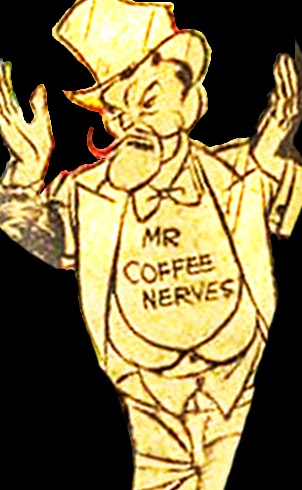
And for once, TPRG was right - The Land of Thirst is an outstanding album. As good as the songs are, the underlying tension beneath each of them, due to Manning's and Kearney's situation, is palpable, and brings a razor-sharp edge to all of them. The epitome of this lyrical edge is in what I consider the album's centerpiece song, "Mr. Coffee-Nerves".

In actuality, Mr. Coffee-Nerves was a villianous cartoon character created by the Postum Decaffinated Coffee people back in the 1940s and 50s. He was the spiritlike presence that appeared whenever people drank shitty non-Postum coffee, the kind that caused people to get jittery, irritable at family members, and just plain jumpy - "coffee nerves". Here's a place that has a number of the cartoon ads that Postum published, featuring this character (the accompanying commentary by the author of this site is equally hilarious).

In the song, the singer (Brendan) describes the events in this life with his (unnamed, but we all know who she is) lover as driving him to the same level of irrational irritability. "The house is like a waiting room, and waiting always puts me on edge - the slightest sound may set me off". "I can't sleep, it's three a.m; you're rolling close to me again - stay away, your flesh disgusts me". And the chorus between each verse is brutal: "Seems that fear always closes our eyes as we connect the dots" - he's too afraid of the consequences of realizing and articulating his dissatisfaction with his relationship, so he chooses to just live in this horrible atmosphere, getting more and more agitated with no apparent way out.


In addition to the cold. biting lyrics, the things that make this song so devastating are:
1) the relentless, ticking-clock beat and nagging guitar, which all but make you FEEL the tension the singer is under;
2) the fact that Brendan sings the song not with anger, but in an indifferent monotone that signals his complete lack of affection for or interest in his partner; and
3) Barbara Manning joins him in the monotone "la-la-la-la" chorus - she had to know the song was specifically about her and the way her boyfriend felt about her.
The complete song is just crushingly effective . . . and yet it's a brilliant song, one of many on the album.

Sadly, The Land of Thirst has never been released on CD, and as far as I know, there are no immediate plans to do so, despite much yip-yap about it over the past fifteen years or so. As happy as I am to have such a rare piece of music in my possession, I still would like for everyone to hear it, and discover how brilliant this band was, and Barbara Manning is and continues to be.

And thus, here you are, carefully cooked off of my treasured and pristine personal vinyl copy:

Please use the email link below to contact me, and I will reply with the download link(s) ASAP:

Send Email