

I hate to start off a post on a negative note, but I've got to get this off of my chest:
I f**king HATE Tony DeFranco.
...Or to be more accurate, I hated him (past tense), once long ago, when I felt that he and his band, The DeFranco Family, directly and negatively affected my life. Let me elaborate:
As I've mentioned several times in previous posts, in the early Seventies, my family moved from Virginia to Wisconsin for my Navy-officer dad to attend graduate school in Madison, the state capital, for a couple of years. I'd spent my first couple of elementary school years in Virginia, and as such I don't think I stood out particularly. I had several friends there, mind you, and was always part of the schoolyard gang at recess, but I didn't consider myself particularly popular or noticeable.
That all changed once I got to Wisconsin. The small-town school I went to was full of mostly kids who had either lived there or on the surrounding farms for most of their entire lives, and as of yet hadn't seen much of the world. A big trip for them and their families was a day in Madison, just up the road; jaunts to more far-flung areas, such as Milwaukee or even Chicago, were almost unheard of. So when my siblings and I entered school that year (all told, there were six of us (including myself), ranging from kindergarten to 5th grade) as the "big city slickers from far away", we were instant novelties and semi-celebs in the classrooms. To my surprise, I found that I was "interesting" and popular - especially with the girls in my 4th grade class. As a youngster, I really hadn't taken that much notice or had that much interest in girls beforehand; most of them didn't like to play the rougher games that the boys used to engage in during recess. Now, during school breaks, they would race to the playground to wait for me to appear, so that one (or two) of them could link their arms with mine and spend that period walking around and being seen with me. It was all very wholesome and innocent for that time, but it was still thrilling for a young boy to get so much female attention. Not to toot my own horn, but I had it 'going on'! This situation lasted for the entire school year, much to my pleasure.
During the school break that summer, my family and I made several jaunts around the state, taking in tourist attractions of  especial interest to kids, like The House On The Rock (with its amazing carousel and coin-operated automatic music machines), Baraboo (the old headquarters of the Ringling Brothers And Barnum & Bailey circus, with the town featuring several circus-related attractions) and Wisconsin Dells, where we spent a blazing afternoon sitting in the lakeside stands watching the old Tommy
 Bartlett water-skiing show (I looked up the weather records years later; that day was recorded as one of the hottest in state history). We also traveled back to Virginia to see relatives for a few days, and I also got the chance to visit our old neighborhood and spend a happy day in the company of my best friend Ricky and a lot of the old gang there.
During our travels as the summer months passed, a new song appeared on the local AM stations and started getting heavy play, "Heartbeat - It's A Lovebeat" by a new teenage pop group, The DeFranco Family.
The song spent the summer climbing the charts, and by the time school was about to reconvene that fall, it was a Top Five hit. Its sound was generic kiddie pop from that period, and in hindsight the lyrics were mainly frothy nonsense... but of course all of the young people back then liked it, including myself. But I didn't really pay that much attention to the group itself.
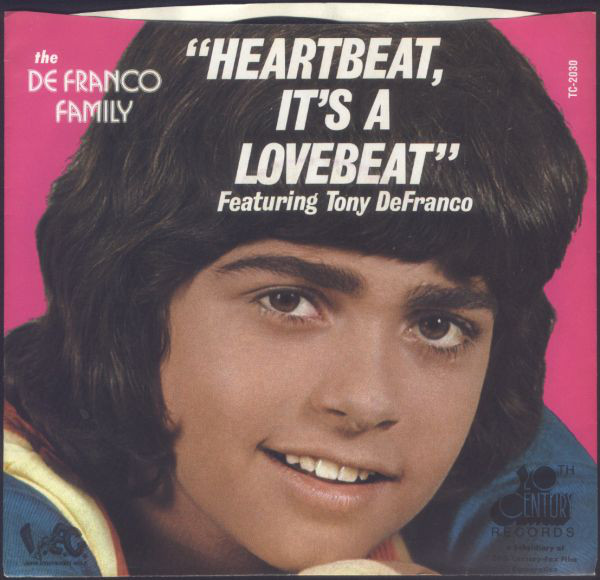
 how could I compete with a genuine rock star, with his sloe-eyed, sultry ‘come hither’ gaze and thick helmet of dark, wavy, young girl-attracting hair? Needless to say, I was consumed with preteen jealousy, and began to hate this little MF with a passion for stealing my mojo. It seemed that he and his family band appeared out of nowhere, just to personally torment me!
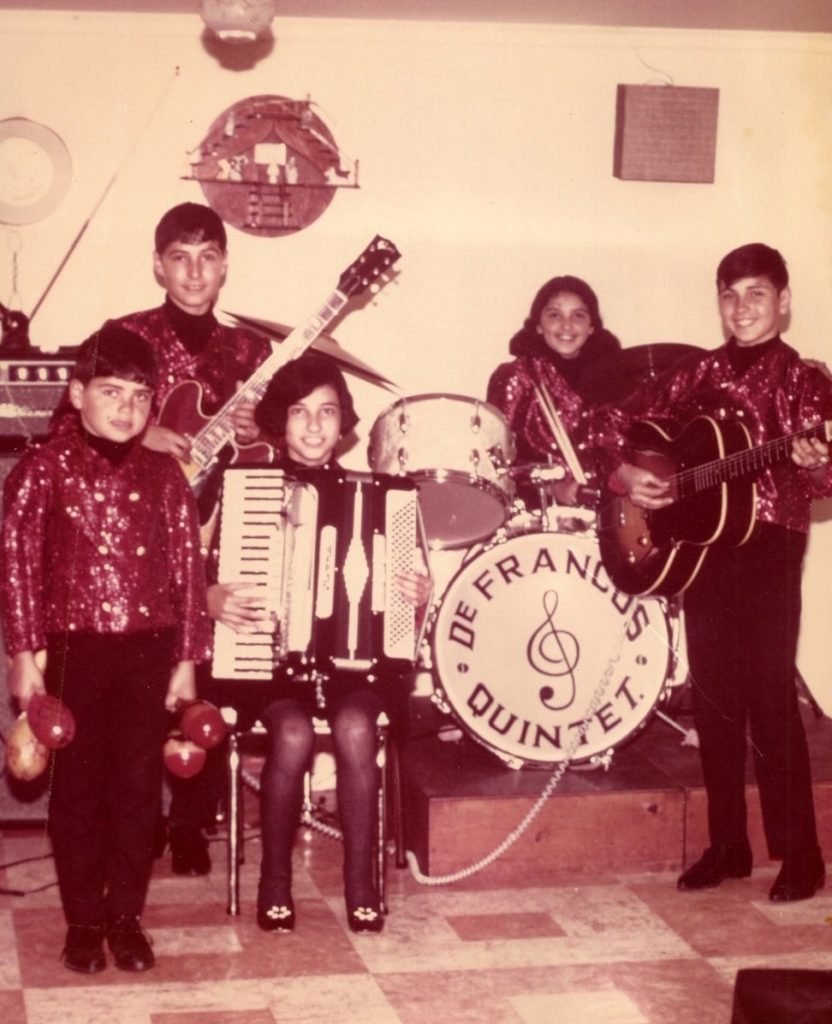 Italian immigrants to Canada in the 1950s, started a band (The DeFranco Quintet) with their parents' encouragement in the late 1960s, and did the local circuit, playing instrumentals and pop standards at area weddings, bar mitzvahs, store openings, parades and the like. They weren't exactly taking the music world by storm... and even in their out-of-the-way corner of the world, they weren't considered one of the top bands in the area.
 But fortunately for The DeFrancos, luck and fate intervened. A local talent scout stumbled upon one of their gigs, taped it, and sent the recording (along with a picture of the band) along to Sharon Lee, editor of Tiger Beat magazine. Ms. Lee liked what she saw and heard enough to forward the material on to the magazine's founder and publisher, Charles Laufer. For Laufer, The DeFranco Family couldn't have come along at a more opportune time.
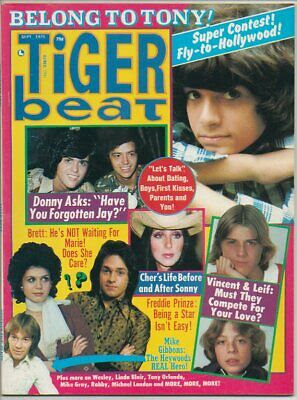
Tiger Beat was founded in 1965 as a fan magazine targeted towards teenage girls, with a heavy emphasis on pop idols and young movie actors who girls of the era found "dreamy" (Decades later, The Simpsons did a wicked - and accurate - send-up of Tiger Beat and similar teenybopper magazines with Lisa Simpson being an avid reader of Non-Threatening Boys magazine). The magazine was essentially a publicity flack journal, featuring wholesome gossip, contests ("Win A Dream Date With...!") and information on the popular preteen entertainment crushes of the period: starting in the '60s with the likes of The Monkees, The Beatles, The Cowsills, Bobby Sherman, and Dino Desi & Billy, and on into the '70s with stars such as David Cassidy, Barry Williams and Chris Knight from The Brady Bunch, The Hudson Brothers,
The Williams Brothers, Shawn Cassidy and Leif
Garrett - and of course, the two top pop titans of the early 1970's, The Jackson 5 and The Osmonds - to name but a few.
Lisa Simpson being an avid reader of Non-Threatening Boys magazine). The magazine was essentially a publicity flack journal, featuring wholesome gossip, contests ("Win A Dream Date With...!") and information on the popular preteen entertainment crushes of the period: starting in the '60s with the likes of The Monkees, The Beatles, The Cowsills, Bobby Sherman, and Dino Desi & Billy, and on into the '70s with stars such as David Cassidy, Barry Williams and Chris Knight from The Brady Bunch, The Hudson Brothers,
The Williams Brothers, Shawn Cassidy and Leif
Garrett - and of course, the two top pop titans of the early 1970's, The Jackson 5 and The Osmonds - to name but a few.
Despite being one of the main go-to sources for pop artist news, Laufer and Tiger Beat had no direct stake in any revenues generated by the artists they promoted. In fact, much of the data and interviews contained in their monthly 'zine were paid for by the publisher, not offered for free by the artists' managers. And yet Laufer was in no position to complain about this arrangement; any pushback or negative press on his part would lead to an immediate curtailing of access of that particular actor or singer. Basically, the entertainment industry had Tiger Beat by the balls. Laufer longed for an artist he could take into his orbit to supervise and exploit outside of the influence of these talent managers... and like magic, The DeFranco Family came into his sights as his golden goose.
In the fall of 1972, Lee flew the band out to Los Angeles for a full-fledged audition with Laufer, and he also liked what he heard. The magazine publisher quickly signed the group to an exclusive deal with his company, Laufer
Entertainment, financed a debut three-song demo, and helped secure for them  a
recording contract with 20th Century Records. Laufer also began some early tub-thumping for The DeFrancos in the pages of his mag, with the very first mention of the group coming in the November 1972 issue, months before any DeFranco Family product had actually made it into the music store bins.
a
recording contract with 20th Century Records. Laufer also began some early tub-thumping for The DeFrancos in the pages of his mag, with the very first mention of the group coming in the November 1972 issue, months before any DeFranco Family product had actually made it into the music store bins.
The DeFranco Family entered United Western Recorders studio in Hollywood (the same place where Pet Sounds and "California Dreamin'" were cut a few years earlier) in February 1973 to lay down tracks for their debut album, utilizing members of the legendary Wrecking Crew as their backing band. The debut single, "Heartbeat - It's A Lovebeat" was released that May, a couple of weeks before the album of the same name hit the shelves, and immediately began climbing the charts.
The success of that single, both in  the U.S and internationally, was boosted somewhat by content regulations in Canada (which mandated that stations there give maximum exposure and airplay to local artists), but was mostly due to relentless positive press for the band generated in the pages of Tiger Beat and picked up by other teen idol magazines of the period. Hardly a month went by in 1973 where The DeFrancos, and Tony
  in particular, weren't featured as cover stars in Laufer's rag. This created a groundswell of support that encouraged radio stations across the U.S. to play the song as much as possible... which simultaneously helped fill Laufer Entertainment's coffers. Laufer's investment in the group began to pay off handsomely.
It can also be argued that another huge factor in The DeFranco Family's success in 1973
came from filling the market void left by mistakes and misfires made by
the two reigning "family" pop bands of the period, the aforementioned Jackson 5 and
Osmonds. After six hit albums in just three years, The Jackson  5 sound
was getting a bit old and tired. Plus, lead singer Michael's voice
began changing in 1972, forcing Motown management and the band's
songwriting team ("The Corporation") to find/craft songs to fit this
vocal shift. The group was enormously dissatisfied with the songs
chosen for their next album, and all of the brothers had begun writing
their own material with the hope of having some of their songs
included. But Motown actively prevented them from recording any of
5 sound
was getting a bit old and tired. Plus, lead singer Michael's voice
began changing in 1972, forcing Motown management and the band's
songwriting team ("The Corporation") to find/craft songs to fit this
vocal shift. The group was enormously dissatisfied with the songs
chosen for their next album, and all of the brothers had begun writing
their own material with the hope of having some of their songs
included. But Motown actively prevented them from recording any of  their own material. The resulting album, Skywriter, containing
nothing but label-mandated music, was released in March of 1973. While
it sold relatively well (2 million copies worldwide), it was the first Jackson 5
disc to miss the Top Ten, peaking at #44. The entire situation left
the Jackson family extremely unhappy as to how they had been treated by
the label. The Skywriter situation was one of a number of factors that led to The Jackson 5 leaving Motown two years later.
their own material. The resulting album, Skywriter, containing
nothing but label-mandated music, was released in March of 1973. While
it sold relatively well (2 million copies worldwide), it was the first Jackson 5
disc to miss the Top Ten, peaking at #44. The entire situation left
the Jackson family extremely unhappy as to how they had been treated by
the label. The Skywriter situation was one of a number of factors that led to The Jackson 5 leaving Motown two years later.
As
for The Osmonds, they were sort of in the same situation as The Jackson
5, having cranked out four albums in rapid succession (within two
years) and also dealing with lead singer Donny's changing voice. But
the difference between the two bands was that The Osmonds got more
musically ambitious with each album, because their label  made some
allowances for them to include their own material. Phase III,
released in early 1972, retained a lot of the bubblegum pop sound that
put them on the map in the first place, with hit songs like "Down By The
Lazy River" and "Yo-Yo". But it also included smatterings of genuine
hard rock. Their subsequent album, Crazy Horses, released in
October of that year, their first with every
made some
allowances for them to include their own material. Phase III,
released in early 1972, retained a lot of the bubblegum pop sound that
put them on the map in the first place, with hit songs like "Down By The
Lazy River" and "Yo-Yo". But it also included smatterings of genuine
hard rock. Their subsequent album, Crazy Horses, released in
October of that year, their first with every  song penned by a band
member, all but completely dispensed with pop sounds - believe it or
not, but it is truly one of the great early '70s hard rock albums.
Listening to it nowadays, you can't BELIEVE that these five clean-cut boys from Utah recorded it - it's that raw, nasty and good. Both of The Osmonds' 1972 albums made the Billboard Top Twenty.
song penned by a band
member, all but completely dispensed with pop sounds - believe it or
not, but it is truly one of the great early '70s hard rock albums.
Listening to it nowadays, you can't BELIEVE that these five clean-cut boys from Utah recorded it - it's that raw, nasty and good. Both of The Osmonds' 1972 albums made the Billboard Top Twenty.
With
that wave of critical and popular success behind them, The Osmonds then
made a curious move. Being devout Mormons, some of the older band
members were coming of the age to go off on year-long church missions,
which would derail their entertainment careers. The band thought that,
rather than placing the group on hiatus while on religious duties, they
would be better served and reach more people through their  music. To
this end, in June 1973 The Osmonds put out an ambitious album called The Plan,
described as "a Mormon concept album with prog rock aspirations" (the
album name is taken from The Plan Of Salvation, a key tenet of the
Mormon faith). All of the songs (recorded in a variety of genres)
relate to aspects of Mormonism. While some saw it as an sincere and
ambitious attempt to celebrate their religion and expose it to the
masses, many critics viewed it as straight-up proselytizing. The disc
was significantly less successful than their two preceding releases (The Plan
peaked at #58 on the Billboard 200, and two singles released from it
both only reached #36), and in hindsight can be viewed as the end of The
Osmonds' chart dominance. The band never put out another album that
made the Top Fifty.
music. To
this end, in June 1973 The Osmonds put out an ambitious album called The Plan,
described as "a Mormon concept album with prog rock aspirations" (the
album name is taken from The Plan Of Salvation, a key tenet of the
Mormon faith). All of the songs (recorded in a variety of genres)
relate to aspects of Mormonism. While some saw it as an sincere and
ambitious attempt to celebrate their religion and expose it to the
masses, many critics viewed it as straight-up proselytizing. The disc
was significantly less successful than their two preceding releases (The Plan
peaked at #58 on the Billboard 200, and two singles released from it
both only reached #36), and in hindsight can be viewed as the end of The
Osmonds' chart dominance. The band never put out another album that
made the Top Fifty.
After "Heartbeat - It's A Lovebeat" went Gold that fall (and subsequently Platinum by Christmas), the second
single from the debut album , "Abra-Ca-Dabra", also made the American Top Forty by
the end of 1973. This was enough to drag their Heartbeat - It's A Lovebeat release up to a peak of #109 on the album charts. While "Abra-Ca-Dabra" was still on the rise, the label pushed the group back into the studio to record their follow-up, another disc full of poppy, lightweight teenager
, "Abra-Ca-Dabra", also made the American Top Forty by
the end of 1973. This was enough to drag their Heartbeat - It's A Lovebeat release up to a peak of #109 on the album charts. While "Abra-Ca-Dabra" was still on the rise, the label pushed the group back into the studio to record their follow-up, another disc full of poppy, lightweight teenager  love songs, along with a cover of the early '60s Drifters hit "Save The Last Dance For Me". The resulting album, also titled Save The Last Dance For Me, failed to stimulate much excitement in the market, only peaking at #163, but the cover song itself was fairly successful, making it into the Top Twenty by May of 1974.
At this point, timing, which had worked to The DeFranco Family's advantage the year before, began to work against them. Family pop groups, both real (like the Jackson 5 and Osmonds) and fake (The Partridge Family and The Brady Kids) began to fall out of favor beginning in 1974, concurrent with the rise of disco. The Jacksons were the only one of those groups to quickly adapt to the times and the new sound, reentering the  Top Twenty album charts with their September 1974 disc Dancing Machine, with the album's title track becoming a smash hit (#2 Pop, #1 R&B) that touched off the "Robot" dance craze of the mid-70s. The DeFrancos weren't equipped musically to make that transition, hence the poor reception of their second album. But 20th Century Records failed to recognize this shift in the music market - instead blaming the failure of Save The Last Dance For Me on the producer of their two albums. The label fired him and selected as his replacement longtime music industry insider (and future Lieutenant Governor of California) Mike Curb to oversee the group's career.
Seeing the success the band had with their last hit single, Curb began pressuring The DeFranco Family to rely solely on cover songs for their subsequent releases. The band strongly resisted, and after a couple of Curb-produced attempts to record them as such (with cover singles of "We Belong Together" in 1975 and "Venus" in 1976) that flopped, the DeFrancos terminated their recording relationship with 20th Century Records and their managerial relationship with Laufer and Laufer Entertainment. Other labels weren't exactly lining up to re-sign them, so The DeFranco Family put together a touring show and went out on the road for a couple of years, playing county fairs and less-than-packed Vegas houses before finally throwing in the towel in 1978.

 elementary school, and the fortunes and fate of The DeFranco Family weren't high on my list of concerns. It was too far in the past and too far removed for me to feel any satisfaction at the comeuppance / downfall of a teen idol who seemingly stole my playground buzz a couple of years earlier.
After the end of their recording career, all of the DeFrancos settled in California and began various careers in film and television production, education and other endeavors. Tony DeFranco is now a very successful high-end Southern California real estate agent with Sotheby's International Realty. All of the siblings are happy and settled in their lives, and remain close - which frankly is a refreshing thing to hear, after so many horror stories about former entertainers sliding into the abyss of poverty and self-destruction. Good on them. Tony, I hereby forgive you.
And here's something for me to give to YOU: both DeFranco Family albums put out by 20th Century Records at the periods indicated:
- Heartbeat - It's A Lovebeat, released in May 1973; and
- Save The Last Dance For Me, released in the spring of 1974.
These discs were hard as heck to track down; to the best of my knowledge, the albums have been out of print since the mid-1970s, and neither of them were ever subsequently released on CD.
This isn't burningly important or technologically innovative music, and I doubt you'll ever see it honored the Rock Hall of Fame anytime soon. But for those of us of a certain age, these DeFranco Family tunes will take us back to a time in our rapidly receding pasts when there was still seemingly enough innocence and wonder in the atmosphere to popularize lightweight poppy AM radio paeans of young love like these being offered. And if you're not old enough to recall those times, at least have a listen and get a chuckle as to what your parents and/or grandparents thought was 'hip' and 'cool' in the early Seventies. Either way, enjoy, and as always, let me know what you think.
Please use the email link below to contact me, and I will reply with the download link(s) ASAP:
Heartbeat - It's A Lovebeat: Send Email
Save The Last Dance For Me: Send Email
...And on a final note, here's a thumbs-up on this post from the man himself (heh... I'm such a sneaky little stinker!):


