Showing posts with label Pop. Show all posts

Saturday, October 25, 2025

Various Artists - Sounds Of The Seventies (1974 & 1975)


An old elementary school classmate of mine died a couple of weeks ago. I can't call him a "friend", per se, but he was an essential presence in my childhood experience.

I've mentioned in previous postings that my Navy officer dad's next duty station after the conclusion of our time in Wisconsin was serving as a professor at the U.S. Naval Academy in Annapolis, Maryland. We arrived there that summer, and settled into a two-story townhouse in military housing across from one of the main academy gates, directly behind the neighborhood pool and adjacent to the neighborhood of West Annapolis.

West Annapolis is about a forty square block area, bounded by Rowe Boulevard to the south, Weems Creek to the west, the Severn River to the north, and government property along its eastern edge. The neighborhood is pretty much cut off from the rest of the city of Annapolis proper due to its proximity to said "government property" - namely, the grounds of the U.S. Naval Academy and the adjacent housing areas for officers and their families stationed there, where I lived. As such, West Annapolis has over the decades developed a somewhat insular, go-it-alone stance among the longtime residents there, not mixing much with regular Annapolitans and maintaining a cool attitude towards the "interloping" military families living just on the other side of the old wooded Baltimore & Annapolis Railroad right-of-way.

However, the young children of area officers had to go to school somewhere. And since the Naval Academy Primary School, a K-through-5 private school located across the Severn at the Naval Station, had limited enrollment, for many years the majority of kids living in Arundel Estates and Perry Circle (the military housing areas) were required to attend local facilities, the first and closest one being West Annapolis Elementary School (WAES). So in 1974, that's where the majority of my siblings and I began our latest academic year.

For the most part, relations between the local youngsters and the relatively more transient military offspring at the school were tranquil. I know that some of the West Annapolis boys and girls considered many from my area as "rich kids" and elitist snobs (believe me, we were most decidedly not!), while some of my Navy acquaintances thought many of the locals were lower-class lowlifes (again, not remotely true). But in those years, that tranquility was constantly being roiled by one boy, Frederick, the Terror of West Annapolis.

Frederick (or "Freddie" as he was more commonly known) was a short, wiry redhead with a fiery temper and rock-hard fists that he seldom hesitated to make use of, if the situation called for it. He was a year behind me in grade; however, for a few years in the early/mid '70s, WAES administration decided to experiment with a new teaching approach whereby instead of having the 3rd, 4th, 5th and 6th grades in four separate classrooms, each classroom would contain a combination of ALL FOUR GRADES. So each individual teacher was were forced to provide instruction to all of the learning levels simultaneously, every day - which must have been a nightmare for them. In hindsight, it was a nutty idea, and I don't recall learning very much that year. WAES finally abandoned that practice before the 1970s ended, segregating the grades into separate classrooms, like most other schools in the nation do. But I went to school there through the brunt of this experimental period... and as 'luck' would have it, Freddie was one of my classmates.

Freddie's fearsome reputation, cultivated by classroom and schoolyard incidents that landed him in the Principal's office several times that year, and nurtured by juvenile word-of-mouth, was such that he became, in many of our minds, the pre-teen 'crime boss' and 'bete noire' of West Annapolis. Outside of attending school there, most Navy kids avoided the neighborhood, especially the area close by Freddie's house, lest they run afoul of "Freddie's gang" of area kids he reportedly controlled.

There used to be a little neighborhood store directly across the street from WAES, on the corner of Melvin Avenue and Annapolis Street about a block away from his home, called Waxman's Grocery. Mr. Waxman was the sour and crotchety proprietor of this old-fashioned one-room store, and he seemed to hate kids (many years later, I learned that Mr. Waxman's son, a WAES graduate, had been killed in Vietnam in his teens shortly after arriving over there as a new enlistee in the late 1960s... so it was then I began to understand Mr. Waxman's demeanor and feel some sympathy for him). Despite his cantankerous nature, children flocked to his shop after classes ended for the day, as Mr. Waxman stocked every brand and variety of popular candy then available - Atomic Fireballs, Mike & Ikes, Lemonheads, Pop Rocks, Marathon bars, Chunky Bars, you name it. The store owner was well aware of the individuals who kept him in business. The market was Ground Zero for the local Wacky Packages craze of the mid-70s; students would buy the packs by the dozen, trading the adhesive parody renditions of popular consumer products with others in the school or otherwise sticking them to their school folders and lockers.

Bubble Yum, the first soft chunk bubble gum, was released by LifeSavers (in limited quantities) in the Western U.S. in late 1974, and the company began a gradual national rollout later that year, with the Baltimore/Washington D.C. area serving as an early East Coast test
market. When it initially appeared, it was shipped to only a few stores in our area in very small quantities, and Waxman's Grocery, with its proven track record of moving vast amounts of confectionery product, was one of the stores selected. When Freddie and his boys discovered this, they staked out Waxman's for hours on end, watching for the delivery trucks and, by their presence, "discouraging" (so to speak) non-neighborhood kids from going there. Freddie's gang would buy up every pack of Bubble Yum available, at 30 cents for a pack of five pieces, then take them to school and resell them to children craving the new gum for upwards of fifty cents to a dollar for each individual chunk. Those guys ended up making a small fortune that winter and spring, until increased product distribution and availability put Bubble Yum in more local stores. But for a long while, they were the preteen Gum Mafia.

As much as I've detailed the fearsome, threatening antics and actions of Freddie and his gang here, I did have some normal interactions with him from time to time. More that once, I recall heading over to West Annapolis to hang out and play with him and his friends, and during the winter he and his crew gathered with the Navy kids sledding down Suicide Hill directly adjacent to Perry Circle, the only decent place to slide in the immediate area. In our few playtimes, a sort of detente existed between us, as it does between kids. Still, Freddie would sometimes suggest we do activities that I wasn't comfortable with, such as shoplift sweets at the local 7-11. In those situations, I would demur, then try to quickly and quietly remove myself from his presence and head back home, as the unspoken threat of drawing the ire of "Freddie's gang" was always present.

The mid-70s period was a transitional period for music. AM radio fare, consisting of lite rock, novelty songs and other lightweight fare, still ruled the airwaves, but harder-edged punk, reggae and hard rock music was bubbling just below the surface, ready to break out. Songs that were giant hits and schoolyard favorites during that time included "Up In A Puff Of Smoke" by an obscure (for the U.S.) British singer named Polly Brown:

For some reason, this song was HUGE as WAES - never did much for me, though (in a related story, Polly Brown never had another charting song in America...).

Another massive song from that time was "Billy, Don't Be A Hero" by Bo Donaldson & The Heywoods:

Although the premise was hokey and overly sentimental (a young woman begs her love not to go off to war, but stay and marry her; he goes anyway and, of course, buys the farm in his first battle), this song still went to #1 in America in the summer of 1974, selling nearly four million copies. However, it was hated as much as it was loved, voted No. 8 on Rolling Stone magazine's readers' poll of "10 Worst Songs of the 1970s".

What I didn't know at the time was that this song was a remake of a British hit from earlier that year. Bo Donaldson & The Heywoods were an obscure group of journeymen from Ohio who hadn't had much success in the prior ten years of their music career, until they glommed on to "Billy, Don't Be A Hero", originally penned by a British group, Paper Lace, who took their version to the top of the UK charts just three months prior. Understandably pissed at seeing their thunder and stateside glory stolen by Bo Donaldson et al., Paper Lace quickly released their follow-up single, which made it to US #1 six weeks later that midsummer, the group's first (and only) American hit - "The Night Chicago Died":

Children couldn't get enough of songs like this back then!

The potential menace of Freddie and his gang overall did little to affect the fun times I had living there in Annapolis.  There was a great group of kids on my street and up the hill in Perry Circle, and we were a close-knit bunch.  We would all hang together at the pool on warm days, playing Marco Polo and basking in the sun.  The winters were marked by building huge snow forts, from which we would choose sides and have intense snowball fights.  There were birthday parties, slumber parties, football games, and expeditions into the restricted areas near Shady Lake or through the old Civil Defense tunnels and shelters under the apartments.  During the holiday season, we would practice Christmas carols together, then put together a chorus and go door to door singing to our neighbors.  Or we would head over across the street through the Naval Academy gates, to play baseball on the diamonds there, hang out on the platforms and structures of the old Academy obstacle course on Hospital Point, or try to sneak into the "Midshipmen/Authorized Staff Only" areas throughout the Yard.  

After years of requests, I was finally awarded the paper route in my neighborhood, delivering the Evening Capital each night after I got home from school (I was one of the paper's youngest newsboys).  I worked that route like a dog, doubling the subscriptions on my street inside of a few months, and by Christmas that year I was making a fortune (well, a relative fortune for a preteen in the 1970s).  The Evening Capital provided me with a few extra over-the-shoulder newsbags, and there were always a few extra papers in my stack each day.  So with them, my friends and I devised a game called Dogfight: each of us would have a bag filled with newspapers tightly wrapped with rubber bands, then we would get on our bikes and ride circles around each other in a big field, whipping papers at other riders to see who we could knock off!  Sounds kinda brutal now... but it was a very fun, looked-forward-to activity, and I never recall anyone getting seriously hurt.

Great memories. 

Freddie and I weren't close friends, only casual acquaintances at best, and I didn't keep in close contact with him after I left elementary school and moved on to Bates Junior High across town the next year. I would, however, continue to hear stories about him from some of my younger friends who still attended WAES - from all reports, his attitude and demeanor didn't change an iota. And after my family left Maryland in the late 1970s, he all but completely faded off of my radar. I learned more about him in recent years through my contact via Facebook with his older brother, who I didn't know at all back during my Annapolis childhood but got to know later. Through him, I learned that after Freddie left high school, he served a short stint as an enlisted Navy man, then quickly returned to the Annapolis area, where for decades he worked as a local handyman and house painter.

My lone interaction with Freddie since the end of our school days together occurred a couple of years ago, when I repeated to his brother a funny (and probably apocryphal) story about a practical joke Freddie reputedly played on one of his West Annapolis cronies, that quickly made the schoolyard rounds. Freddie fired off a blistering response through his brother's thread, angrily denying the legend and castigating me up and down for even INSINUATING that it was true. Mind you, I was retelling the tale of a harmless and minor childhood prank that allegedly occurred... but still, almost fifty years later, it managed to set him off. Apparently, some things - and some people - never change. Freddie's brother is friendly, stable and accomplished, and managed to put together a pretty good life for himself and his family - in other words, the complete opposite of Freddie.

So, as such, I don't have any particularly deep feeling of loss regarding Freddie's demise - he was a bully, and sort of a dick, and from all reports and indications remained so up to his dying day.  I wasn't the only one with this reaction; for decades, I've remained in close contact with several of my old Arundel Estates childhood friends. Their feelings on Freddie's death can be summarized in a single comment one of them made to me: "He was the 'bogeyman' for a lot of kids back then." Can't really refute that assessment.

With that being said, Freddie was an integral part of that fondly remembered time and place in my life, and his presence and actions have done little to obscure the happy times I recall living in Annapolis as a child (prior to my return there as a Naval Academy midshipmen almost a decade later). If anything, Freddie was like a grain of sand in an oyster shell - an irritant whose presence still ended up creating something lasting and cherished.

So, in honor of his passing, and in homage to that time, here are a few music compilations from that period that will give you a sense of what was being listened to in the mid-70s. These are part of a forty-volume(!) series of recordings released by Time-Life Music between 1989 and 1999, covering the entirety of the 1970s. I only picked up a few of these, since I had other compilations that covered this same general time period. But the ones provided here, covering 1974 and 1975, are an excellent summation of music from that time.

In case you're wondering, here's the lineup:

Sounds Of The Seventies: 1974:

  1. Can't Get Enough – Bad Company
  2. Show and Tell – Al Wilson
  3. Come and Get Your Love – Redbone
  4. I Shot the Sheriff – Eric Clapton
  5. Help Me – Joni Mitchell
  6. I Can Help – Billy Swan
  7. Sha-La-La (Make Me Happy) – Al Green
  8. Rock the Boat – The Hues Corporation
  9. Bennie and the Jets – Elton John
  10. Midnight Rider – Gregg Allman
  11. Sweet Home Alabama – Lynyrd Skynyrd
  12. The Loco-Motion – Grand Funk Railroad
  13. Smokin' in the Boys' Room – Brownsville Station
  14. Rikki Don't Lose That Number – Steely Dan
  15. Rock On – David Essex
  16. Midnight at the Oasis – Maria Muldaur
  17. Kung Fu Fighting – Carl Douglas
  18. Keep on Smilin' – Wet Willie
  19. Then Came You – Dionne Warwick & The Spinners
  20. The Bitch Is Back – Elton John

Sounds Of The Seventies: 1974 - Take Two:

  1. Lookin' for a Love – Bobby Womack
  2. You Ain't Seen Nothing Yet – Bachman-Turner Overdrive
  3. The Joker – Steve Miller Band
  4. Until You Come Back to Me (That's What I'm Gonna Do) – Aretha Franklin
  5. Can't Get Enough of Your Love, Babe – Barry White
  6. Mockingbird – Carly Simon with James Taylor
  7. I've Got to Use My Imagination – Gladys Knight & The Pips
  8. Sundown – Gordon Lightfoot
  9. Everlasting Love – Carl Carlton
  10. Shinin' On – Grand Funk Railroad
  11. Rock and Roll, Hoochie Koo – Rick Derringer
  12. Takin' Care of Business – Bachman-Turner Overdrive
  13. Rock Your Baby – George McCrae
  14. Sideshow – Blue Magic
  15. Haven't Got Time for the Pain – Carly Simon
  16. Tin Man – America
  17. Dancing Machine – Jackson Five
  18. Jungle Boogie – Kool & the Gang
  19. Nothing from Nothing – Billy Preston
  20. I'll Have to Say I Love You in a Song – Jim Croce
  21. Radar Love – Golden Earring

Sounds Of The Seventies: 1975:

  1. You're No Good – Linda Ronstadt
  2. Jackie Blue – Ozark Mountain Daredevils
  3. That's the Way (I Like It) – KC & the Sunshine Band
  4. Must of Got Lost – J. Geils Band
  5. Why Can't We Be Friends? – War
  6. Sister Golden Hair – America
  7. Philadelphia Freedom – Elton John
  8. Black Water – Doobie Brothers
  9. Love Is a Rose – Linda Ronstadt
  10. How Long – Ace
  11. Dance with Me – Orleans
  12. Free Bird – Lynyrd Skynyrd
  13. You Are So Beautiful – Joe Cocker
  14. Feel Like Makin' Love – Bad Company
  15. Lady Marmalade – Labelle
  16. Pick Up the Pieces – Average White Band
  17. Island Girl – Elton John
  18. Some Kind of Wonderful – Grand Funk Railroad
  19. The Hustle – Van McCoy & Soul City Symphony
  20. Let's Do It Again – Staple Singers

Sounds Of The Seventies: 1975 - Take Two:

  1. When Will I Be Loved – Linda Ronstadt
  2. Bad Time – Grand Funk Railroad
  3. Roll On Down the Highway – Bachman-Turner Overdrive
  4. Movin' On – Bad Company
  5. Take Me in Your Arms (Rock Me a Little While) – The Doobie Brother
  6. They Just Can't Stop It (The Games People Play) – The Spinners
  7. L-O-V-E (Love) – Al Green
  8. Shining Star – Earth, Wind & Fire
  9. Get Down Tonight – KC & the Sunshine Band
  10. I'm on Fire – Dwight Twilley
  11. SOS – ABBA
  12. Shame, Shame, Shame – Shirley & Company
  13. Cut the Cake – Average White Band
  14. You're the First, the Last, My Everything – Barry White
  15. Low Rider – War
  16. Fight the Power (Part 1 & 2) – Isley Brothers
  17. Bungle in the Jungle – Jethro Tull
  18. Only Women Bleed – Alice Cooper
  19. Can't Get It Out of My Head – Electric Light Orchestra
  20. Poetry Man – Phoebe Snow
  21. I'm Not in Love – 10CC

Enjoy these discs, released in 1990 and 1991 (for the "Take Two" versions), and as always, let me know what you think.

Please use the email links below to contact me, and I will reply with the download link(s) ASAP:
  • Various Artists - Sounds Of The Seventies: 1974: Send Email
  • Various Artists - Sounds Of The Seventies: 1975: Send Email
  • Various Artists - Sounds Of The Seventies: 1974 - Take Two: Send Email
  • Various Artists - Sounds Of The Seventies: 1975 - Take Two: Send Email

Wednesday, June 11, 2025

The Beach Boys - The Pet Sounds Sessions (4 disc set)


R.I.P. to the great Brian Wilson... a true visionary, innovator and musical genius who with his group The Beach Boys, in my opinion, saved American rock - and indeed rock music as a whole - in the early sixties after the demise/sidelining of some of the genre's early stars (Buddy Holly, Elvis, Chuck Berry, Eddie Cochran, Little Richard, etc., as I mentioned here earlier). Wilson used his deep musical knowledge and melodic sense to craft, at first, seemingly simple but sonically advanced anthems to the beach life and culture of Southern California, then began to expand his musical palette and subject areas into more intense, personal areas and compositions. He put every iota of his being into his search for crafting the perfect pop song, miniature "teenage symphonies to God". It's an open debate as to whether this intensity of focus was the cause of his subsequent mental breakdowns, or if tensions and situations outside of music (such as drug abuse, or his relationship with his father and early band manager Murry Wilson) were the reason. But Brian Wilson LIVED, FELT, and SAW music... clearer than almost anyone else.

In regards to his celebrated output, many reviewers and critics reference Smile, The Beach Boys' unfinished 1967 concept album, as Wilson's peak. However, I feel that the praise regarding Smile is somewhat overblown, heavily influenced by its aura of being a "legendary" 'lost" album (true, the original album sessions were finally released in 2011 as a multi-disc box set that included an approximation of what the finished album would have sounded like... but in my opinion, it's not quite the same thing as having the thing appear in its proper time and place back in the 1960s).

For my money, however, Brian Wilson's magnum opus was and will always be Pet Sounds, released in 1966. Although ostensibly a Beach Boys album, Wilson was the sole producer and arranger, and primary composer (along with guest lyrical collaborator (and ad man/jingle writer) Tony Asher) of every song on the disc. Brian put his heart and soul into this release; he basically considered Pet Sounds to be a solo album - reportedly, somewhat to the chagrin of his bandmates, who generally weren't consulted regarding compositions and lyrics, instead being presented with completed arrangements they were expected to follow explicitly.

Although the album met with "meh" reviews and middling sales in the U.S., Pet Sounds was lauded by critics in the U.K., and was a major hit over in England, reaching #2 on the national charts and remaining in the English Top Ten for over six months. Eventually, critics around the world caught up with what was heard and felt about this album in Britain. Today, Pet Sounds is widely recognized as an innovative, groundbreaking, revolutionary rock release, and is considered one of, if not THE, greatest album of all time (currently #2 on the Rolling Stone 500).

I distinctly remember purchasing my copy of this album at a record store in Austin, Texas in the late '90s, while on a road trip to that city. Strangely, despite my voluminous music collection even back then, I had yet to add this one to my stacks. As such, that day on the road in Central Texas, for some reason I was COMPELLED to acquire this album IMMEDIATELY, and went out of my way to find a local music store that carried it.   And after all these years, I still love the music it contains. I consider "God Only Knows" to be one of the greatest, most beautiful songs ever composed.

Call me crazy... but I am convinced that, should the Earth come to an end hundreds of millions of years from now, on the day it occurs at least one of our successors (whether humanoid or not) will be listening to this song on the way out.

1997 saw the release of The Pet Sounds Sessions, containing detailed excerpts of the recording sessions and remastered mono and stereo mixes of the original album. The original plan was that Sessions was to have been released in May 1996 to coincide with the 30th anniversary of Pet Sounds. But Beach Boys vocalist Mike Love took exception to the box set's planned liner notes, which he felt diminished what he claimed was his more active involvement in the making of the original album (an observation and attitude that, for all intents and purposes, existed solely in his own head...). So modifications were made to Sessions' essays to include Love's self-serving and generally nonfactual comments, which delayed the set hitting store shelves by eighteen months.

Allmusic provides this review of the set:

"Part of the fascination with Pet Sounds lies in its detailed, multi-layered arrangements, in which all the parts blend together into a symphonic whole. The richness of the music is one of the reasons hardcore fans have desired a set like The Pet Sounds Sessions, a four-disc box that presents an abundance of working mixes, alternate takes, instrumental tracks, and rarities, as well as the first true stereo mix of the album. Certainly, a set this exacting is only of interest to serious fans, and even they might find the endless succession of work tracks tedious. Nevertheless, there's something fascinating about hearing the album broken down to its individual parts; after hearing horn lines, vocals, and percussion tracks out of their original context, the scope and originality of Brian Wilson's vision becomes all the more impressive."

'Nuff said.

So in memory of the late, great Brian Wilson, who passed away earlier today, I hereby provide you with The Pet Sound Sessions, a four-disc compilation of alternate mixes, instrumental track, isolated vocals, and other pieces and parts that made up the whole of one of the most influential and celebrated rock albums in history, released by Capitol Records on November 4th, 1997. Have a listen and revel once again in Brian's genius... and, as always, let me know what you think.

Please use the email link below to contact me, and I will reply with the download link(s) ASAP:

Send Email

Friday, December 17, 2021

The Brady Bunch - Merry Christmas From The Brady Bunch


Time for some of my annual Christmas postings...  and my first selection for this year is a doozy!

As mentioned in a previous post, the television program The Brady Bunch premiered on ABC in the fall of 1969.  The show was extremely popular with kids in its first couple of seasons, but that popularity wasn't reflected in the overall Nielsen TV ratings, which ranked The Brady Bunch somewhere near the middle (at best) to the back of the pack.  Still, the network and the producers wanted to further capitalize on the program's pre-teen popularity, and early in the second season, someone came up with the inspired idea of releasing an album full of Christmas standards sung by the kids as something that might appeal with their target audience.

It goes without saying that this recording was not exactly a labor of love by anyone involved... The kids (Barry Williams ("Greg"), Maureen McCormick ("Marcia"), Christopher Knight ("Peter"), Eve Plumb ("Jan"), Mike Lookinland ("Bobby") and Susan Olsen ("Cindy")) weren't particularly enthused about doing it - except for perhaps McCormick, who had some limited vocal experience, the rest of them had little if any significant singing talent to exploit.  Facing this fact and the relative brevity of time allotted to cut this disc, the production staff were even less happy to be involved in this project (album producer Tim O’Brien, who was also Paramount’s house producer, was later quoted as lamenting trying to pull something listenable from “six little kids who could not sing”).  And network management could have cared less about the resulting quality of the finished product - they just wanted something related to their semi-hit show out before the holidays.  In that atmosphere, production commenced in mid-October, 1970.

Recorded in less than two weeks, the album mixed group sing-alongs with solo performances on classic holiday standards (“We finished our vocals in one afternoon, and then listened intently as the audio engineers used every gimmick, trick and echo chamber in the book to get us at least up to ‘listenable’ status,” recalled Barry Williams).   None of the tracks are especially memorable; frankly, most of them are jaw-droppingly horrible renditions that soon segue into the realm of "Oh my God!" hilarity.  A prime example of this is their version of "O Holy Night", which I only recently listened to for the first time in years.  The song starts off semi-tolerable, until it reaches the chorus... at which point I burst out in incredulous laughter at its stunning awfulness.  The label had the cojones to actually release a single from this album, Susan Olsen's lisping rendition of "Frosty The Snowman" - there wouldn't be another.

It's not like there weren't any decent Christmas numbers to pull from the show; mother Carol Brady (Florence Henderson) laid down a beautiful performance of “O Come All Ye Faithful,” featured in the series’ only Christmas episode, that for some reason was not among the selections (I guess they just wanted to focus on the kids - bad decision).  


All in all, this record, in my opinion, has all the hallmarks of a recording of an amateur holiday pageant from some elementary school in the Midwest - good enough for parents and attendees to have a memory of their child warbling off-key Christmas songs, but nowhere near good enough to actually release for purchase.

One of the other weird things about this album is that the kids recorded it "in character". As shown below, some of the songs say "lead vocal by Bobby Brady, Jan Brady", etc., not by the actors' names. 
 
 
This thing was pushed out the door so fast, they obviously didn't spend a lot of time on spell checking or proper song annotation - "Marcia Brady's" name is spelled "Marsha" here; and some of the lead vocals are credited to the incorrect child.

These are the correct lead vocals for this disc:
1) The First Noel - Mike
2) Away in a Manger - Maureen
3) The Little Drummer Boy - all 6 kids
4) O Come All Ye Faithful - Eve
5) O Holy Night - Maureen & Barry
6) Silent Night - all 6 kids
7) Jingle Bells - all 6 kids
8) Frosty the Snowman - Susan
9) Silver Bells - all 6 kids
10) Rudolph the Red-Nosed Reindeer - all 6 kids
11) Santa Claus is Coming to Town - Barry
12) We Wish You a Merry Christmas - all 6 kids
Not exactly the mark of a quality production.
 
Anyway, for good or ill for you this holiday season, here you are: The Brady Bunch Kids' debut album, Merry Christmas From The Brady Bunch, released by Paramount Records on November 2nd, 1970, and rereleased on CD (and renamed Christmas With The Brady Bunch) by MCA Records in 1995.  Get ready...
 
Whatever your reaction, as always, let me know what you think.

Please use the email link below to contact me, and I will reply with the download link(s) ASAP:

Send Email

Thursday, October 21, 2021

Various Artists - Elvira Presents...

With October 31st just around the corner, and longtime horror hostess Elvira (or more specifically Cassandra Peterson, the actress who plays Elvira) in the news recently due to the revelations in her recently published autobiography Yours Cruelly, Elvira: Memoirs of the Mistress of the Dark, I thought I might post a couple of her Halloween-related compilations.

The first Elvira music compilation came out in 1983, a couple of years after Peterson auditioned for and won the job of presenter for a revival of a popular Los Angeles-area weekend horror show featuring old scary movies called Fright Night. The program (renamed Elvira's Movie Macabre) featured her now-iconic character Elvira, Mistress Of The Dark, a saucy, sarcastic, 'Valley Girl'-type tricked out in heavily-applied horror-film makeup, a huge black beehive wig and a tight-fitting, low-cut black gown which displayed Peterson's ample chest.  Elvira not only introduced the decidedly Grade-B, -C and -Z films, she would often interrupt the flicks during the program to poke fun of their overall crappiness, in addition to making racy double entendres and jokes about her boobs. She quickly gained notoriety and popularity in the region, and parlayed that success to appearances on Johnny Carson's Tonight Show and other programs (like CHiPs and The Fall Guy) which brought her nationwide fame.

Her first release, Elvira Presents Vinyl Macabre - Oldies But Ghoulies (Vol. 1), was a quickie collection of Halloween/horror-related rock and pop hits and standards by the likes of Bobby "Boris" Pickett and Sheb Wooley, slapped together by Rhino Records in the early years of that label's existence. As such, Peterson/Elvira had little to do with or on the album, other than record a couple of intros/outros and appear on the cover in all her glory. Despite its relative generic October music presentation, today this disc commands high prices, probably because the record was never rereleased on cassette or CD.

The follow-up to this initial release was Elvira Presents Haunted Hits, put out in 1988. Actually, in some ways, this album serves as sort-of rerelease of Vinyl Macabre, as it reprises a number of songs that were on the first compilation (like "Monster Mash", "Purple People Eater" and "Haunted House"), while adding a substantial number of other holiday-related tunes, some rather popular and renowned. In case you're interested, here's the lineup:

  1. Monster Mash - Bobby 'Boris' Pickett & The Crypt-Kickers
  2. Haunted House - Jumpin' Gene Simmons
  3. Ghostbusters - Ray Parker Jr.
  4. Out OF Limits - The Marketts
  5. The Blob - The Five Blobs
  6. The Creature From The Black Lagoon - Dave Edmunds
  7. The Purple People Eater - Sheb Wooley
  8. The Addams Family (Main Title) - Victor Mizzy
  9. Twilight Zone - Neil Norman & His Cosmic Orchestra
  10. Welcome To My Nightmare - Alice Cooper
  11. End Of Side One - Elvira
  12. Beginning Of Side Two - Elvira
  13. Halloween Spooks - Lambert, Hendricks & Ross
  14. Dead Man's Party - Oingo Boingo
  15. Little Demon - Screamin' Jay Hawkins
  16. Horror Movie - The Skyhooks
  17. I Put A Spell On You - Screamin' Jay Hawkins
  18. King Kong - Big T. Tyler
  19. Attack OF The 50-Foot Woman - The Tubes
  20. I Was A Teenage Werewolf - The Cramps
  21. Voodoo Voodoo - LaVern Baker
  22. The Creature (From Outer Space) - The Jayhawks
  23. Full Moon - Elvira
  24. Martian Hop - The Ran-Dells
  25. Attack Of The Killer Tomatoes - Lee Lewis
  26. Elvira's Outro - Elvira

Elvira was a little more involved on this album; in addition to her commentary, she's even provided a full song to sing, "Full Moon" - a lightweight, synth-poppy confection that doesn't hold up well next to the other classics included here. But all in all, in my opinion, this is probably the best of the compilations released under her name, due to the breadth, scope and volume of fun Halloween music offered here. It was a bestseller for the label when it was released, and remains a perennially popular disc.

But the success of the ...Haunted Hits album seemed to lead to some unfortunate decisions/choices for the next Elvira compilation, Elvira Presents Monster Hits, released six years later. It appears that someone (either Peterson herself or the producers) believed that the big selling point for the earlier set was the increase in Elvira's voice and presence. So for this new one, the decision was made to ratchet up the "Elvira factor" - more than one-third of this short (28 minute long) album is centered on her. This includes two original songs, "Monsta' Rap" and "Here Comes The Bride (The Bride Of Frankenstein)" - both generally bland, worthless songs that do little more than take up space that could have been better utilized by including more classic and well-known Halloween songs.  The track list for this brief release is as follows:

  1. Introduction - Elvira
  2. Monsta' Rap - Elvira
  3. Little Demon - Screamin' Jay Hawkins
  4. Feed My Frankenstein - Alice Cooper
  5. Monster Mash - Bobby 'Boris' Pickett
  6. Nightmare On My Street - DJ Jazzy Jeff & The Fresh Prince
  7. The Addams Family - Joey Gaynor
  8. Here Comes The Bride (The Bride Of Frankenstein) - Elvira
  9. Outro - Elvira

Also note that this comp includes several repeats from Elvira's previous releases, making the existence of this one somewhat redundant.

In years to come, Rhino would release a couple more Halloween compilations under Elvira's name, all to gradually diminishing returns: Revenge Of The Monster Hits in 1995 and Elvira's Gravest Hits (an 'best of' (*eye roll*) album devoted almost solely to tunes crooned by her) in 2010, along with Heavy Metal Halloween in 2009. But these have done little to decrease the fame of Peterson's signature character; Elvira remains popular and active to this day.

Anyway, here for your spook-tacular pleasure are two discs to make your haunted holiday complete:

  • Elvira Presents Haunted Hits, released in 1988; and
  • Elvira Presents Monster Hits, released in 1994

Both were put out by Rhino Records.

Enjoy, and have a wonderful, safe and happy Halloween! And as always, let me know what you think.

Please use the email link below to contact me, and I will reply with the download link(s) ASAP:

Various Artists - Elvira Presents Haunted Hits: Send Email
Various Artists - Elvira Presents Monster Hits: Send Email

Sunday, August 22, 2021

The Everly Brothers - The Price Of Fame (7-disc set)


R.I.P. to Isaac Donald (Don) Everly yesterday at the age of 84, the last surviving member of the Everly Brothers (Phil Everly died in 2014) - if not THE greatest, certainly the most influential rock 'n' roll duo of all time. The Everly's close harmonies were a major influence on rock greats like The Beach Boys, The Beatles, The Bee Gees, and especially Simon & Garfunkel. They hold the record for the most Top 100 U.S. singles by any duo, and trail only Hall & Oates as the duo with the most Top 40 hits. The Everly Brothers are recipients of the Grammy Lifetime Achievement Award, have a star dedicated to them on the Hollywood Walk of Fame, and have been inducted into the Vocal Group Hall of Fame, the Rockabilly Hall of Fame, the Musician's Hall of Fame (for Don's innovative rhythm guitar riff on their early hit "Wake Up, Little Susie"), the Country Music Hall of Fame, and of course the Rock Hall of Fame, where the group was included as part of the inaugural class of genre pioneers in 1986. Rolling Stone magazine ranked The Everly Brothers at #33 on its list of "The 100 Greatest Artists Of All Time". 

(I list all of these superlatives because, although it seems the duo are all but forgotten today, they were the real deal, and no joke.) 

With their greatness basically pretty self-explanatory, I don't think I need to go into great length here with this posting on the background, whys and wherefores of The Everly Brothers.  I'll just cut to the chase, and pony up the music...

The duo had their first breakout hits on Cadence Records in the late 1950s, finding massive and widespread success with classic songs like "Bye Bye Love" and "Wake Up, Little Susie" (both 1957), "All I Have To Do Is Dream" and "Bird Dog" (both 1958).  

After three years at Cadence, the Everlys signed with Warner Bros. Records in 1960 and stayed with the label for a decade.  Their early years at Warners were their most successful, with their first label release, "Cathy's Clown", topping the charts and selling eight million copies.  Other early '60s Top Ten hits included "Walk Right Back" and "Crying In The Rain".  Although their star faded somewhat in America with the advent of the British Invasion, The Everly Brothers remained very popular and successful in the United Kingdom and Canada for the remainder of the decade.

Here for your listening pleasure is the Everly Brothers compilation The Price Of Fame, covering the first five years (1960-1965) the group was at Warner Bros., and including not only every release from that period, but a number of alternate takes and outtake sessions.  Every early huge label hit is here, along with re-recordings of some of their early Cadence music.  This is a massive set... but I feel it's an essential one for fans of the Everlys and for rock fans in general.

The compilation was put out by the celebrated German label and reissue specialists Bear Family Records on January 31st, 2006.  Since its a Bear Family release, you know it's going to be thorough!

Anyway, enjoy, and let me know what you think.  Thanks and farewell to you, Don - the choir in Rock 'n' Roll Heaven just got a little better.  All the best to you and your brother, wherever you are.

Please use the email link below to contact me, and I will reply with the download link(s) ASAP:

Send Email

Wednesday, July 28, 2021

Various Artists ‎– Things Go Better With Coke: Sixties Coca-Cola Commercials 1965-69


[I started this one way back in 2017, but for some reason never got around to finishing it.  Here you go...]

Back when I was a kid, my parents discouraged us from drinking much in the way of soft drinks. There was never that much soda in any of the houses where we lived, and that that was present was generally reserved for the grown-ups; the kids had to make do with things like milk, water, juice and occasionally Wyler's and/or (in some cases, stunningly culturally inappropriate) Funny Face fruit-flavored drink mixes. I suppose at the time it was just one of the ways and methods our folks used to watching out for our health and well-being - and being a parent now, I can sympathize with and relate to that attitude. But when I was a child, it felt like a heavy blow, as if we were being unfairly and arbitrarily deprived of something that other kids had ready access to.

However, my grandmother (on my father's side) had no such compunctions; she always had a plentiful stock of stuff like RC Cola, 7-Up and Mr. Pibb readily at hand in big half-gallon (later two liter) bottles at her house, and during our visits there she would spoil us unmercifully with near-unlimited access to this carbonated nectar ("unlimited", that is, until my folks would inevitability step in and order us "not to drink all of Grandmama's soda"). I don't think my parents fully understood that that limited availability only served to make us children desire it more, and make it seem more "special".

Even with all of that, once I got older and began living (and shopping) on my own, I can't say that I became a big pop drinker. To this day, my non-alcoholic beverages of choice continue to be water, milk and OJ (so I guess my parents did that right after all). I do keep cans of soda in the fridge, and have never prevented my own children from having them when they felt the desire. In doing so, I think I've kept them from equating soft drinks as special treats, as I once did, regarding them now as just another choice that they can take or leave. And I think that tactic has been successful; they are not big soda guzzlers either.

I think that this info will not be regarded as good news by the big beverage bottlers - Keurig Dr. Pepper, PepsiCo, and the longtime industry giant, The Coca-Cola Company - all of whom have invested hundreds of millions of dollars in advertising revenue promoting their products and exhorting us to drink more-More-MORE!   These companies have gone to great lengths to convince/coerce the public to consume mass quantities, with some campaigns more memorable than others. Those of us of a certain age fondly recall this classic Dr. Pepper commercial:

Or this memorable 7-Up commercial, featuring the talents and voice of the incomparable Geoffrey Holder:

And this, probably the gold standard as far as soft drink commercials are concerned, the 1971 "Hilltop" ad for Coca-Cola, featuring a reworked version of the New Seekers' song "I'd Like To Teach The World To Sing (In Perfect Harmony)" - a song so popular that not one, but TWO versions of it, both made the U.S. Top Ten in 1972 and went Gold:

Coca-Cola had long been the industry leaders in innovative, creative product promotion.  The company began placing ads in national magazines as early as 1904, and by the end of that decade, their advertising budget exceeded $1 million per year, an extraordinary sum for that time.  

The very design of the unique and world-famous Coca-Cola bottle in the 1910s was a deliberate choice to differentiate the brand from that of other cola competitors.  Coke was one of the first brands to feature Santa Claus prominently in its print ads, beginning in the 1930s, an association that has remained to this day.  And from the dawn of the 20th century, the firm made heavy use of celebrity endorsements, beginning with popular singer Hilda Clark in 1901.

For over fifty years, Coca-Cola engaged the services of the D’Arcy Advertising Company as its official ad agency, and the union was very successful.  But in 1956, Coke ended its relationship with D’Arcy and transferred the company’s advertising account to McCann-Erickson, Inc. The aim was to more successfully utilize new media like television, areas that McCann-Erickson was more in touch and in tune with. The new agency proved its worth quickly with the first two Coca-Cola campaigns it managed in the 1950s – “The Sign of Good Taste” (1957) and “Be Really Refreshed” (1959).  Pop performers from the period, such as the McGuire Sisters, The Brothers Four and Connie Francis were involved in these successful efforts (note that, at the time, Coke didn't appear to be very interested in utilizing rock 'n' roll stars and making inroads into the youth market... curious).

The next major McCann-Erickson campaign was “Things Go Better with Coke,” which began in 1963. For this campaign, there was an explosion in the number and quality of ads, and the number of top contemporary music stars involved, making up for that dearth in the earlier campaigns. As mentioned in Allmusic.com:

During the 1960s, it wasn't unheard of for rock & roll groups and music performers to lend their voices to commercial jingles... But in the '60s, artists of surprisingly high stature were willing (and artists of surprisingly middling stature were asked) to lend their talents and skills to the cutting of product advertising jingles. Any act with lesser stature than The Beatles or The Rolling Stones was fair game to be approached by an advertising agency with some hope of success.

McCann-Erickson (backed by Coca-Cola's huge checkbook, I'm sure) convinced some huge stars of the period to record radio and/or television commercials under the “Things Go Better with Coke” campaign. These artists were asked to incorporate the “Things Go Better with Coke” slogan into a commercial-length song, which was generally inspired by one of their big hits (for example, Tom Jones’ Coke commercial uses the melody and arrangement of his signature tune “It’s Not Unusual”):

 Again, from Allmusic.com:

It may seem monotonous -- most of the spots include the phrase "Things Go Better With Coke" -- but the variations are fascinating, and it is a chance to hear these acts having what can only be considered fun with their respective sounds. There is a kind of surreal fun to be found in these sounds -- many of the tracks run well over a minute and are done in each artist's straight style, whatever that might be. The second of three Roy Orbison numbers here, for example, is in his hardest rocking style of the mid- to late '60s, while the third blatantly imitates "Oh, Pretty Woman." [Other] acts... completely absorb the Coca-Cola lyrics into their own respective sounds.

Acts who participated include the aforementioned Tom Jones and Roy Orbison, along with The Supremes, The Tremeloes, Jan & Dean, The Moody Blues, Boyce & Hart, Marvin Gaye, Gladys Knight & The Pips, Gary Lewis & The Playboys, The Easybeats, Ray Charles, The Box Tops, The Bee Gees, Aretha Franklin, and many, many more. All in all, the "Things Go Better With Coke" campaign, which ran until 1970, was a smashing success, and to this day the phrase is probably second only to "It's The Real Thing" in regards to a signature, recognizable brand slogan.

Initially, there doesn't appear to have been any great interest in preserving these ads for posterity; I think both the company and the performers themselves considered them to be for commercial use and generally disposable. So the origin and sourcing of this album is pretty scanty and sketchy, to say the least.  It appears that these songs were all but forgotten about for over twenty-five years, until someone at McCann-Erickson corporate headquarters pulled them all together in the mid-1990s as an in-house thing, commemorating and celebrating their innovative and successful 60's ad campaign.  As such, it was initially produced in very limited quantities (only about 100 copies or so) - it was definitely not done by a studio.  It probably would have remained an internal ad agency document if some enterprising and on-the-ball individual hadn't recognized its significance and historical value, nabbed a copy and began marketing it as a hard-to-find blank-label bootleg CD in the late 1990s.  However, even that effort was short-lived; this album has been off the market now for close to twenty years and has become a difficult find on the Web, and/or an rare, high-priced purchase from sites like eBay.

With this being an unlicensed, unregulated bootleg, even its format and track listing vary from version to version, with different album covers (as shown here) and song listings.  The original boot release listed a total of sixty-four cuts, but actually only included sixty-one, for some reason.  I can't recall where or when I ended up acquiring my copy from, but it appears I hit the jackpot - my version of this compilation includes over ONE HUNDRED tracks, both short and long radio commercials done by dozens of artists.  The quality throughout this comp is generally good to excellent, although the American material is slightly lower in fidelity for the most part (The Box Tops' tracks in particular reveal some surface noise, and seem to be the only tracks taken from sources other than tape).  And the final song, "Come Alive", appears to have been appended on to my version as a joke, as "Come Alive" was the late-60's slogan for Coca-Cola's bitter (no pun intended) rival, Pepsi-Cola.

Anyway, here for your listening pleasure is the hard-to-find but enjoyable bootleg compilation Things Go Better With Coke: Sixties Coca-Cola Commercials 1965-69, original release date unknown.  Have a listen to these short but interesting and classic blasts of '60s radio ephemera, and as always, let me know what you think.

(...and, if I may, might I suggest you enjoy this auditory experience while imbibing the thirst-quenching soft drink of your choice;  I won't make any recommendations - I'm sure one brand in particular will somehow come to mind...)

Please use the email link below to contact me, and I will reply with the download link(s) ASAP:
Send Email

Friday, April 16, 2021

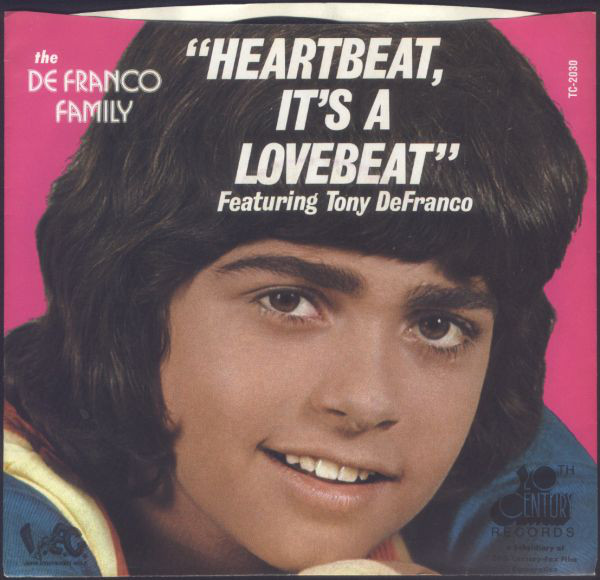
The DeFranco Family Featuring Tony DeFranco - Heartbeat - It's A Lovebeat and Save The Last Dance For Me


I hate to start off a post on a negative note, but I've got to get this off of my chest: 

I f**king HATE Tony DeFranco.

...Or to be more accurate, I hated him (past tense), once long ago, when I felt that he and his band, The DeFranco Family, directly and negatively affected my life. Let me elaborate:

As I've mentioned several times in previous posts, in the early Seventies, my family moved from Virginia to Wisconsin for my Navy-officer dad to attend graduate school in Madison, the state capital, for a couple of years. I'd spent my first couple of elementary school years in Virginia, and as such I don't think I stood out particularly. I had several friends there, mind you, and was always part of the schoolyard gang at recess, but I didn't consider myself particularly popular or noticeable.

That all changed once I got to Wisconsin. The small-town school I went to was full of mostly kids who had either lived there or on the surrounding farms for most of their entire lives, and as of yet hadn't seen much of the world. A big trip for them and their families was a day in Madison, just up the road; jaunts to more far-flung areas, such as Milwaukee or even Chicago, were almost unheard of. So when my siblings and I entered school that year (all told, there were six of us (including myself), ranging from kindergarten to 5th grade) as the "big city slickers from far away", we were instant novelties and semi-celebs in the classrooms. To my surprise, I found that I was "interesting" and popular - especially with the girls in my 4th grade class. As a youngster, I really hadn't taken that much notice or had that much interest in girls beforehand; most of them didn't like to play the rougher games that the boys used to engage in during recess. Now, during school breaks, they would race to the playground to wait for me to appear, so that one (or two) of them could link their arms with mine and spend that period walking around and being seen with me. It was all very wholesome and innocent for that time, but it was still thrilling for a young boy to get so much female attention. Not to toot my own horn, but I had it 'going on'! This situation lasted for the entire school year, much to my pleasure.

During the school break that summer, my family and I made several jaunts around the state, taking in tourist attractions of especial interest to kids, like The House On The Rock (with its amazing carousel and coin-operated automatic music machines), Baraboo (the old headquarters of the Ringling Brothers And Barnum & Bailey circus, with the town featuring several circus-related attractions) and Wisconsin Dells, where we spent a blazing afternoon sitting in the lakeside stands watching the old Tommy Bartlett water-skiing show (I looked up the weather records years later; that day was recorded as one of the hottest in state history).  We also traveled back to Virginia to see relatives for a few days, and I also got the chance to visit our old neighborhood and spend a happy day in the company of my best friend Ricky and a lot of the old gang there.

During our travels as the summer months passed, a new song appeared on the local AM stations and started getting heavy play, "Heartbeat - It's A Lovebeat" by a new teenage pop group, The DeFranco Family.


The song spent the summer climbing the charts, and by the time school was about to reconvene that fall, it was a Top Five hit.  Its sound was generic kiddie pop from that period, and in hindsight the lyrics were mainly frothy nonsense... but of course all of the young people back then liked it, including myself.  But I didn't really pay that much attention to the group itself.

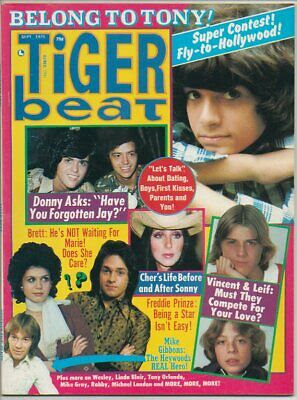
As the start of the new elementary school year approached that fall, I found myself looking forward to getting back to class, to once again resume my role as the area's #1 primary school paramour.  But soon after the start, I found that my star had been eclipsed - ALL the girls would talk about amongst themselves was about how "cute" and "talented" the new group's lead singer, Tony DeFranco, was.  They would whisper and giggle to one another about him, and during recess, instead of vying for my company, they would ogle pictures of him culled from the most recent teenybopper magazine.  Suddenly, I was yesterday's news - Tony was top dog now, and how could I compete with a genuine rock star, with his sloe-eyed, sultry ‘come hither’ gaze and thick helmet of dark, wavy, young girl-attracting hair?  Needless to say, I was consumed with preteen jealousy, and began to hate this little MF with a passion for stealing my mojo.  It seemed that he and his family band appeared out of nowhere, just to personally torment me!

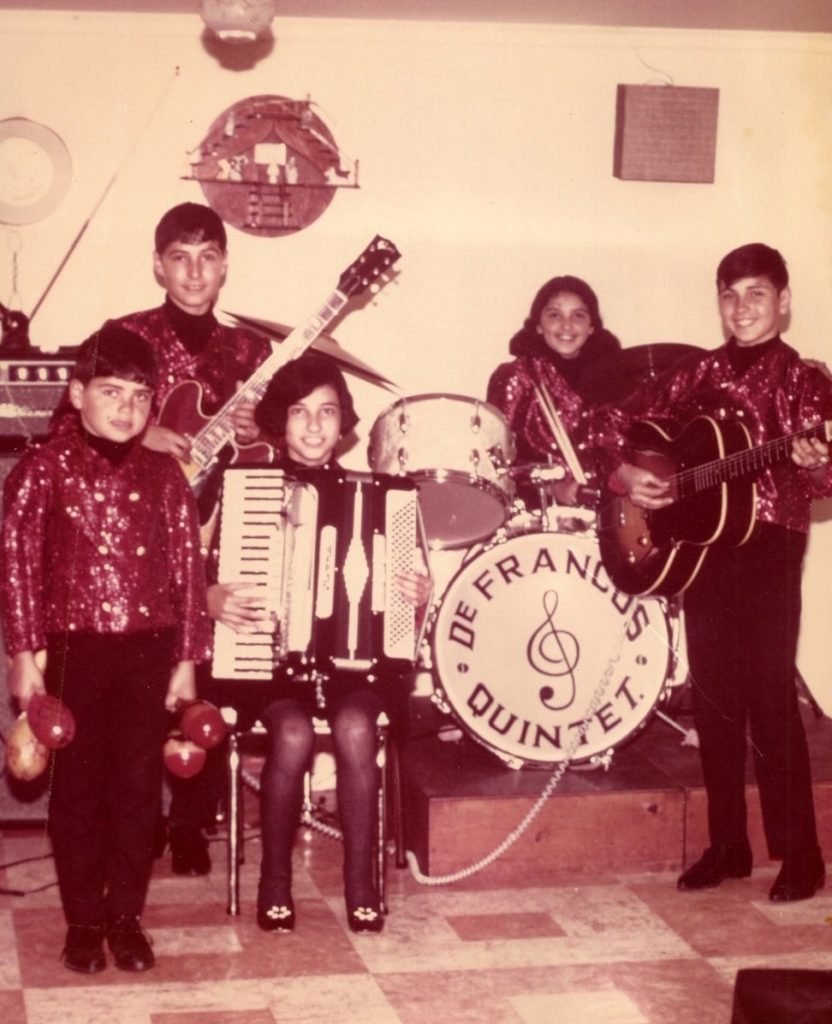
The DeFranco Family were originally from the Niagara Falls, Canada area; specifically sleepy small Canadian towns like Port Colborne and Welland hard by the tourist/resort city, wedged on a strip of land between Lake Erie and Lake Ontario.  The siblings (consisting of older brother and lead guitarist Benny, sisters Marisa on keyboards and Merlina on drums, younger brother Nino on rhythm guitar and kid brother Tony as lead singer), children of Italian immigrants to Canada in the 1950s, started a band (The DeFranco Quintet) with their parents' encouragement in the late 1960s, and did the local circuit, playing instrumentals and pop standards at area weddings, bar mitzvahs, store openings, parades and the like.  They weren't exactly taking the music world by storm... and even in their out-of-the-way corner of the world, they weren't considered one of the top bands in the area.  

But fortunately for The DeFrancos, luck and fate intervened.  A local talent scout stumbled upon one of their gigs, taped it, and sent the recording (along with a picture of the band) along to Sharon Lee, editor of Tiger Beat magazine.  Ms. Lee liked what she saw and heard enough to forward the material on to the magazine's founder and publisher, Charles Laufer.  For Laufer, The DeFranco Family couldn't have come along at a more opportune time.

Tiger Beat was founded in 1965 as a fan magazine targeted towards teenage girls, with a heavy emphasis on pop idols and young movie actors who girls of the era found "dreamy" (Decades later, The Simpsons did a wicked - and accurate - send-up of Tiger Beat and similar teenybopper magazines with Lisa Simpson being an avid reader of Non-Threatening Boys magazine).  The magazine was essentially a publicity flack journal, featuring wholesome gossip, contests ("Win A Dream Date With...!") and information on the popular preteen entertainment crushes of the period: starting in the '60s with the likes of The Monkees, The Beatles, The Cowsills, Bobby Sherman, and Dino Desi & Billy, and on into the '70s with stars such as David Cassidy, Barry Williams and Chris Knight from The Brady Bunch, The Hudson Brothers, The Williams Brothers, Shawn Cassidy and Leif Garrett - and of course, the two top pop titans of the early 1970's, The Jackson 5 and The Osmonds -  to name but a few.

Despite being one of the main go-to sources for pop artist news, Laufer and Tiger Beat had no direct stake in any revenues generated by the artists they promoted.  In fact, much of the data and interviews contained in their monthly 'zine were paid for by the publisher, not offered for free by the artists' managers.  And yet Laufer was in no position to complain about this arrangement; any pushback or negative press on his part would lead to an immediate curtailing of access of that particular actor or singer.  Basically, the entertainment industry had Tiger Beat by the balls.  Laufer longed for an artist he could take into his orbit to supervise and exploit outside of the influence of these talent managers... and like magic, The DeFranco Family came into his sights as his golden goose.

In the fall of 1972, Lee flew the band out to Los Angeles for a full-fledged audition with Laufer, and he also liked what he heard.  The magazine publisher quickly signed the group to an exclusive deal with his company, Laufer Entertainment, financed a debut three-song demo, and helped secure for them a recording contract with 20th Century Records.  Laufer also began some early tub-thumping for The DeFrancos in the pages of his mag, with the very first mention of the group coming in the November 1972 issue, months before any DeFranco Family product had actually made it into the music store bins.

The DeFranco Family entered United Western Recorders studio in Hollywood (the same place where Pet Sounds and "California Dreamin'" were cut a few years earlier) in February 1973 to lay down tracks for their debut album, utilizing members of the legendary Wrecking Crew as their backing band. The debut single, "Heartbeat - It's A Lovebeat" was released that May, a couple of weeks before the album of the same name hit the shelves, and immediately began climbing the charts.

The success of that single, both in the U.S and internationally, was boosted somewhat by content regulations in Canada (which mandated that stations there give maximum exposure and airplay to local artists), but was mostly due to relentless positive press for the band generated in the pages of Tiger Beat and picked up by other teen idol magazines of the period.  Hardly a month went by in 1973 where The DeFrancos, and Tony in particular, weren't featured as cover stars in Laufer's rag.  This created a groundswell of support that encouraged radio stations across the U.S. to play the song as much as possible... which simultaneously helped fill Laufer Entertainment's coffers. Laufer's investment in the group began to pay off handsomely.

It can also be argued that another huge factor in The DeFranco Family's success in 1973 came from filling the market void left by mistakes and misfires made by the two reigning "family" pop bands of the period, the aforementioned Jackson 5 and Osmonds.  After six hit albums in just three years, The Jackson 5 sound was getting a bit old and tired.  Plus, lead singer Michael's voice began changing in 1972, forcing Motown management and the band's songwriting team ("The Corporation") to find/craft songs to fit this vocal shift. The group was enormously dissatisfied with the songs chosen for their next album, and all of the brothers had begun writing their own material with the hope of having some of their songs included. But Motown actively prevented them from recording any of their own material.  The resulting album, Skywriter, containing nothing but label-mandated music, was released in March of 1973.  While it sold relatively well (2 million copies worldwide), it was the first Jackson 5 disc to miss the Top Ten, peaking at #44. The entire situation left the Jackson family extremely unhappy as to how they had been treated by the label. The Skywriter situation was one of a number of factors that led to The Jackson 5 leaving Motown two years later.

As for The Osmonds, they were sort of in the same situation as The Jackson 5, having cranked out four albums in rapid succession (within two years) and also dealing with lead singer Donny's changing voice. But the difference between the two bands was that The Osmonds got more musically ambitious with each album, because their label made some allowances for them to include their own material.  Phase III, released in early 1972, retained a lot of the bubblegum pop sound that put them on the map in the first place, with hit songs like "Down By The Lazy River" and "Yo-Yo".  But it also included smatterings of genuine hard rock.  Their subsequent album, Crazy Horses, released in October of that year, their first with every song penned by a band member, all but completely dispensed with pop sounds - believe it or not, but it is truly one of the great early '70s hard rock albums. Listening to it nowadays, you can't BELIEVE that these five clean-cut boys from Utah recorded it - it's that raw, nasty and good. Both of The Osmonds' 1972 albums made the Billboard Top Twenty.

With that wave of critical and popular success behind them, The Osmonds then made a curious move. Being devout Mormons, some of the older band members were coming of the age to go off on year-long church missions, which would derail their entertainment careers. The band thought that, rather than placing the group on hiatus while on religious duties, they would be better served and reach more people through their music.  To this end, in June 1973 The Osmonds put out an ambitious album called The Plan, described as "a Mormon concept album with prog rock aspirations" (the album name is taken from The Plan Of Salvation, a key tenet of the Mormon faith).  All of the songs (recorded in a variety of genres) relate to aspects of Mormonism.  While some saw it as an sincere and ambitious attempt to celebrate their religion and expose it to the masses, many critics viewed it as straight-up proselytizing. The disc was significantly less successful than their two preceding releases (The Plan peaked at #58 on the Billboard 200, and two singles released from it both only reached #36), and in hindsight can be viewed as the end of The Osmonds' chart dominance. The band never put out another album that made the Top Fifty.

So for The DeFranco Family, in many ways the timing of their entry onto the market was almost perfect. Their 1973 was full of hit songs, sold-out concerts, TV appearances (they were on American Bandstand a record nine times) and widespread teen adulation. But it wouldn't last.

After "Heartbeat - It's A Lovebeat" went Gold that fall (and subsequently Platinum by Christmas), the second single from the debut album, "Abra-Ca-Dabra", also made the American Top Forty by the end of 1973.  This was enough to drag their Heartbeat - It's A Lovebeat release up to a peak of #109 on the album charts.  While "Abra-Ca-Dabra" was still on the rise, the label pushed the group back into the studio to record their follow-up, another disc full of poppy, lightweight teenager love songs, along with a cover of the early '60s Drifters hit "Save The Last Dance For Me".  The resulting album, also titled Save The Last Dance For Me, failed to stimulate much excitement in the market, only peaking at #163, but the cover song itself was fairly successful, making it into the Top Twenty by May of 1974.

At this point, timing, which had worked to The DeFranco Family's advantage the year before, began to work against them. Family pop groups, both real (like the Jackson 5 and Osmonds) and fake (The Partridge Family and The Brady Kids) began to fall out of favor beginning in 1974, concurrent with the rise of disco.  The Jacksons were the only one of those groups to quickly adapt to the times and the new sound, reentering the Top Twenty album charts with their September 1974 disc Dancing Machine, with the album's title track becoming a smash hit (#2 Pop, #1 R&B) that touched off the "Robot" dance craze of the mid-70s. The DeFrancos weren't equipped musically to make that transition, hence the poor reception of their second album. But 20th Century Records failed to recognize this shift in the music market - instead blaming the failure of Save The Last Dance For Me on the producer of their two albums.  The label fired him and selected as his replacement longtime music industry insider (and future Lieutenant Governor of California) Mike Curb to oversee the group's career.

Seeing the success the band had with their last hit single, Curb began pressuring The DeFranco Family to rely solely on cover songs for their subsequent releases. The band strongly resisted, and after a couple of Curb-produced attempts to record them as such (with cover singles of "We Belong Together" in 1975 and "Venus" in 1976) that flopped, the DeFrancos terminated their recording relationship with 20th Century Records and their managerial relationship with Laufer and Laufer Entertainment.  Other labels weren't exactly lining up to re-sign them, so The DeFranco Family put together a touring show and went out on the road for a couple of years, playing county fairs and less-than-packed Vegas houses before finally throwing in the towel in 1978.

Tiger Beat never stopped trying to promote the DeFrancos (and milking every possible dollar they could out of the group) during the two years (1974-76) they were circling the drain; as late as the fall of 1976, more than two years after their last chart appearance, Tony DeFranco appeared as a magazine cover star.  But by that time, the group's brief months of glory and once vast and rabid fan base were far behind them. Too bad. Of course by then, I'd moved on from Wisconsin and elementary school, and the fortunes and fate of The DeFranco Family weren't high on my list of concerns. It was too far in the past and too far removed for me to feel any satisfaction at the comeuppance / downfall of a teen idol who seemingly stole my playground buzz a couple of years earlier.

After the end of their recording career, all of the DeFrancos settled in California and began various careers in film and television production, education and other endeavors.  Tony DeFranco is now a very successful high-end Southern California real estate agent with Sotheby's International Realty. All of the siblings are happy and settled in their lives, and remain close - which frankly is a refreshing thing to hear, after so many horror stories about former entertainers sliding into the abyss of poverty and self-destruction. Good on them. Tony, I hereby forgive you.

And here's something for me to give to YOU: both DeFranco Family albums put out by 20th Century Records at the periods indicated:

  • Heartbeat - It's A Lovebeat, released in May 1973; and
  • Save The Last Dance For Me, released in the spring of 1974.

These discs were hard as heck to track down; to the best of my knowledge, the albums have been out of print since the mid-1970s, and neither of them were ever subsequently released on CD. 

This isn't burningly important or technologically innovative music, and I doubt you'll ever see it honored the Rock Hall of Fame anytime soon. But for those of us of a certain age, these DeFranco Family tunes will take us back to a time in our rapidly receding pasts when there was still seemingly enough innocence and wonder in the atmosphere to popularize lightweight poppy AM radio paeans of young love like these being offered. And if you're not old enough to recall those times, at least have a listen and get a chuckle as to what your parents and/or grandparents thought was 'hip' and 'cool' in the early Seventies. Either way, enjoy, and as always, let me know what you think.

Please use the email link below to contact me, and I will reply with the download link(s) ASAP:

Heartbeat - It's A Lovebeat: Send Email
Save The Last Dance For Me: Send Email
 

...And on a final note, here's a thumbs-up on this post from the man himself (heh... I'm such a sneaky little stinker!):