Random mumblings and mundom ramblings on music (mostly), and whatever else pops into my mind . . .
[The files attached here are for review only, and should be deleted after two weeks. If you like the bands, go buy the albums . . . like I did!] . . .
And yes - EVERYTHING posted here is still available!
Wow, man - Charlie Watts... We lost a GIANT today, ladies and gentlemen, and an inspiration to rock drummers everywhere. The consummate, detached, sardonic professional and perfectionist, who grounded The Rolling Stones with his steady, yet innovative beats for nearly sixty years.
I've been going through the multitude of remembrances, eulogies and tributes to Mr. Watts all afternoon since I heard the news. Of all of them, I feel that Rob Sheffield captured the manner, spirit and essence of him the best, in the article filed earlier today in Rolling Stone magazine. Honestly, what more need be said?
In honor of the late drummer, I'm offering up for your enjoyment not a Rolling Stones album or rarity, but the loose and rollicking jam session members of the band recorded with two longtime friends and session players (pianist Nicky Hopkins and guitarist Ry Cooder) one night in the spring of 1969, while The Stones were in the middle of recording tracks with producer Glyn Johns for their upcoming album Let It Bleed. The quintet shambled and shuffled through a few loose bluesy originals (penned by Watts, Cooder and Hopkins), along with a couple of blues covers they liked.
It was all a big goof, and at the time it was done, they had no intention whatsoever of releasing the songs. In the original liner notes, Mick Jagger describes the album as "a nice piece of bullshit... which we cut one night in London, England while waiting for our guitar player to get out of bed. It was promptly forgotten (which may have been for the better) ..." As such, it sat around in the vaults for years, until one day a bored Johns retrieved it. Johns said of the album: "[It] was just a joke really, just a laugh. I recorded it and they played it, and then, I don't know how long later [ed. note: nearly three years, actually], we dug the tapes out, I mixed it and they stuck it out on an album. It didn't really warrant releasing really, but it was okay, a bit of fun, and there's some good playing on it." The disc charted briefly in America, eventually peaking at #33 on Billboard, but did nothing in the UK.
To this day, this release is generally reviled and disowned by Rolling Stones purists, who equate the recorded performances here to that of A Toot And A Snore In '74, a recording of a similarly loose (albeit drug-fueled) jam session by John Lennon, Paul McCartney, Harry Nilsson and Stevie Wonder in Los Angeles in the spring of 1974. But I feel that comparison is unfair, and unwarranted. Despite its slapdash nature, there is some good playing on this disc, and at best it shows The Stones unadorned, belting out numbers like the bar band they started out as. All in all, it's definitely worth a listen.
So here it is for you all to do just that - Jamming With Edward! ("Edward" was Nicky Hopkins' nickname), recorded on the evening of April 23rd, 1969, and released on Rolling Stones Records on January 7th, 1972. Enjoy this in the spirit in which it is offered, in honor of the life and legacy of the sublime and now-immortal Charlie Watts. And as always, let me know what you think.
Please use the email link below to contact me, and I will reply with the download link(s) ASAP:
[I started this one way back in 2017, but for some reason never got around to finishing it. Here you go...]
Back when I was a kid, my parents discouraged us from drinking much in the way of soft drinks. There was never that much soda in any of the houses where we lived, and that that was present was generally reserved for the grown-ups; the kids had to make do with things like milk, water, juice and occasionally Wyler's and/or (in some cases, stunningly culturally inappropriate) Funny Face fruit-flavored drink mixes. I suppose at the time it was just one of the ways and methods our folks used to watching out for our health and well-being - and being a parent now, I can sympathize with and relate to that attitude. But when I was a child, it felt like a heavy blow, as if we were being unfairly and arbitrarily deprived of something that other kids had ready access to.
However, my grandmother (on my father's side) had no such compunctions; she always had a plentiful stock of stuff like RC Cola, 7-Up and Mr. Pibb readily at hand in big half-gallon (later two liter) bottles at her house, and during our visits there she would spoil us unmercifully with near-unlimited access to this carbonated nectar ("unlimited", that is, until my folks would inevitability step in and order us "not to drink all of Grandmama's soda"). I don't think my parents fully understood that that limited availability only served to make us children desire it more, and make it seem more "special".
Even with all of that, once I got older and began living (and shopping) on my own, I can't say that I became a big pop drinker. To this day, my non-alcoholic beverages of choice continue to be water, milk and OJ (so I guess my parents did that right after all). I do keep cans of soda in the fridge, and have never prevented my own children from having them when they felt the desire. In doing so, I think I've kept them from equating soft drinks as special treats, as I once did, regarding them now as just another choice that they can take or leave. And I think that tactic has been successful; they are not big soda guzzlers either.
I think that this info will not be regarded as good news by the big beverage bottlers - Keurig Dr. Pepper, PepsiCo, and the longtime industry giant, The Coca-Cola Company - all of whom have invested hundreds of millions of dollars in advertising revenue promoting their products and exhorting us to drink more-More-MORE! These companies have gone to great lengths to convince/coerce the public to consume mass quantities, with some campaigns more memorable than others. Those of us of a certain age fondly recall this classic Dr. Pepper commercial:
Or this memorable 7-Up commercial, featuring the talents and voice of the incomparable Geoffrey Holder:
And this, probably the gold standard as far as soft drink commercials are concerned, the 1971 "Hilltop" ad for Coca-Cola, featuring a reworked version of the New Seekers' song "I'd Like To Teach The World To Sing (In Perfect Harmony)" - a song so popular that not one, but TWO versions of it, both made the U.S. Top Ten in 1972 and went Gold:
Coca-Cola had long been the industry leaders in innovative, creative product promotion. The company began placing ads in national magazines as early as 1904, and by the end of that decade, their advertising budget exceeded $1 million per year, an extraordinary sum for that time.
The very design of the unique and world-famous Coca-Cola bottle in the 1910s was a deliberate choice to differentiate the brand from that of other cola competitors. Coke was one of the first brands to feature Santa Claus prominently in its print ads, beginning in the 1930s, an association that has remained to this day. And from the dawn of the 20th century, the firm made heavy use of celebrity endorsements, beginning with popular singer Hilda Clark in 1901.
For over fifty years, Coca-Cola engaged the services of the D’Arcy Advertising Company as its official ad agency, and the union was very successful. But in 1956, Coke ended its relationship with D’Arcy and transferred the company’s advertising account to McCann-Erickson, Inc. The aim was to more successfully utilize new media like television, areas that McCann-Erickson was more in touch and in tune with. The new agency proved its worth quickly with the first two Coca-Cola campaigns it managed in the 1950s – “The Sign of Good Taste” (1957) and “Be Really Refreshed” (1959). Pop performers from the period, such as the McGuire Sisters, The Brothers Four and Connie Francis were involved in these successful efforts (note that, at the time, Coke didn't appear to be very interested in utilizing rock 'n' roll stars and making inroads into the youth market... curious).
The next major McCann-Erickson campaign was “Things Go Better with Coke,” which began in 1963. For this campaign, there was an explosion in the number and quality of ads, and the number of top contemporary music stars involved, making up for that dearth in the earlier campaigns. As mentioned in Allmusic.com:
During the 1960s, it wasn't unheard of for rock & roll groups and
music performers to lend their voices to commercial jingles... But in the '60s, artists of surprisingly high stature were willing (and artists of
surprisingly middling stature were asked) to lend their talents and skills to the cutting of product advertising jingles. Any act with lesser stature than The Beatles or The Rolling Stones was fair game to be approached by an advertising agency with some hope of success.
McCann-Erickson (backed by Coca-Cola's huge checkbook, I'm sure) convinced some huge stars of the period to record radio and/or television commercials under the “Things Go Better with Coke” campaign. These artists were asked to incorporate the “Things Go Better with Coke” slogan into a commercial-length song, which was generally inspired by one of their big hits (for example, Tom Jones’ Coke commercial uses the melody and arrangement of his signature tune “It’s Not Unusual”):
Again, from Allmusic.com:
It may seem monotonous -- most of the spots include the phrase "Things Go Better With Coke" -- but the variations are fascinating, and it is a chance to hear these acts having what can only be considered fun with their respective sounds. There is a kind of surreal fun to be found in these sounds -- many of the tracks run well over a minute and are done in each artist's straight style, whatever that might be. The second of three Roy Orbison numbers here, for example, is in his hardest rocking style of the mid- to late '60s, while the third blatantly imitates "Oh, Pretty Woman." [Other] acts... completely absorb the Coca-Cola lyrics into their own respective sounds.
Acts who participated include the aforementioned Tom Jones and Roy Orbison, along with The Supremes, The Tremeloes, Jan & Dean, The Moody Blues, Boyce & Hart, Marvin Gaye, Gladys Knight & The Pips, Gary Lewis & The Playboys, The Easybeats, Ray Charles, The Box Tops, The Bee Gees, Aretha Franklin, and many, many more. All in all, the "Things Go Better With Coke" campaign, which ran until 1970, was a smashing success, and to this day the phrase is probably second only to "It's The Real Thing" in regards to a signature, recognizable brand slogan.
Initially, there doesn't appear to have been any great interest in preserving these ads for posterity; I think both the company and the performers themselves considered them to be for commercial use and generally disposable. So the origin and sourcing of this album is pretty scanty and sketchy, to say the least. It appears that these songs were all but forgotten about for over twenty-five years, until someone at McCann-Erickson corporate headquarters pulled them all together in the mid-1990s as an in-house thing, commemorating and celebrating their innovative and successful 60's ad campaign. As such, it was initially produced in very limited quantities (only about 100 copies or so) - it was definitely not done by a studio. It probably would have remained an internal ad agency document if some enterprising and on-the-ball individual hadn't recognized its significance and historical value, nabbed a copy and began marketing it as a hard-to-find blank-label bootleg CD in the late 1990s. However, even that effort was short-lived; this album has been off the market now for close to twenty years and has become a difficult find on the Web, and/or an rare, high-priced purchase from sites like eBay.
With this being an unlicensed, unregulated bootleg, even its format and track listing vary from version to version, with different album covers (as shown here) and song listings. The original boot release listed a total of sixty-four cuts, but actually only included sixty-one, for some reason. I can't recall where or when I ended up acquiring my copy from, but it appears I hit the jackpot - my version of this compilation includes over ONE HUNDRED tracks, both short and long radio commercials done by dozens of artists. The quality throughout this comp is generally good to excellent, although the American material is slightly lower in fidelity for the most part (The Box Tops' tracks in particular reveal some surface noise, and seem to be the only tracks taken from sources other than tape). And the final song, "Come Alive", appears to have been appended on to my version as a joke, as "Come Alive" was the late-60's slogan for Coca-Cola's bitter (no pun intended) rival, Pepsi-Cola.
Anyway, here for your listening pleasure is the hard-to-find but enjoyable bootleg compilation Things Go Better With Coke: Sixties Coca-Cola Commercials 1965-69, original release date unknown. Have a listen to these short but interesting and classic blasts of '60s radio ephemera, and as always, let me know what you think.
(...and, if I may, might I suggest you enjoy this auditory experience while imbibing the thirst-quenching soft drink of your choice; I won't make any recommendations - I'm sure one brand in particular will somehow come to mind...)
Please use the email link below to contact me, and I will reply with the download link(s) ASAP:
Here's something that's a bit of a departure from my usual music posts (although it IS music-related). I still think that this offering will be warmly appreciated by a broad majority of readers here.
Beat Monthly was a pop/rock magazine that began being published in Great Britain in May 1963. As indicated in the title, the magazine focused on the country's burgeoning beat music scene and the popular groups emerging from it: The Shadows, Gerry & The Pacemakers, The Tornados, Wayne Fontana & The Mindbenders, Peter Jay & The Jaywalkers, The Big Three and the like. Beat Monthly was put out by Sean O'Mahony, a young publisher and entrepreneur, and his target audience wasn't music fans, but the musicians themselves, the emphasis being on instruments, production and equipment in its articles. The mag gained a small but devoted following, changing its name from Beat Monthly to Beat Instrumental Monthly in the fall of 1964, then simply to Beat Instrumental in 1966, and it continued being published regularly until 1980.
The Beatles were featured on the cover of the second issue of Beat Monthly in June 1963, shortly after their second single "Please Please Me" had been released in the UK and climbed to #2 on the charts, a significant improvement over the performance of their first single, "Love Me Do", which only made it to #17. The band's album of the same name (Please Please Me) hit the music shops in late April of that year, and by late May it was the top-selling album in the nation, where it would remain for the next six months (until replaced by another Beatles album, With The Beatles). O'Mahony sensed early on that The Beatles were going to be huge, bigger than just being a featured artist in his beat magazine. So he reached out to the group's manager, Brian Epstein, and asked if he could publish a magazine solely focused on and devoted to Epstein's band. At the time, Epstein was dependent upon the releases of the group's press agent, Tony Barrow, to keep The Beatles' names and activities in the public eye. So he welcomed O'Mahony's exclusive offer.
The first issue of The Beatles Book (also known as Beatles Monthly) came out in August 1963, in an initial print run of 80,000. The magazine was an immediate smash, the go-to source for Beatles fans for up-to-the-minute information on the group. By the end of 1963, circulation in Britain had more than quadrupled, to over 330,000 subscribers, with hundreds of thousands of issues being sold overseas. O'Mahony retained control over Beat Monthly and other magazines (such as the similarly group-dedicated Rolling Stones Book beginning in 1964 and Record Collector) under his Beat Publications corporate umbrella, but he began devoting most of his time and energy to editing and overseeing the Beatles mag, penning opening editorials in every issue under the pseudonym Johnny Dean. Tony Barrow also became a regular contributor, writing articles under his pen name Frederick James and ghostwriting columns presented to readers as being written "on tour" by Beatles roadies Neil Aspinall and Mal Evans.
In O'Mahony's case, on being admitted into the band's trusted inner fold, he occupied a very rarified and privileged perspective in Beatleworld, and he knew it (the following is taken from John McMillan's book Beatles Vs. Stones):
O'Mahoney operated from a special vantage; awarded the sole and exclusive rights to publish their profit-oriented fan magazine, he became thickly intertwined in a socio-professional relationship with Epstein... and how the group [was] managed. Whatever O'Mahony's private knowledge or feelings, his acquiescence was complete. [For example] in 1964, when journalist Michael Braun released his book Love Me Do! - a gossipy account of his travels with The Beatles during the first flush of Beatlemania, which rather contradicted the group's "squeaky clean" image - its publication was not even mentioned in The Beatles Book. Nor was O'Mahony eager to reveal that John Lennon was married, since Epstein feared that the knowledge would adversely affect the band's popularity with teenage girls. When publishing photos of The Beatles, O'Mahony often turned to retouch artists who would fix any splotches or blemishes on their faces, thereby making sure they were "the sort of pictures Brian wanted to see".
In other words, O'Mahony in this period closely resembled a Madison Avenue flack. Whatever inside information he had, he would never have wanted to print anything truly relevatory about John or Paul... Instead, his magazine was merely [a] platform... meant to promote the Beatles' carefully considered "brand" meticulously.
Along with O'Mahony, staff photographer Leslie Bryce also gained exclusive and unrivaled access to the band in both their public and most private moments. He traveled the world with John, Paul, George and Ringo and took literally thousands of pictures, a multitude of which adorned the magazine during its run but the vast majority of which have never been seen in public.
As much as O'Mahony appeared to be co-opted by Beatles management, the man still showed flashes of independence in his coverage of the band. In its later years, The Beatles Book did not hide from controversial subjects, such as whether
songs should be credited to Lennon/McCartney or McCartney/ Lennon, and
the nature of the relationship between John and Yoko Ono. And on the one occasion when The Beatles and their representatives pushed the publisher too hard, he showed that he too had real teeth and could push back even harder than they could. Also from Beatles Vs. Stones:
...In 1966, The Beatles decided they'd had enough of their silly fan magazine, and so they stopped providing Sean O'Mahony with the access, interviews, and photographs he needed to keep The Beatles Book afloat. But O'Mahony would not be deterred so easily. In response to The Beatles' new attitude, he phoned his lawyer and called for a meeting. Epstein likewise showed up with his solicitor, plus two more advisors, and he matter-of-factly told O'Mahony it was time to wind down the publication of The Beatles Book. Asked for an explanation, he replied, "They feel you don't tell the truth. You're not reporting them as they are..."
"O'Mahony exploded with anger," said Epstein's biographer:
The truth? What do you mean? Do you mean for example when we were in Blackpool, John Lennon flinging open the window of the dressing room and shouting to the fans below: "Fuck off and buy more records?" Was that the level of revelation Epstein and the Beatles expected from their authorized mouthpiece? Should the Beatles be reported as they really were? Or were there no-go areas?
A brief silence fell over the room... after which the two parties were able to proceed amicably enough to reach an agreement.
The Beatles Book continued to be published for another three years, until December 1969, when it was then obvious to all that the end of the group was nigh. This final issue (#77) contained a long and remarkable article by O'Mahony regarding the circumstances behind the rise and fall of the publication. In it, he levels pointed criticism at the band for their drug use, disassociating himself from that aspect of their lives (Golly, it only took him six-plus years to finally come out and condemn it, but still...).
Although the original print run of The Beatles Book ended in the late '60s, in 1976 O'Mahony revived the magazine, reprinting each of the old issues every month surrounded by eight to sixteen pages of new Beatles-related material. When after six and a half years, he ran out of material to reissue in September 1982, O'Mahony kept the magazine going with new articles and information for another twenty years, finally throwing in the towel with issue #321 in 2003. By then, circulation had dropped to below 10,000, a decent number for a fanzine, but not one to make a publisher economically viable.
I personally have never had much interest in the reissued format of this magazine that started coming out in the mid-70s, and neither have many fans. However, the original Sixties run is highly sought after and celebrated by Beatles aficionados, who eagerly sell and trade old copies on sites like eBay and Amazon. A few years ago, I found an offering of the original seventy-seven issues digitized in .pdf format, and moved quickly to acquire a copy. I can't remember for the life of me where I found these; I'd like to give the compiler the props he or she is due. But in any event, here they are for your Beatles reading enjoyment: the entire original print run of The Beatles Book, from 1963 to 1969, formatted for viewing on your computer or printing, if you're so inclined.
This one's for the legions of Beatles fans out there! Download, have a gander, and as always... well, you know.
Please use the email link below to contact me, and I will reply with the download link(s) ASAP:
Fifty years since Woodstock... what else can I say that hasn't already been said in the run-up to this historic anniversary? With the reams of memories, commentaries, scholarly dissertations, criticisms, accolades and contextual perspectives published and broadcast over the past couple of months, there is simply no chink of daylight left for a small-time music blogger like myself to add any fresh thoughts or new ideas regarding this seminal, semi-mythical event.
I believe it's the "semi-mythical" part about Woodstock that makes it so hard for modern-day writers to get a handle on the festival, what it was all about, and what it "meant". So much of what most people in this day and age know about Woodstock comes from fragmentary snippets (such as pictures of topless women dancing in the mud, Country Joe McDonald's infamous "Gimme an F! Gimme a U! Gimme a..." chant, and of course Jimi Hendrix's electrified "Star Spangled Banner") displayed and broadcast constantly over the decades - images that I feel have served to morph the event from simply a gargantuan and well-attended rock festival into this shining, hippie-fied anti-war wonderland of universal hope and community, truly "three days of peace and love".
In conjunction with this, Michael Wadleigh's 1970 documentary film of the concert, while celebrated, presented only three hours of the three-day show... but it drew in contemporary audiences of the time and future audiences who hadn't been/couldn't have been in attendance at the original concert with a contrived sense that, by seeing the movie, they HAD been there, and they were feeling the same sort of glow from that time and place. Of course, that "glow" had less to do with the overall vibe there, and a lot to do with Wadleigh's skillful film editing (it even got nominated for an Oscar in the Film Editing category, a rare distinction for a documentary). In his original four-star review of Woodstock, critic Roger Ebert (who should have known better) stated "The remarkable thing about Wadleigh's film is that it succeeds so completely in making us feel how it must have been to be there", adding in a later expanded review, "...how touching it is in this film to see the full flower of its moment, of its youth and hope."
So, there's a lot of legend and mythology surrounding Woodstock, which I feel skews the perception of the overall concert. Music producers Brian Kehow and Andy Zax felt the same way regarding the show's legacy, apparently. Instead of presenting to the public only the parts of the festival that fit into the overarching "peace and love" narrative, Zax and Kehow decided to restore and reconstruct the ENTIRE concert, from start to finish, utilizing all available sources. The result of their decade-plus long effort is what I am presenting here today: a 38-disc, 432-track compilation of nearly every song sung, note played and word spoken from the stage in Bethel, New York from the evening of August 15th to the morning of August 18th, 1969, chronologically sequenced (the only tracks missing are two songs from Hendrix's set, "Mastermind" and "Gypsy Woman"/"Aware Of Love", which his estate requested not be included, and a song and a half ("Teenager In Love" and the first half of "Little Darlin") from Sha Na Na's performance due to a gap in the taping). In all, over 250 of the tracks present within this box set have never seen official release.
This set provides more of a "boots on the ground" perspective of the entire event; not just the highs and lows, but some of the more mundane instances and situations involved in the operation of a large rock concert. The many stage announcements included in this set really give you a sense of being there as a participant, and modifies the established view of how it was there over those three days. Pitchfork recently published an article on this set which describes this feeling and function much better than I ever could; here it is.
This is a gargantuan release, and as such was released in extremely limited quantities - only 1,969 copies (cute) of this set were produced, retailing for $800 or more. Two smaller sets containing selections from this box - the three-disc, 42-track Woodstock – Back To The Garden: 50th Anniversary Collection and the ten-disc, 162-track Woodstock – Back To The Garden: 50th Anniversary Experience - were released earlier this year and are more widely available.
But I got my hands on the source, the granddaddy, and thus I present it to you for your perusal and enjoyment (or at least for those of you without a spare $800 lying around...) - Woodstock - Back To The Garden: The Definitive 50th Anniversary Archive, all thirty-eight discs, released by Rhino Records just last month, on August 2nd, 2019. Enjoy, and as always, let me know what you think.
Please use the email link below to contact me, and I will reply with the download link(s) ASAP:
On this date fifty years ago, the short-lived supergroup Blind Faith played its debut concert (and as it turned out, their ONLY live appearance on English soil) on a scorching hot day in London's Hyde Park. Less than three months later, after a 30+-date worldwide tour that ended in Hawaii, the band (comprised of co-lead vocalists keyboardist Steve Winwood (ex-Spencer Davis Group and Traffic) and guitarist Eric Clapton (ex-Bluesbreakers, Yardbirds and Cream), along with drummer Ginger Baker (ex-Cream) and bassist Ric Grech (ex-Family)) called it a day, leaving behind only one
artifact, their eponymous 1969 album release (with its controversial cover), to mark their passing.
The rapid rise and fall of Blind Faith was the result of wild hype, overblown expectations, and corporate/managerial greed destroying what started out as an informal jam session/get-together between old friends. I would usually go into the details, whys and wherefores of this story of rock 'n' roll misfortune in my own long-winded and inimitable (ha) way... but it appears I won't have to. Writer Johnny Black penned the definitive version of this chronicle for MOJO magazine back in July 1996 - a link to his article is provided here.
So, instead of my blathering on and on regarding the circumstances that led up to this historic day in rock history a half-century ago, how about if I let you all see the performance for yourself? Here's London Hyde Park 1969, the official video album by the band at their free concert on that day, the full 45-minute show with band member interviews dispersed throughout. Despite the brevity of the performance, this is still a classic, and worth viewing.
Enjoy London Hyde Park 1969, released on DVD in 2005 and burned to .mp4 format off of my personal copy. And as always, let me know what you think.
Please use the email link below to contact me, and I will reply with the download link(s) ASAP:
(Seems like I'm writing more and more of these "tribute" posts nowadays . . .)
I was sorry to hear this morning of the death of Beatles producer Sir George Martin at age 90. The man was quite possibly the most famous record producer who ever lived . . . but he was more than just a guy working the mixing board controls behind the glass. Martin was a true collaborator with the group, helping John, Paul, George and Ringo hone and polish their sometimes rough and sketchy ideas and musical doodles into the legendary Beatles hits we all know and love. Without George Martin's influence, support and quiet guidance, there would BE no Beatles.
My words of respect for Martin's work and my regret at his passing will no doubt be inadequate . . . so I'll enlist some assistance. My friend, the writer and Beatles expert Colin Fleming, penned a piece for Rolling Stone earlier today in remembrance of Mr. Martin - it superbly and succinctly sums up the man's life and the nature and importance of his interactions with the most influential rock band of all time. Check out Colin's article here.
I can't add much more to that, so I'll leave you all with this: The Beatles' Yellow Submarine, the soundtrack album to the animated film of the same name, issued by Apple Records on January 13th, 1969. In addition to the previously released songs "Yellow Submarine" and "All You Need Is Love", this album includes four other Beatles tunes of second-rate quality that the band admittedly put minimum effort into, to satisfy their contractual obligation of United Artists for new music to use in the film (still, you've got to admit - "second-rate" Beatles music is still pretty doggone good).
The last half of the album is a re-recording of the incidental orchestral music used in the film, composed by George Martin himself. At first listen, the Martin songs seem lightweight and out of place on this disc. But further listening reveals hidden gems and surprises Sir George placed in his music, like his references to other Beatles songs (for instance, "Sea Of Time" briefly and quietly quotes "Within You Without You") and tucking in nods to works by Stravinsky and Bach.
Since its release, Yellow Submarine has generally been slagged by critics as a "meh", mostly inconsequential album, and it really isn't considered a major or important addition to The Beatles' overall canon, due to the inclusion of older and/or "filler" material like the Martin orchestral tracks (Magical Mystery Tour is another Beatles release that gets slammed for similar reasons). Some have gone so far to say that this album would have made a superb 4-song EP, with the other songs left off entirely or perhaps relegated to a separate release.
But I think by now that the Yellow Submarine album, as it is, has been with us so long that most people are sort of used to the juxtapositions inherent within it. For example, I recall how
appalled I was when Yellow Submarine Songtrack was released in 1999 - the album was being promoted as a remixed "movie soundtrack" album, when in actuality it was little more than a compilation of Beatles music from that period. It just looked like a crass Beatles money-grab . . . plus, it just didn't sound "right" - like the Yellow Submarine album I grew up with. I own Songtrack, but I rarely if ever play it. For good or ill, warts and all, I'm sticking with the original album, if only to hear George Martin's music which can be found nowhere else. And I don't think I'm alone in that attitude; in regards to Yellow Submarine, David Gassman at PopMatters magazine wrote: "No matter how you get them, though, the otherwise unavailable songs on this album ought to be part of any thinking Beatles fan's collection."
Yup - I agree wholeheartedly. And I KNOW you're ALL thinking Beatles fans. So, here ya go. Enjoy this version of the original Yellow Submarine (remastered and reissued on September 9th, 2009), and as always, let me know what you think.
R.I.P., Sir George.
Please use the email link below to contact me, and I will reply with the download link(s) ASAP:
It's been a week-plus now since David Bowie's death . . . and it still feels weird. I don't want to overplay the "end of a era" thing, but that's sort of the way his passing feels. And most of the tributes and commentaries that followed in the wake of his death have all, either overtly or not, mentioned the same feeling. The man was one of a kind, and it may be a long time before someone with his creative gifts, innate intelligence, and puckish wit ever passes this way again.
In the past week, Bowie's latest album Blackstar has shot to the top of the U.S. and several international charts, and NINE of his earlier albums also reentered the Billboard 200, including two more in the Top 40: The Best Of Bowie at #4 and The Rise And Fall of Ziggy Stardust & The Spiders From Mars at #21. Radio stations around the world have held week-long tributes - since last Monday, Radio NZ has played nothing but Bowie hits. And music bloggers all over the Internet (myself included) have fallen all over themselves writing about the man and artist and trying to come up with obscure, hard-to-find tidbits of Bowie-ibilia to make themselves stand out from their peers.
I was going to try to avoid doing that . . . but in reviewing the artist's offerings made available on various sites over the past few days, I noted that one interesting artifact appeared to be missing - an artifact that I happen to have in my possession.
In the mid-60s, a teenaged David Jones passed through a series of unsuccessful bands - The Konrads, The King Bees, The Manish Boys, The Lower 3rd, The Riot Squad - most of which recorded non-charting, poorly-received singles. With the emergence of another English David (Davy) Jones, a member of the American pop group The Monkees, Jones
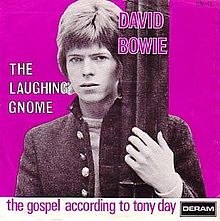
changed his name to David Bowie in late 1966 to differentiate himself. Not that the change in moniker did him any good; he released a solo single in April 1967 (the weird and wonderful/embarrassing (depending on who you ask) children's song "The Laughing Gnome") and his debut album, David Bowie, that June (the same day Sgt. Pepper's Lonely Hearts Club Band was released), both on Deram Records.
The problem with David Bowie especially, in my opinion, is that it's all over the map - on it, Bowie does folk tunes, Anthony Newley-type show tunes, baroque pop, etc.; none of them written especially well. Buyers just didn't know what to make of him; was he 'for real', or just a novelty artist? The result was that they stayed away in droves - neither the single nor the album charted. This would be the last music Bowie released for more than two years (Deram dropped him a couple of months later).
In the interim, Bowie began an intensive course of study in dance and the dramatic arts under renowned choreographer Lindsey Kemp. He immersed himself in lessons in mime, Medieval Italian comedy and avant-garde performance, and began his first serious exploration into creating a distinct persona/personae for himself. David also started performing again, in a folk/Merseybeat combo with mime interludes and poetry readings mixed in, with his new girlfriend Hermione Farthingale (God, how 'English' a name can you get?) and friend John Hutchinson. And through his connection with Kemp, he got a couple of small uncredited parts in British movie and TV productions. Here he is (blink and you'll miss him) as an extra in the 1969 movie The Virgin Soldiers:
Around the same period, Bowie got a new manager, Kenneth Pitt, who believed in David's talent but was annoyed and frustrated by his lack of wider recognition. Pitt wracked his brains to figure out some way to bring Bowie's gifts to the masses. A chance encounter with a West German television producer in late 1968 provided him with what he thought was an answer: Pitt would put together a short promotional film showcasing Bowie's talents. The professionally-produced short would include not only music from David's 1967 album, but also dramatic and mime bits. The German producer broadly hinted that, once completed, he would air the film on Zweites Deutsches Fernsehen (ZDF), the country's public broadcasting station, the equivalent to the American Public Broadcasting Service (PBS). Pitt figured that that sort of exposure might break Bowie out in Europe, with that fame subsequently translating back to Britain. He suggested his plan to Bowie, who also thought it was a boffo idea.
In choosing which songs to feature and dramatize in the film, Pitt and Bowie selected four from David Bowie, along with two new songs David had recently written with Farthingale and Hutchinson, "Ching-A-Ling" and "When I'm Five". Added to these selections was "Let Me Sleep Beside You", a single recorded and rejected by Deram shortly after the 1967 album was released and shortly before the label released him (Bowie wrote this song with a new friend of his, a young American expat record producer named Tony Visconti). Pitt enlisted a Scottish friend who had spent considerable time in the U.S., Malcolm Thomson, as the director, and arranged for a week's shooting at a studio in Greenwich in late January 1969; the schedule was delayed due to Bowie's participation in The Virgin Soldiers, shooting earlier that month.
David arrived at the Greenwich studios that January 26th ready to go in every aspect but one; his hair was unfashionably short, cut to regulation Army length for the war film. Pitt and Thomson were aghast, but quickly improvised by finding a suitable long-haired wig for Bowie to wear throughout the shoot. Bowie also arrived with another piece to include in the production; an unfinished outer space-themed song that he and John Hutchinson had been working on during the prior week called "Space Oddity".
The filming ran into difficulties from nearly the very beginning. Pitt and Thomson began to clash over content, quality and subject matter. I think that Pitt was looking for more of a quickie showreel done relatively cheaply, where Bowie's songs were the standout/featured attraction. Thomson, on the other hand, wanted to add more costumes, camera movement, and artistic nuances into the production. A major point of contention between the two centered on plans for "Space Oddity"; in particular, Thomson wanted to make the part where Major Tom cavorts with the "space maidens" considerably more
sexy and risque than what may have been permitted for German television. Also, a considerable amount of time and effort was expended on Bowie's mime segment, titled "The Mask". As a result of all of this, studio time had to be extended, and the overall cost of the film began to mount.
Finally, after nearly two weeks of filming, the film (entitled Love You Till Tuesday) wrapped on February 7th. Here's a list of the performance pieces on it:
"Love You Till Tuesday"
"Sell Me a Coat"
"When I'm Five"
"Rubber Band"
"The Mask (A Mime)"
"Let Me Sleep Beside You"
"Ching-a-Ling"
"Space Oddity"
"When I Live My Dream"
Pitt immediately contacted his West German friend, to let him know the short was ready for airing . . . but found that the producer had moved on from ZDF, and no one else there was interested in showing a music film by some unknown English artist. Bowie's manager found he had spent all of his money for seemingly nought. Desperate now, Pitt began shopping the showreel around to various British networks and record labels, but no one was interested in anything about it . . .
Well, that is, ALMOST no one.
Ken Pitt was given an audience with representatives from Mercury Records' British subsidiary Philips in the early spring of 1969. The reps found little of interest in the film . . . except for "Space Oddity". From that modicum of interest, Pitt was then able to negotiate a one album deal (with an option for another one or two albums) for Bowie with the label. David was rushed into the studio; "Space Oddity" was recorded that June 20th, and released as a single on July 11th, 1969, just in time to take advantage of the Apollo 11 mission (the first lunar landing) nine days later. The single proved to be a hit in Britain, where after a slow start it peaked at #5 (it did nothing in America on its initial release, stalling at #124 - but on its re-release in 1973 in the wake of Ziggy Stardust, it reached #15, his first U.S. hit single).
This song, and the subsequent album David Bowie (aka Man Of Words/Man Of Music in the States) released in November 1969, launched David's career.
As for the film: apart from its use to secure the Mercury/Philips deal, Pitt found no immediate further use for it and filed it away, where it sat unseen for years. But in the early '80s, with the advent of home video, Bowie's former producer (the two split in 1971) realized he may have something golden on his hands. He contacted Polygram (by
then the holding company for Philips) and made a deal for its release; Love You Till Tuesday went on sale in VHS format in May 1984. Not to be outdone, Deram Records, the label holding most of the material used in the movie, released a "soundtrack album" (actually, just the versions of film songs recorded for David Bowie, along with non-film singles from the same period) that same month. Here's the song lineup:
1. Space Oddity
2. Love You Till Tuesday
3. When I'm Five
4. Ching-A-Ling
5. The Laughing Gnome
6. Rubber Band
7. Sell Me A Coat
8. Liza Jane
9. When I Live My Dream
10. Let Me Sleep Beside You
11. The London Boys
Looking at the film nowadays, it's hard to properly consider it for its standalone artistic and musical merits in the context of its time. It's very much a time capsule of late '60s "Swinging London" styles and attitudes, and as such, in this day and age it's an effort to take it all seriously. For example, it is difficult to watch Bowie, the dapper young puka-beaded gentleman, lounge suggestively on pillows while warbling the title track and resist the urge to shout "Yeah, baby!" in a cheesy Austin Powers accent:
(Did you hear him briefly snicker halfway through the video? David knew full well what the story was, and what he was doing . . .)
All in all, there's nothing in Love You Till Tuesday, either the album or the film, that's particularly deathless or essential in Bowie's career. Other than "Space Oddity", which was considerably revamped for its summer 1969 release, most of the other tunes here are either lightweight or forgettable. But both works of art stand as interesting artifacts in the early design and development of David's sound and vision of himself to come. The seeds of Major Tom, Ziggy Stardust, Pierrot from Scary Monsters, and the otherworldly/alien Bowie can be found in his performances here.
And what's also great to see and hear here is Bowie as a young man - full of energy, life and happiness, presenting his compositions and ideas to the world with a knowing smile on his face and absolutely no fear whatsoever. No matter what other changes he brought to his act and career, that part of him always stayed consistent and true. Thank God for that.
So, for your consideration, here's:
The albumLove You Till Tuesday, released by Deram Records on vinyl and cassette in May 1984 (not released on CD until 1991);
The filmLove You Till Tuesday, produced in 1969 but released by Polygram in May 1984. The complete 30-minute film is exceedingly difficult to find on the Web; so here it is, in .mp4 format.
I promise that this will be my last Bowie post for the foreseeable future. So enjoy, and as always, let me know what you think.
Please use the email link below to contact me, and I will reply with the download link(s) ASAP:
Saying "Thanks" for the music you receive from here costs you absolutely nothing, and yet is worth quite a bit to me… If you can't bother leaving a comment on this blog for the first album/set we send you, don't bother making a request For a second album…