Showing posts with label Soundtrack. Show all posts

Tuesday, December 24, 2024

Various Artists - Mr. Magoo's Christmas Carol (Unofficial Soundtrack)

[I've been writing this doggone post off and on for over two years now... could never seem to find a time to finish it before the holiday, so I kept holding it over. Finally time to put this one to bed!]

It’s that time of year again - time to me to settle in on cold winter evenings and enjoy one of the many, many holiday movies, cartoons, specials and extravaganzas dedicated to and associated with the Christmas season... with a few exceptions, as noted below.

My Christmas go-to shows have always included the old Rankin-Bass stop-motion animation specials that I first saw as a kid and still enjoy to this day - not only the early ones like Rudolph The Red-Nosed Reindeer (a timeless classic) and Frosty The Snowman, but later productions like Santa Claus Is Comin' To Town and The Year Without A Santa Claus (which presented the immortal Heat Miser and Cold Miser) (I'm not a big fan of their '60s special The Little Drummer Boy, however - probably because the title character in the story is such a mopey, whiny little bitch...). And of course, A Charlie Brown Christmas rates high on the holiday "must-see" list.

In regards to longer-form holiday narratives (i.e., Christmas movies), I personally have never had much use for or interest in the plethora of holiday movies that the Hallmark Channel inundates the airwaves with every year - in my mind, they all seem to have the same basic plot: cold, spiritless, workaholic guy/girl gets into a situation that removes him/her from the hectic, unfeeling city/palace/posh life to a more warm and rustic location, where gradually he/she finds love, happiness, and the true spirit and magic of Christmas dwelling in the hearts and lives of the people he/she is thrust upon and made to interact with. It's the same old formula, time and time again (summed up in this this hilarious (but spot-on) article from a few years ago, "Every 2020 Hallmark Christmas Movie Has One of Twelve Plots"). That hasn't stopped Hallmark from cranking these cliched flicks out over and over - I read somewhere recently that the channel was releasing FORTY-TWO "new" ones this year along alone, on top of the thirty-one premieres last year, and the scores of others released in the years prior to that.

Lord have mercy. Enough already!

The period films I like during this time of year are things like the original Miracle on 34th Street from 1947 (were you aware that this movie not only was nominated for Best Picture at that year's Academy Awards, but Edmund Gwenn, who played Santa Claus, won Best Supporting Actor?) and the immortal It's A Wonderful Life. And I've recently gotten into another classic Hollywood musical, White Christmas with Bing Crosby and Danny Kaye; it's fairly enjoyable, although I still cringe inwardly during the scenes when the duo fondly reminisce in song about the "good ol' minstrel show days"...

But for me, the holiday story that stands the test of time over and over again is Charles Dickens' archetypal yuletide yarn A Christmas Carol. There have been seemingly dozens of versions of this tale committed to film, starring the likes of Reginald Owen, Alastair Sim, Albert Finney, George C. Scott, etc., etc. All of these takes have their proponents, and rightfully so; Dickens' story is so well-written, that it's almost impossible to make a bad movie of it. But if you were to watch just one Christmas Carol this year, which would it be?

In my mind, a good case could be made for — believe it or not — Mr. Magoo’s Christmas Carol, starring the voice of Jim Backus as the comically myopic Quincy Magoo. Not merely a superior musical version, it is a pioneer among animated Christmas traditions. Before Charlie Brown, before the Grinch, and even before Rudolph, Magoo was the go-to Christmas special everyone watched. In fact, it is considered the FIRST animated holiday television special.

But before we go into the show itself, let's start with a not-so-brief history of the production arm that ended up producing this classic.

United Productions of America (UPA) origins began at the Walt Disney studio in the late 1930s and early 1940s. During that time, as Disney expanded into feature films beginning with Snow White, he rapidly expanded his staff with young art school graduates who were generally more progressive and artistically aware than the older, more established, but generally less academically trained bullpen of Disney animators. This led to a schism between the "anti-art", "we owe Walt for where we are" old-timers and the change-oriented, Depression-era molded newcomers who had fewer stars in their eyes about Walt's influence and importance.

This schism came to a head during the infamous Disney animators' strike in the spring of 1941, a result of Disney's resistance to the progressive employees' attempt to form a union. Walt responded to the strike by firing many of his animators (although he eventually was pressured into reinstating some of them and recognizing the new union, the Screen Cartoonists Guild). Many of these fired employees found new positions with other studios (for instance, Frank Tashlin was given creative control of the Screen Gems studio and hired practically his entire staff off of the Disney picket line) or struck out on their own, doing freelance work (safety filmstrips and the like) for industrial corporations.

Shortly after their voluntary exodus from the studio, two former Disneyites, Zach Schwartz (then at Screen Gems) and David Hilberman (with Graphic Films), began renting a small space in a Los Angeles warehouse where they could paint in their spare time. Another former Disney colleague of theirs, Stephen Bosustow, was working in design at Hughes Aircraft. Bosustow convinced his superiors at Hughes to commission a filmstrip on safety, and he brought the idea to Graphic Films - but Graphic turned the job down. Hilberman then talked his way into doing the job with his partner Schwartz, and the resulting product was well-received by the corporation. The three men then formed a loose partnership, calling themselves Industrial Film & Poster Service, and began seeking other production work.

Around that time, the United Auto Workers (UAW) began considering sponsoring a pro-Roosevelt campaign film in the run-up to the 1944 general election. The union got in touch with the Screen Cartoonists Guild, and members of that organization put together a storyboard and began shopping it around to various studio animation production houses. But due to its political content, no major studio would touch it. As a last resort, the unions approached Schwartz, Bosustow and Hilberman's tiny shop to see if they could handle the job. They were awarded the contract for the film, called Hell Bent For Election, in January 1944, with the caveat that it be completed by that August, just six months away.

Overnight, their little warehouse hideaway became a beehive of activity, as all of the trio's friends and professional colleagues heard about what they were doing and ran to help - some working their regular jobs in animation during the day, then spending all night moonlighting on this exciting project. Most of them worked for free, including director Chuck Jones, musician Earl Robinson and lyricist "Yip" Harburg (of The Wizard Of Oz fame). The resulting film was stylish, modern, and a bold move away from "Disney-style" animation. It was also a great success with the UAW. Here it is:

After Hell Bent For Election, the little studio began receiving steady commissions for work on industrial and government films and slides, and started building a full-time staff of animators (including names revered in cartoon history to this day, including John Hubley, Bobe Cannon and Bill Hurtz). It was also around this time that it was decided that the name of the company should change from Industrial Film & Poster Service to United Productions of America, or UPA for short. The new concern was established as a three-way partnership, with Schwartz, Hilberman and Bosustow all owning equal shares. However, by 1946, the partners had a falling out, resulting in Schwartz and Hilberman selling out their interests in the company, making Bosustow initially the sole, then later (as he parceled out shares to key staff) majority shareholder in UPA.

It was also in the late 1940s that UPA took over Columbia Pictures animation duties out from under Screen Gems; Columbia had been dissatisfied for years with the Screen Gems product and was looking to make a change, provided that UPA continue using the studio's signature characters, the Fox and Crow. The new cartoon studio produced two releases with the characters: 1948's Robin Hoodlum and 1949's The Magic Fluke. Both were well received by Columbia, and both were nominated for Oscars for Best Short Subject (Cartoons) in subsequent years. But UPA wanted to get away from "funny animal" cartoons and begin creating its own characters. In the spring of 1949, they proposed a story that Columbia reluctantly accepted, only because the short had an animal in it, as well as a human character. The cartoon was titled Ragtime Bear, released in September 1949, and the star of the film was the curmudgeonly, near-sighted Mr. Magoo, featuring the voice of character actor Jim Backus:

Mr. Magoo was UPA's first successful series (six more Magoos were rapidly produced in the following year), but the film that made the studio a household word and put them in the forefront of the "animation as art" movement was Gerald McBoing Boing, released in January 1951.

With Gerald McBoing Boing, UPA made a clean break from Disney-style animation, and reviewers and the public noticed and approved. From a Time magazine piece in February 1951:

"Everything about the film is simple but highly stylized: bold line drawings, understated motion, striking color and airy design in the spirit of modern poster art, caricatured movements and backgrounds as well as figures... In his own way, [little Gerald's] 'Boing!' may prove as resounding as the first peep out of Mickey Mouse."

Gerald won similar raves from newspapers, highbrow critics and film trade reporters. And that spring, the cartoon won the Academy Award for Best Animated Short Subject, UPA's first Oscar.

The praise and popular success the studio received for Gerald McBoing Boing and the early Magoo cartoons carried through for several years, and kept UPA a dynamic and financially-viable concern. Columbia increased their budget per short by more than 25 percent, to almost $35,000 each, an amount that UPA sorely needed; the firm was run by artists committed to putting a quality product up on screen. Few UPA staff members were budget-oriented; they were film-oriented. As such, the extra money was used to refine and enhance what seemed to outsiders to be "simple" drawings and "limited" animation, but didn't lead to any increased profitability in the company.

However, this approach led to some remarkable releases in the mid-1950s, including a delicate adaptation of Ludwig Bemelmans' popular children's story Madeline (1952); the amazing Rooty Toot Toot (also in 1952; still one of the best-known and remembered UPA cartoons); a faithful reproduction of James Thurber's distinctive drawing style for 1953's A Unicorn In The Garden; and a striking and disturbing version of Edgar Allan Poe's The Tell-Tale Heart, also in 1953 (I remember seeing this one in junior high school English class, and it made a deep impression on me at the time). The Magoo series, however, was the studio's bread and butter, and UPA continued to churn out shorts featuring the character (while also toning down/softening much of his cantankerous ways), in the last half of that decade producing six to eight Magoo shorts a year. Despite the increase in volume, these cartoons did not lack for quality; in fact, two Magoo shorts - When Magoo Flew in 1954 and Magoo's Puddle Jumper in 1956 - both won Academy Awards in their respective years.

UPA established a satellite studio in New York in the early 1950s to handle exclusively commercial and nontheatrical work, and initially it was very successful, as businesses were eager to work with an Academy Award-winning company. The commercial studio's biggest triumph was the Bert & Harry Piel beer commercial campaign, featuring the voices of radio greats Bob & Ray. The New York office was so successful, in fact, that much of its profits were siphoned off to keep the theatrical division of UPA afloat (seems that that $35,000 budget increase from Columbia still wasn't covering costs).

However, by the late 1950s, the wheels were starting to come off of at UPA. In 1956, CBS Television commissioned The Gerald McBoing Boing Show, the very first Saturday morning program made especially for network TV. By agreeing to it, the studio committed to producing much more animation than had ever been put out at any one time, and required an immediate hiring frenzy. The resulting show, a mixture of old UPA cartoons and new bits, came off as disjointed, 'soft' and generally unfunny, but it managed to air for two years before CBS pulled the plug. It was also around this period that the New York office, inundated by competition for commercial work, closed its doors, shortly after an ambitious but poorly-conceived London branch was established and also failed within a year.

1958 was also the year work began on a Magoo feature film. There had been talk regarding an animated feature ever since the early award-winning years at the studio, but Columbia would not commit to financing any of UPA's ideas, which included adaptations of Gilbert & Sullivan's HMS Pinafore, Ben Jonson's Volpone, and/or Cervantes' Don Quixote (all of which, frankly, were probably too highbrow for Columbia executives to understand or grasp). Finally that year, Columbia provided the funds to animate a version of The Arabian Nights. Production of 1001 Arabian Nights did not go smoothly - the director quarreled with Bosustow and quit, resulting in a frantic search for a viable replacement (the job went to Disney veteran Jack Kinney). And there were issues with the story - Mr. Magoo's character was sort of shoehorned into the tale of Aladdin, and he comes off as inconsequential and tangential. The film was released in late 1959 to lackluster reviews and tepid box office, and failed to recoup back Columbia's investment.

By the time of the feature film's release, many of the main/founding staff of UPA had by then left the company to create their own studios, including Format Films (future producers of The Alvin Show) and Jay Ward Productions (producers of the hilarious Rocky & Bullwinkle cartoons for television). Bosustow saw the handwriting on the wall, and in 1960 he sold his controlling interest in UPA and rights to all characters to producer Henry G. Saperstein.

Saperstein was a longtime cinema owner/operator who had branched out into tie-in/licensed of merchandising of Western TV characters like Wyatt Earp and Roy Rogers, and entertainment personalities such as Rosemary Clooney, The Three Stooges and Elvis Presley. As such, he showed little concern or regard for the artistic pretensions and commitment to perfection of the old UPA; he was just interested in utilizing the remaining staff to churn out as much product as possible, milking the studio's established characters and his animators' talents for all they were worth. Saperstein quickly entered the TV market, producing a Mr. Magoo series for NBC in late 1960 and a syndicated Dick Tracy series in early 1961. The studio cranked out more than 125 episodes of each program over the next two years, destroying the last vestiges of UPA's once renowned reputation for quality - these shows made the contemporary Hanna-Barbera product look lavish by comparison.

But Saperstein and UPA still made one last stab at repairing/retaining their artistic mojo with critics and the public. The studio prepared two major releases for late 1962.  The first, Gay Purr-ee, a tale of a feline's adventures in Paris in the late 19th century and featuring the voices of Judy Garland and Robert Goulet, was released to theaters on December 17th of that year. The very next day, the second production, Mr. Magoo's Christmas Carol, made its television debut on NBC. While Gay Purr-ee was critically savaged for both its animation style and story (one magazine's review felt that the film's subject matter was too sophisticated for an animated film, drily noting that its target audience seemed to be "the fey four-year-old of recherché taste") and an outright box-office failure, Mr. Magoo's Christmas Carol was immediately hailed as a classic, a reputation which has lived on to this day.

The following is excepted from a 2012 New York Times article celebrating the fiftieth anniversary of the venerable program:

At the time [of its debut] “Magoo” was a big enough event to warrant extensive and positive media coverage. As soon as it was over Walt Disney telephoned Mr. Orgel [the show's producer] to tell him, “Not only is this generation going to watch it, but your children, your children’s children and your children’s children’s children will watch this show.”...

“It has the quality of a cozy quilt,” said Adam Abraham, author of When Magoo Flew: The Rise and Fall of Animation Studio UPA (Wesleyan University Press). “It’s like figurines of your imagination playing out a very familiar story against a dreamlike Victorian design.”

“Magoo” is hardly definitive Dickens. Much of the original tale, especially the entire subplot of Scrooge’s relationship with his nephew, Fred, was cut to fit the 60-minute running time. For no apparent reason the Ghost of Christmas Present precedes the Ghost of Christmas Past.

“Magoo” also offers a curious framing device whereby the whole story is treated as a Broadway production, with Magoo as an actor portraying Scrooge. The producer, Lee Orgel, feared that audiences wouldn’t accept Magoo being plucked out of his cartoon context and plopped into the 19th century without explanation. In retrospect this concern seems absurd. But the result is still good enough to have lasted 50 years.

Alas, the success of the Magoo special wasn't enough to save UPA. Saperstein gradually wound down animation production during the 1960s, finally shuttering the cartoon studio in 1970, and he also sold off the studio library of films (which shrewdly retaining the rights to Magoo, Gerald McBoing-Boing and other characters). The studio then entered into a partnership with Toho Co., Ltd. of Japan, and for the following decade helped distribute the firm's "Giant Monster" movies in the States. After Saperstein died in 1998, his family sold off what remained of UPA two years later. Thus closed the saga of a once-innovative and ground-breaking studio.

Throughout the 1960s, Mr. Magoo's Christmas Carol was a network staple, appearing on NBC every year until 1969. The show then entered syndication, and for the next couple of decades you had to be lucky enough to catch it on one of your local stations... That's how I came upon the program - I was browsing the stations as a kid one December, stumbled across it, and was immediately charmed, so much so that for every year afterward, I made an effort to track down when and where the cartoon would be played. The show moved to cable TV in the '90s. However, to mark the program's golden anniversary, NBC presented it in 2012, its first prime-time network appearance in decades.

A lot of the greatness inherent in Mr. Magoo's Christmas Carol lies in the excellent songs created for the show by the celebrated Broadway composers and lyricists Jule Styne and Bob Merrill, who between them provided the music for the stage hits Carnival!, Gypsy, Gentlemen Prefer Blondes, and Funny Girl, and penned such classics as "Let It Snow! Let It Snow! Let It Snow!", "Everything's Coming Up Roses", "(How Much Is) That Doggie In The Window?" and "If I Knew You Were Comin' I'd've Baked A Cake". Again, from the NYT 2012 article:

The magic of “Magoo” begins with rich songs by Jule Styne and Bob Merrill. “Ringle Ringle,” a celebration of money, and “The Lord’s Bright Blessing,” about the true meaning of Christmas, might easily have worked for a live-action staging.

“Styne and Merrill really understood the characters and brought them to the surface,” said Darrell Van Citters, author of “Mister Magoo’s Christmas Carol: The Making of the First Animated Christmas Special” (Oxberry Press).

One song in particular underscores this mature sensibility: “Winter Was Warm,” the lament of Scrooge’s former love, Belle, over how he lost her to his pursuit of wealth. Mr. Van Citters calls this number “the story’s emotional core.”

The showstopping number “We’re Despicable,” a grotesque march of the human maggots who plunder the dead Scrooge’s estate, features goofy lyrics like “We’re reprehensible/We’ll steal your pen/And pencible.”

(For years, it was rumored that the song "People" from the musical Funny Girl, a huge hit for production star Barbra Streisand in 1964, was originally written by Styne and Merrill for inclusion in Mr. Magoo's Christmas Carol. But both composers denied this in their memoirs.)

The music in Magoo... is SO superb, in fact, that it's somewhat surprising that no official soundtrack was ever released by any label. These songs by the two honored composers were slated to be lost Christmas classics, appearing only during rare broadcasts of the program. But in 2010, intrepid individuals released bootleg copies of tunes from the show. It wasn't done in a technically sophisticated manner; they basically just copied the overall narrative/soundtrack into audio and separated/sequenced the tracks. Still, it's nice to have this music available.

So here for your holiday listening pleasure is Mr. Magoo's Christmas Carol, the unofficial soundtrack of the now sixty-two year old(!) program. Enjoy some woofle-berry cake and razzleberry dressing this holiday with your family and friends! And, as always, let me know what you think.

God bless you, every one! Expect more to come here in 2025.

Please use the email link below to contact me, and I will reply with the download link(s) ASAP:

Send Email

Tuesday, December 10, 2024

Various Artists - The Year Without A Santa Claus (Unofficial Soundtrack)


Can you BELIEVE this TV Christmas special is FIFTY YEARS OLD today?  Out of all the holiday specials released by producers Arthur Rankin, Jr. and Jules Bass from the early '60s to the late '80, this show is, in my opinion, part of the great triumvirate of classic Rankin/Bass productions, along with 1964's Rudolph The Red-Nosed Reindeer and 1969's Frosty The Snowman.  When I was young, I always looked forward to seeing this one the most (to be honest, I always found Frosty to be a little annoying, as the main character seemed borderline mentally impaired - and having Jimmy Durante as the narrator seemed sort of an odd choice to me...  Rudolph is redeemed by the presence of the great Yukon Cornelius and the Burl Ives snowman character).

This program is chock-full of beloved scenes and songs... probably none more memorable than the outstanding Snow Miser introduction and song, performed by the great Dick Shawn::

 
(that little cymbal 'stinger' that plays as Snow Miser sits in his chair has ALWAYS had a special place in my heart!)

Not to be outdone by his brother Heat Miser's entrance:  


I was going to put together a longer, more detailed writeup regarding this show's golden anniversary... (un)fortunately, People Magazine already beat me to it - I can add nothing further to this story, located here.

Unlike a couple of other Rankin/Bass Christmas specials (including Frosty, Santa Claus Is Comin' To Town, and 'Twas The Night Before Christmas), no official soundtrack for this program was ever produced.  However, over the years, a number of bootleg versions of the tunes from this show, culled from the audio track, have been released.  Here's the lineup of songs provided here:

1. Leroy Anderson - Sleigh Ride (Instrumental)
2. The Wee Winter Singers - The Year Without A Santa Claus
3. Shirley Booth - I Could Be Santa Claus
4. Ron Marshall & Mickey Rooney - I Believe In Santa Claus
5. Ron Marshall (ft. The Wee Winter Singers) - It’s Gonna Snow Right Here In Dixie
6. Dick Shawn - The Snow Miser Song
7. George S. Irving - The Heat Miser Song
8. Christine Winter - Blue Christmas
9. The Wee Winter Singers - Here Comes Santa Claus
10. Mickey Rooney – There'll Be No Year Without A Santa Claus
11. The Wee Winter Singers - The Year Without A Santa Claus

So here for your listening pleasure is the unofficial soundtrack to The Year Without A Santa Claus, originally released in 1974.  Enjoy, and as always, let me know what you think.

Please use the email link below to contact me, and I will reply with the download link(s) ASAP:

Send Email

Wednesday, December 20, 2023

Vince Guaraldi - A Charlie Brown Christmas (Super Deluxe Edition)


A Charlie Brown Christmas - what else need be said about this beloved perennial holiday favorite?  I mentioned in an earlier post what an unexpected smash hit the initial airing of this program was in 1965, and how the soundtrack is not only one of the top ten best-selling Christmas albums of all time, but also the second-best selling jazz album of all time (behind Miles Davis' Kind Of Blue) (It was also voted into the Grammy Hall of Fame in 2007, and in 2012 added to the National Recording Registry of the Library of Congress for being "culturally, historically, or aesthetically significant").  Any other superlatives I can present here will do little to convey the near-universal adoration of this program and its music, with many of its original Vince Guaraldi compositions (including "Christmas Time Is Here"and "Skating") becoming popular holiday standards.

The soundtrack album was originally released on Fantasy Records in December 1965.  In 2022, Craft Recordings, which now owns the legacy Fantasy label, issued a four-disc deluxe edition of this album, featuring a new stereo mix (remastered from the original 3-track and 2-track sources), the original 1965 stereo mix, and up to 50 previously unreleased outtakes from five separate recording sessions conducted by Guaraldi and his group at various locations in California in the fall of 1965. Here's the song lineup by disc:

 Disc 1 - New and Original Stereo Mix

1     O Tannenbaum (2022 Stereo Mix)
2     What Child Is This (2022 Stereo Mix)
3     My Little Drum (2022 Stereo Mix)
4     Linus and Lucy (2022 Stereo Mix)
5     Christmas Time Is Here (Instrumental / 2022 Stereo Mix)
6     Christmas Time Is Here (Vocal / 2022 Stereo Mix)
7     Skating (2022 Stereo Mix)
8     Hark, the Herald Angels Sing (2022 Stereo Mix)
9     Christmas Is Coming (2022 Stereo Mix)
10     Fur Elise (2022 Stereo Mix)
11     The Christmas Song (2022 Stereo Mix)
12     A Charlie Brown Christmas (Original Stereo Mix)
13     O Tannenbaum (Original Stereo Mix)
14     What Child Is This (Original Stereo Mix)
15     My Little Drum (Original Stereo Mix)
16     Linus and Lucy (Original Stereo Mix)
17     Christmas Time Is Here (Instrumental / Original Stereo Mix)
18     Christmas Time Is Here (Vocal / Original Stereo Mix)
19     Skating (Original Stereo Mix)
20     Hark, the Herald Angels Sing (Original Stereo Mix)
21     Christmas Is Coming (Original Stereo Mix)
22     Fur Elise (Original Stereo Mix)
23     The Christmas Song (Original Stereo Mix)
 Disc 2 - The Recording Sessions (September 17, 1965)
1     Christmas Is Coming (#1, Take 1)
2     Christmas Is Coming (#1, Take 2)
3     Christmas Is Coming (#1, Take 3)
4     Christmas Is Coming (#1, Takes 4-5)
5     Christmas Is Coming (#1, Take 6)
6     Christmas Is Coming (#1, Take 7)
7     Christmas Time Is Here (Instrumental) (#2, Takes 1-2)
8     Christmas Time Is Here (Instrumental) (#2, Take 3)
9     Skating (Unnumbered)
10     Skating (#3, Takes 1-2)
11     Skating (#3, Take 3)
12     Skating (#3, Takes 4-6)
13     Skating (#3, Take 7)
14     Linus and Lucy (#4, Take 1)
15     Christmas Is Coming (#5, Take 1)
16     Christmas Is Coming (#5, Take 2)
17     Christmas Is Coming (#5, Take 3)
18     Christmas Is Coming (#5, Take 4)
19     Christmas Time Is Here (Instrumental) (#6, Take 1)
20     Christmas Time Is Here (Instrumental) (#6, Take 2)
 Disc 3 - The Recording Sessions (September 21-22, 1965_Unknown Session Date)
1     Christmas Is Coming (#1, Take 1)
2     Christmas Is Coming (#1, Take 2)
3     Christmas Is Coming (#1, Take 3)
4     Christmas Is Coming (#1, Takes 4-6)
5     Christmas Is Coming (#1, Take 7)
6     O Tannenbaum (#2, Take 1)
7     O Tannenbaum (#2, Take 2)
8     O Tannenbaum (#2, Takes 3-4)
9     O Tannenbaum (#2, Take 5)
10     Jingle Bells (#3, Takes 1-4)
11     Goin' Out of My Head (Unnumbered)
12     Christmas Time Is Here (Instrumental) (#6, Take 3)
13     Skating (#7, Take 1)
14     Skating (#7, Take 2)
15     FÜR Elise (Takes 1-2)
16     Christmas Time Is Here (Vocal) (#1, Take 1)
17     Christmas Time Is Here (Vocal) (#1, Takes 2-3)
18     Christmas Time Is Here (Vocal) (#1, Take 4)
19     Christmas Time Is Here (Vocal) (#1, Take 5)
20     Christmas Time Is Here (Vocal) (Rehearsal)
21     Christmas Time Is Here (Vocal) (#1, Take 6)
22     Christmas Time Is Here (Vocal) (#1, Take 7)
 Disc 4 - The Recording Sessions (October 28, 1965)
1     Greensleeves (Take 1)
2     Greensleeves (Takes 2-4)
3     Greensleeves (Take 5)
4     Greensleeves (Take 6)
5     Greensleeves (Take 7)
6     Greensleeves (Take 8)
7     Greensleeves (Takes 9-10)
8     Greensleeves (Take 11)
9     Greensleeves (Take 12)
10     The Christmas Song (Take 1)
11     The Christmas Song (Takes 2-3)
12     The Christmas Song (Takes 4-7)
13     The Christmas Song (Take 8)
14     The Christmas Song (Take 9)
15     The Christmas Song (Take 10)
16     The Christmas Song (Take 11)

Hearing the session recordings, it's almost like you're there in the studio with Guaraldi & Co., as the musicians work through their arrangements.  For me, it's a fascinating view of the development of a classic work!

So here for your holiday pleasure is the expanded Deluxe edition of the A Charlie Brown Christmas soundtrack, originally released on Fantasy in late 1965, and rereleased on Craft Recordings on August 22nd, 2022.  Enjoy, and as always, let me know what you think.  Merry Christmas!

Please use the email link below to contact me, and I will reply with the download link(s) ASAP:

Send Email

Thursday, October 26, 2023

Vince Guaraldi - It's The Great Pumpkin, Charlie Brown: Music From The Soundtrack

In the early 1960s, Charles Schulz's comic strip Peanuts was entering into a long period of enormous international popularity, which others in the entertainment industry were eager to capitalize on.  Television producer Lee Mendelson was keen to produce a documentary featuring Schulz and the success of his strip, and by 1964 had established a good working relationship with the cartoonist which also morphed into a fast friendship.  The documentary Mendelson envisioned would be mostly live action, with only a couple of minutes of animation included.  For that, Schulz recommended an animator named Bill Melendez, who he had earlier worked with for several years on a series of commercials for Ford vehicles featuring the characters.  


But despite his efforts, and the acclaim for the strip, Mendelson couldn't interest any of the then-existing networks in funding and airing a Charlie Brown & Charles Schulz documentary of the type he had in mind.

However, Peanuts-mania continued unabated; in the spring of 1965, the Peanuts gang was featured on the cover of Time magazine.  Shortly after the release of that issue, Mendelson was contacted by representatives of McCann Erickson, a New York-based ad agency whose biggest client was the Coca-Cola Company.  He was told that Coca-Cola was looking for a Christmas holiday special to sponsor, envisioning a half-hour animated program to air on the CBS Television network, and wanted to know if he and Charles Schulz were interested.  The two completed and forwarded to Coke executives a show outline from scratch in a single day, and after belated approval from the corporation, completed the production of that first special, A Charlie Brown Christmas, in just six months.  

Many of those involved in the making of A Charlie Brown Christmas and corporate and network executives were convinced that the program would be a disaster, due to its relatively slow pacing, flat animation, odd jazz-influenced music score, no laugh track and the inclusion of the reading of a Bible verse in the middle of it.  But for the fact that the special was completed only ten days before its air date, it might not have aired at all ("I really believed, if it hadn't been scheduled for the following week, there's no way they were gonna broadcast that show," Mendelson later said).  But CBS was left with practically no alternative but to show it.

Instead of being a disaster, the first showing of A Charlie Brown Christmas, on the evening of Thursday, December 9th, 1965, was a smash hit, with almost half of the TVs on that night tuned in to the program.  The special ended up being the #2 show for the week (behind Bonanza), garnering considerable critical acclaim as well, and during the following year's awards season winning not only an Emmy but a Peabody award as well (the show is also credited with killing off the decade-long aluminum Christmas tree fad; within two years of its airing, the ornamental trees were no longer being regularly manufactured).  It also set the template for the subsequent tradition of half-hour animated television specials (Mr. Magoo's Christmas Carol and Rudolph The Red-Nosed Reindeer had begun airing in the years prior to the Schulz special, but both were full hour-long programs).

Eager to exploit what they saw as a winning formula, Coca-Cola immediately commissioned another Charlie Brown special, Charlie Brown's All Stars, to air during the summer of 1966.  That show was also a huge hit, the top-rated show for that week, with ratings and audience share rivaling that of the Christmas special.

With the added success of the second special, Mendelson, Schulz and Melendez figured they were in a pretty good place with the network.  But that impression soured with the very next meeting, held the week after All Stars aired.  From Mendelson's recollection of the conference:

Network Exec:  Congratulations.  The ratings [last week] were great - two in a row!  ...What do you have in mind for the NEXT one?

Mendelson:  Well, we really haven't discussed it...

Network Exec:  We want you to come up with a BLOCKBUSTER like Christmas... something we can run every year, sometime between October and February.  ...If we don't get a blockbuster, we may not pick up the option [for additional Peanuts shows}.  Can you do it? 

On the spot, Mendelson agreed to do it, although at that point he had no clue as to what sort of story idea and setting the production team could come up with in which to place this anticipated "blockbuster".  However, going back to Schulz and Melendez, within a week the trio had hashed out an outline focusing around the Halloween holiday, based upon a series of strips printed in October, 1959, where Linus, confusing the traditions of Halloween and Christmas, began believing in the Great Pumpkin, a magical being who was claimed to bring toys and gifts to deserving children every October 31st.  The "Great Pumpkin" stories became an annual theme in the comic strip for every October afterwards, so there was a wealth of input and gags for the team to mine.  Other now-iconic elements and scenes, such as Lucy pulling the football away from Charlie Brown, and Snoopy as a World War I flying ace, were added, along with scenes involving Schroeder and his piano so the team could once again engage the services of jazz musician Vince Guaraldi, whose score for the Christmas special was widely celebrated.

Guaraldi was enthusiastic about scoring another Peanuts-related project, his fourth after ...Christmas, ...All Stars and the unsold Schulz documentary.  In his excitement and interest regarding the many scene and mood changes in the Great Pumpkin script, he composed twenty original songs for the program in the basement of his San Francisco home, and expanded his regular recording trio to a sextet to include a flutist to accentuate the loneliness and isolation of scenes with Linus sitting in the pumpkin patch.  He also re-utilized the song "Linus and Lucy" from the Christmas show, establishing it as the signature tune for all subsequent Peanuts specials.
 

The time allotted for production of the Peanuts Halloween special was even shorter than that for A Charlie Brown Christmas - just four months this time, rather than the previous six.  But with a solid story and chops honed from the previous specials, the show was completed and ready to air far ahead of time. The initial broadcast of It's The Great Pumpkin, Charlie Brown occurred on Thursday, October 27th, 1966 on CBS.  It was an even huger hit than A Charlie Brown Christmas, scoring a 49 share in the Nielsen ratings (meaning almost half of all TVs on that night were tuned into the program) and tied for the #1 show of that week.  Although it was nominated for Emmys in the next year for "Outstanding Children's Program" and "Special Classifications of Individual Achievements", it did not win (in the former category, both Great Pumpkin and All Stars were nominees, which I think split the Peanuts votes, allowing some forgotten Jack & The Beanstalk cartoon from NBC to walk away with the award).

However, the show was immediately hailed as a classic, and celebrated for its artistic style; unlike the first special, It's The Great Pumpkin utilized much more camera movement.  And artist Dean Spille went the extra mile, and hand-painted the backgrounds of the French countryside during Snoopy's flying ace sequence, utilizing a linear perspective rather than the regular flat design of the earlier shows.  To this day, those scenes are recognized as a major achievement, and influenced several other animated specials for years to come.  The show was also the first Halloween-related special, establishing that holiday as a television genre.  And the execs got what they asked for: It's The Great Pumpkin, Charlie Brown was rebroadcast annually on network TV (on CBS until 2001, then on ABC) for the next fifty-three years, until Apple TV+ purchased the rights in 2020.

I adore both A Charlie Brown Christmas and It's The Great Pumpkin, Charlie Brown - but if I had to chose between the two, I'd go for the latter, every time.  The Great Pumpkin just hits me different...  And I'm not alone; the program is regarded to this day as the best of all the Peanuts specials.  When I was a kid, I couldn't WAIT until the night this program aired!  It was the perfect way to get into the anticipatory mood for upcoming trick-or-treating and other Halloween shenanigans.  It's sort of sad now that kids today don't really have the chance to see it as their parents and grandparents viewed the show, as a widely anticipated annual network event and tradition - somehow, watching it on Apple TV+ just doesn't feel the same to me.  Despite the program's now-wide availability and easy access, to this day I REFUSE to watch it at any time other than the Halloween season.

Although the soundtrack to A Charlie Brown Christmas was released immediately after the show's first airing (on Fantasy Records in December 1965 - it is still the second-best selling jazz record (behind Miles Davis's Kind Of Blue) and top-ten best selling Christmas album of all time), it took decades for the Great Pumpkin soundtrack to see the light of day.  Concord Music announced that it would be releasing the long-awaited soundtrack in 2018, but discovered that the original studio master recordings were missing.  So instead, the label released music culled directly from the special's audio track, removing any dialogue and most of (but not all) extraneous sound effects, a move that Concord Music was heavily criticized for.

After Lee Mendelson's death in 2019, his children combed through his basement archives, searching for any Peanuts-related music he might have retained.  In mid-2021 they finally found some of the original monaural analog session reels recorded for the show in 1966.  The tapes included nearly all of the music cues recorded by Guaraldi, along with several alternate takes.  Concord utilized these masters to rerecord and reissue the soundtrack album the following year, although some songs remained missing, forcing the label to one again use some selections from the audio track, albeit 'cleaner' versions.

So here for your perusal is the reissued It's The Great Pumpkin, Charlie Brown: Music From The Soundtrack, recorded by the Vince Guaraldi Sextet in Hollywood on October 4th, 1966, and released by Concord subsidiary Craft Recordings on August 26th, 2022.  I hope that this selection gets you and your family into the Halloween mood!  Have a happy October 31st... and as always, let me know what you think.

Please use the email link below to contact me, and I will reply with the download link(s) ASAP:

Send Email

Wednesday, June 15, 2022

Various Artists - Until The End Of The World (Original Motion Picture Soundtrack)


I was saddened to learn of the death in Pittsfield, Massachusetts last week of singer and actress Julee Cruise. About four years ago, she announced that she was suffering from systemic lupus, a painful autoimmune condition that left her depressed and unable to move and walk. Reports state that she took her own life at her home, with The B-52's song "Roam" playing as she died (Cruise was a touring member of The B-52's in the early 1990s, replacing Cindy Wilson who took a few years off to raise her children; I remember seeing her on stage at a band show I attended in Washington, DC during that period).

In a post I wrote almost a dozen years ago, I detailed how I first came across Cruise's music and my impressions regarding it - the melancholy, haunting quality that both repels and attracts the listener. After the release of her debut album Floating Into The Night in 1989, Cruise issued a follow-up, The Voice Of Love, four years later. As with the first album, almost all of the songs on her sophomore release were written by director David Lynch and composer Angelo Badalamenti, so the sound and atmosphere are remarkably similar to Floating Into The Night. The Voice Of Love is more of a continuation of her debut, rather than a stand-alone entity. If you liked the first, than this one will be right up your alley as well.

Between these two albums, Cruise recorded a Lynch/Badalamenti-modified cover of an old Elvis Presley song, "Summer Kisses, Winter Tears", for the soundtrack to Wim Wenders' scifi drama Until The End Of The World, starring William Hurt. The plot of the film had something to do with in a finding and using a device that can record visual experiences and visualize dreams... but the end result was so confusing and convoluted that the few people who DID go to see the movie were left flummoxed by it. Cashing in on his success with small, cerebral films like Paris, Texas and Wings Of Desire, Wenders managed to secure a budget of $22 million for this latest film, an amount more than the cost of all of his previous films combined. And he proceeded to spend every penny of that money, spreading his production over almost half a year with setups in 11 countries.

While Graeme Revell (co-founder of the Australian industrial band SPK) was commissioned to compose the movie theme and other incidental music for the film, Wenders asked a number of his favorite recording artists (including Cruise) to contribute songs as well for inclusion. For their selections, he asked them to anticipate the kind of music they would be making a decade later, when the film was set. It was Wenders' desire to use every song he received to its fullest extent that ultimately contributed to the overall length of the film. The initial cut was reportedly TWENTY HOURS long, from which the director and producer whittled down to a more standard running time versions of 2 1/2 and 3 hours (which Wenders called the "Reader's Digest" versions). There is also reportedly a five-hour "director's" cut of this film which has been screened at various festivals over the years.

...Not that any of that mattered. The truncated versions of Until The End Of The World were released to theaters, first in Germany in September 1991, and later in the U.S. that December, and overall the flick was a commercial failure, managing to gross only about $830,000 against its $22 million budget.  Critics at the time savaged it; Roger Ebert gave the film 2 stars out of 4, describing it as lacking the "narrative urgency" required to sustain interest in the story, and wrote that it "plays like a film that was photographed before it was written, and edited before it was completed". He went on to say that a documentary about the globe-trekking production would likely have been more interesting than the film itself.  Other reviewers were even less kind.

But while the film flopped, the soundtrack was, frankly, amazing, featuring great songs by some of the top alternative performers of the day.  Wenders chose well.  Here's the soundtrack lineup:

  1. "Opening Title" – Graeme Revell
  2. "Sax and Violins" – Talking Heads
  3. "Summer Kisses, Winter Tears" – Julee Cruise
  4. "Move with Me (Dub)" – Neneh Cherry
  5. "The Adversary" – Crime & the City Solution
  6. "What's Good" – Lou Reed
  7. "Last Night Sleep" – Can
  8. "Fretless" – R.E.M.
  9. "Days" – Elvis Costello
  10. "Claire's Theme" – Graeme Revell
  11. "(I'll Love You) Till the End of the World" – Nick Cave & The Bad Seeds
  12. "It Takes Time" – Patti Smith (with Fred Smith)
  13. "Death's Door" – Depeche Mode
  14. "Love Theme" – Graeme Revell
  15. "Calling All Angels" (Remix Version) – Jane Siberry with k.d. lang
  16. "Humans from Earth" – T Bone Burnett
  17. "Sleeping in the Devil's Bed" – Daniel Lanois
  18. "Until the End of the World" – U2
  19. "Finale" – Graeme Revell

Personal favorites on this disc, in additon to the Julee Cruise song, include R.E.M.'s "Fretless", Depeche Mode's "Death's Door" and the Jane Siberry/k.d.lang collaboration "Calling All Angels".  At the time, most of these songs were unavailable anywhere else, making the compilation a gold mine of rarities. All in all, the soundtrack did better than the movie, eventually reaching #114 on the U.S. Billboard Top 200 Albums chart in 1992.

So, in honor of the life and art of Julee Cruise, I proudly offer to you all Until The End Of The World (Original Motion Picture Soundtrack), released on Warner Brothers Records on December 10th, 1991.  Enjoy, and as always... well, you know.

Please use the email link below to contact me, and I will reply with the download link(s) ASAP:

Send Email

Monday, January 3, 2022

2021 In Memorium - #3: Leslie Bricusse (Born 1931)

I'm sure that for many of you visiting this blog, the name of Leslie Bricusse, who died this past October 19th at the ripe old age of 90, won't ring any particular bells. But for a time in the '60s and '70s, the man was a giant in music, particularly in musical theater. His work provided the world with several beloved and memorable tunes which are now regarded as popular standards.

Born in London in 1931 to a wholly nontheatrical family (his father was a newspaper circulation manager), Bricusse gained entrance to the prestigious University of Cambridge, majoring in languages. While there, he quickly found a place in the college's famous amateur theatrical troupe, Footlights, an organization he eventually became president of during his senior year (later, beginning in the 1960s, Footlights alumnae came to dominate British comedy, producing such celebrated performers as David Frost, Douglas Adams (The Hitchhiker's Guide To The Galaxy), National Lampoon's Tony Hendra, Stephen Fry, Hugh Laurie, and several members of the Monty Python troupe).  

As president of the Footlights, he co-wrote and appeared in the 1954 revue Out of the Blue, the first Cambridge revue to reach the West End (London's equivalent to New York's Broadway theater scene). The success of this show caught the attention of longtime West End music hall star Beatrice Lillie, who took Bricusse under her wing as her leading man in her own popular revue, An Evening With Beatrice Lillie. Lillie's show played in both London and New York, and through it Bricusse was established as a "name" in international musical theater. He remained with Lillie's show through the end of the 1950s.

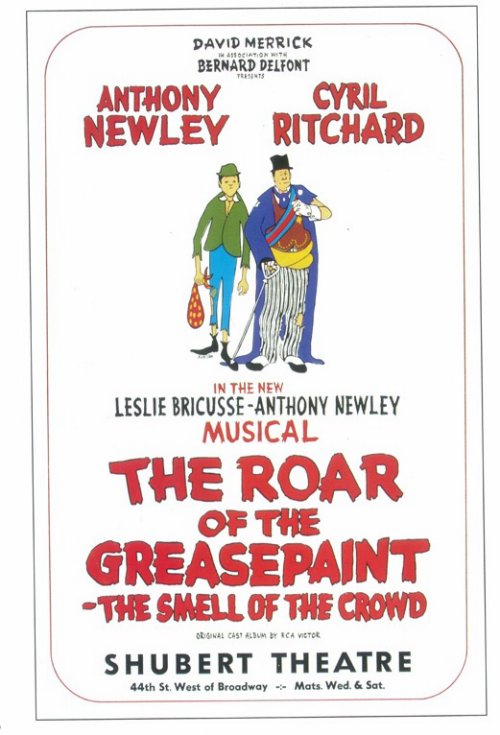
Late in that decade, while on a cruise in the Indian Ocean, Bricusse caught the show of the ocean liner's featured performer, British radio star, screen actor and occasional pop singer Anthony Newley. The two became acquainted while at sea, and began making plans to work together on a musical production. The pair's first collaboration, 1961's Stop The World - I Want To Get Off, was a smash hit in both the West End and on Broadway. The show included Bricusse and Newley's show-stopping song "What Kind Of Fool Am I?", which eventually won a Grammy Award as Song Of The Year and is currently a popular standard. The pair followed this show with another Broadway musical success, 1965's The Roar Of The Greasepaint - The Smell Of The Crowd, a show that was nominated for several Tony Awards that year.

Fresh from their Broadway triumphs, Bricusse and Newley moved into the world of movie music, with their first effort turning out to be a classic; in 1964, they wrote the words to composer John Barry's theme for a James Bond movie coming out later that year - Goldfinger. This tune - sung the HELL out of by Shirley Bassey - is still considered the all-time greatest Bond movie song:

Bricusse scored the title theme to another James Bond movie, You Only Live Twice, in 1967. The song is regarded as another Bond classic and was a huge hit for Nancy Sinatra that year.  From that year onward, Bricusse concentrated his work in film scores and movie musicals rather than with stage productions.  This included 1967's Doctor Doolittle (a notorious box-office bomb for its time, that still produced a hit song, the Oscar-winning "Talk To The Animals") and 1970's Scrooge (featuring another popular hit, "Thank You Very Much").


But in 1971, again collaborating with Newley, the pair produced the work they are most known and revered for. They were commissioned to write all of the songs for a musical fantasy film being directed by Mel Stuart and starring Gene Wilder - Willy Wonka & The Chocolate Factory. This movie is chock-full of Bricusse/Newley classics, including "The Candy Man", a revised version becoming a big hit for Sammy Davis Jr. the following year (in fact, his only #1 song):

But probably the most beloved song from the Willy Wonka soundtrack is the one sung by the title character, the great "Pure Imagination".

In the past fifty years, this song has been covered and remixed hundreds of times by a wide variety of artists, including Lou Rawls, Mariah Carey, The Muppets, Barbra Streisand and Primus.

Willy Wonka the movie was not a huge success when first released, barely making back its production costs, and the original owners and producers (Paramount Pictures and Quaker Oats) sold off the rights to the property to Warner Bros. for a pittance a few years later. The film really didn't become widely seen or popular until the advent of home video in the mid-1980s, gradually growing its status from a cult film into a widely-loved classic. Eventually, Willy Wonka & The Chocolate Factory was selected for preservation in the United States National Film Registry by the Library of Congress in 2014 as being "culturally, historically, or aesthetically significant".

However, the flick's soundtrack was almost immediately recognized and celebrated as something special.  Bricusse and Newley's work received Willy Wonka's only Academy Award nomination that year, for Best Original Score (it lost to Fiddler On The Roof).  The soundtrack album was first released on Paramount Records in 1971; here's the complete track listing, for your edification:

  1. "Main Title (Golden Ticket/Pure Imagination)"
  2. "The Candy Man"
  3. "Charlie's Paper Run"
  4. "Cheer Up, Charlie"
  5. "Lucky Charlie"
  6. "(I've Got A) Golden Ticket"
  7. "Pure Imagination"
  8. "Oompa Loompa"
  9. "The Wondrous Boat Ride"
  10. "Everlasting Gobstoppers/Oompa Loompa"
  11. "The Bubble Machine"
  12. "I Want It Now/Oompa Loompa"
  13. "Wonkamobile, Wonkavision/Oompa Loompa
  14. "Wonkavator/End Title (Pure Imagination)"

In 1996, Hip-O Records (in conjunction with MCA Records, which by then owned the Paramount catalog), released the soundtrack on CD as a "25th Anniversary Edition".  And in 2016, Universal Music Group and Geffen Records released a 45th Anniversary Edition LP.  In all, these multiple releases seemed like overkill/a money grab by the respective labels, since every version had the exact same songs listed above on it.

Leslie Bricusse continued to write music and lyrics for several movie and stage productions throughout the remainder of his life... but Willy Wonka will probably always be the one he'll be most remember for. In honor of his long and productive life, here's Willy Wonka & The Chocolate Factory (Music From The Original Soundtrack), put out by the labels noted above in their respective years.  Enjoy, and as always, let me know what you think.

Please use the email link below to contact me, and I will reply with the download link(s) ASAP:

Send Email

Friday, August 28, 2020

Various Artists - Ren & Stimpy Production Music, Vol. 1-3

I watched the new documentary Happy Happy Joy Joy: The Ren & Stimpy Story earlier this week, an amazing, thrilling, hilarious and ultimately deeply disturbing chronicle of the rise and fall of the groundbreaking and beloved 1990s Nickelodeon cartoon and its creator, John Kricfalusi. Here's the trailer for it:

If you're an old fan of the show, I heartily recommend you see this film. I won't give anything away here, other than to say that it will jolt you to your core... but hopefully not enough to displace your fond memories of this program.

I distinctly recall the first time I ever saw Ren & Stimpy. I moved to the Washington, DC area during the summer of 1991, and soon afterward acquired a new girlfriend. During the first weekend we hung out together that fall, she insisted that we get up to watch this manic new cartoon airing on Nicktoons... it was the "Space Madness"/"The Boy Who Cried Rat!" episode, and by the end of it, I knew that I had just seen one of the greatest cartoons of the age.  From then on, I watched the program religiously every weekend, absorbing multiple viewings of the same shows (Ren & Stimpy's production company, Spümcø, was notorious for missing delivery deadlines, leaving Nickelodeon no choice but to air the same episodes over and over again as a stopgap), and loving every single one of them.

As I mentioned in a previous blog posting, one of my all-time favorite Ren & Stimpy episodes is "Rubber Nipple Salesmen", containing what has to be the most disturbing, off-putting - and yet, hilarious - scene EVER included in what was ostensibly a children's cartoon:

By the start of the second season, it was all over. Nickelodeon fired Kricfalusi in September 1992 (for several valid reasons, in my opinion - see the documentary film for details), and Spümcø completed the slate of remaining shows written or directed by Kricfalusi before production of the show was moved by the network to Games Animation. Ren & Stimpy aired for another three seasons, into 1995, but without John K.'s imagination and energy behind it, the later-period episodes were little more than pale echoes of the show in its heyday.

A lot of what made this show great was in its liberal use of vintage "incidental music" from the 1950s and 1960s, that gives every cartoon a certain "throwback" tone to some of the classic animation and studios from that era. Way back in 2006, a great site called Secret Fun Blog and its compiler Kirk D. went the extra mile, and began offering compilations of music from Ren & Stimpy.  To quote from his superb post:

Put simply, these melodies have enriched my life. Play them on your drive to work and you're the star of an instructional traffic safety film, turn it on during dinner and mealtime becomes 80% happier (but be careful.. play the wrong track and you could wind up with a touch of Space Madness). Best of all you can listen and imagine that you live in the world of Ren and Stimpy where the walrus-napping horse is your next door neighbor, where the toy stores are stocked with Log from Blammo, and a visit from Powdered Toast Man is just a complaint away!

The links to Volumes 1 and 2 of this great collection have long been dead on his blog... but fortunately, I took the opportunity at the time to acquire this outstanding music. There was also a THIRD volume of tunes from this show released during that time... this comp was a little harder to track down, and even harder to sort out, since most of the tracks came without track numbers or composer attribution. But I took care of that, to the best of my ability, utilizing various authoritative sources. So what you have here for Vol. 3 is about as complete as you're going to find out there.

Comedy Central announced earlier this month that it had greenlighted a reboot of Ren & Stimpy, featuring all new episodes, for the upcoming season, to air alongside rebooted versions of old 90s cult hit shows like Daria and Beavis & Butthead. My personal feeling on this is that they should just leave it well enough alone.  These shows - especially Ren & Stimpy - were of a certain time and place in the past, and fondly remembered by those of us lucky enough to see them when they first emerged. Ren & Stimpy (at least the first two seasons) was lightning in a bottle, and attempting to recapture that is a foolish and futile exercise - especially so when John Kricfalusi, the creator and lead animator of the original series, is slated to have no involvement whatsoever in the reboot.  Just let it go, Comedy Central - stop trying to "reanimate" the corpse, as it were.

Enough of that.  Here for your listening pleasure are all three fan-assembled volumes of music from this seminal cartoon, released between 2006 and 2008.  I hope that this post brings you plenty of "Happy Happy, Joy Joy!"

(And as always, let me know what you think.)

Please use the email link below to contact me, and I will reply with the download link(s) ASAP:

Various Artists - Ren & Stimpy Production Music Vol. 1 (2006): Send Email
Various Artists - Ren & Stimpy Production Music Vol. 2 (2007): Send Email
Various Artists - Ren & Stimpy Production Music Vol. 3 (2008): Send Email