Random mumblings and mundom ramblings on music (mostly), and whatever else pops into my mind . . .
[The files attached here are for review only, and should be deleted after two weeks. If you like the bands, go buy the albums . . . like I did!] . . .
And yes - EVERYTHING posted here is still available!
I'm sure that for many of you visiting this blog, the name of Leslie Bricusse, who died this past October 19th at the ripe old age of 90, won't ring any particular bells. But for a time in the '60s and '70s, the man was a giant in music, particularly in musical theater. His work provided the world with several beloved and memorable tunes which are now regarded as popular standards.
Born in London in 1931 to a wholly nontheatrical family (his father was a newspaper circulation manager), Bricusse gained entrance to the prestigious University of Cambridge, majoring in languages. While there, he quickly found a place in the college's famous amateur theatrical troupe, Footlights, an organization he eventually became president of during his senior year (later, beginning in the 1960s, Footlights alumnae came to dominate British comedy, producing such celebrated performers as David Frost, Douglas Adams (The Hitchhiker's Guide To The Galaxy), National Lampoon's Tony Hendra, Stephen Fry, Hugh Laurie, and several members of the Monty Python troupe).
As president of the Footlights, he co-wrote and appeared in the 1954 revue Out of the Blue, the first Cambridge revue to reach the West End (London's equivalent to New York's Broadway theater scene). The success of this show caught the attention of longtime West End music hall star Beatrice Lillie, who took Bricusse under her wing as her leading man in her own popular revue, An Evening With Beatrice Lillie. Lillie's show played in both London and New York, and through it Bricusse was established as a "name" in international musical theater. He remained with Lillie's show through the end of the 1950s.
Late in that decade, while on a cruise in the Indian Ocean, Bricusse caught the show of the ocean liner's featured performer, British radio star, screen actor and occasional pop singer Anthony Newley. The two became acquainted while at sea, and began making plans to work together on a musical production. The pair's first collaboration, 1961's Stop The World - I Want To Get Off, was a smash hit in both the West End and on Broadway. The show included Bricusse and Newley's show-stopping song "What Kind Of Fool Am I?", which eventually won a Grammy Award as Song Of The Year and is currently a popular standard. The pair followed this show with another Broadway musical success, 1965's The Roar Of The Greasepaint - The Smell Of The Crowd, a show that was nominated for several Tony Awards that year.
Fresh from their Broadway triumphs, Bricusse and Newley moved into the world of movie music, with their first effort turning out to be a classic; in 1964, they wrote the words to composer John Barry's theme for a James Bond movie coming out later that year - Goldfinger. This tune - sung the HELL out of by Shirley Bassey - is still considered the all-time greatest Bond movie song:
Bricusse scored the title theme to another James Bond movie, You Only Live Twice, in 1967. The song is regarded as another Bond classic and was a huge hit for Nancy Sinatra that year. From that year onward, Bricusse concentrated his work in film scores and movie musicals rather than with stage productions. This included 1967's Doctor Doolittle (a notorious box-office bomb for its time, that still produced a hit song, the Oscar-winning "Talk To The Animals") and 1970's Scrooge (featuring another popular hit, "Thank You Very Much").
But in 1971, again collaborating with Newley, the pair produced the work they are most known and revered for. They were commissioned to write all of the songs for a musical fantasy film being directed by Mel Stuart and starring Gene Wilder - Willy Wonka & The Chocolate Factory. This movie is chock-full of Bricusse/Newley classics, including "The Candy Man", a revised version becoming a big hit for Sammy Davis Jr. the following year (in fact, his only #1 song):
But probably the most beloved song from the Willy Wonka soundtrack is the one sung by the title character, the great "Pure Imagination".
In the past fifty years, this song has been covered and remixed hundreds of times by a wide variety of artists, including Lou Rawls, Mariah Carey, The Muppets, Barbra Streisand and Primus.
Willy Wonka the movie was not a huge success when first released, barely making back its production costs, and the original owners and producers (Paramount Pictures and Quaker Oats) sold off the rights to the property to Warner Bros. for a pittance a few years later. The film really didn't become widely seen or popular until the advent of home video in the mid-1980s, gradually growing its status from a cult film into a widely-loved classic. Eventually, Willy Wonka & The Chocolate Factory was selected for preservation in the United States National Film Registry by the Library of Congress in 2014 as being "culturally, historically, or aesthetically significant".
However, the flick's soundtrack was almost immediately recognized and celebrated as something special. Bricusse and Newley's work received Willy Wonka's only Academy Award nomination that year, for Best Original Score (it lost to Fiddler On The Roof). The soundtrack album was first released on Paramount Records in 1971; here's the complete track listing, for your edification:
"Main Title (Golden Ticket/Pure Imagination)"
"The Candy Man"
"Charlie's Paper Run"
"Cheer Up, Charlie"
"Lucky Charlie"
"(I've Got A) Golden Ticket"
"Pure Imagination"
"Oompa Loompa"
"The Wondrous Boat Ride"
"Everlasting Gobstoppers/Oompa Loompa"
"The Bubble Machine"
"I Want It Now/Oompa Loompa"
"Wonkamobile, Wonkavision/Oompa Loompa
"Wonkavator/End Title (Pure Imagination)"
In 1996, Hip-O Records (in conjunction with MCA Records, which by then owned the Paramount catalog), released the soundtrack on CD as a "25th Anniversary Edition".And in 2016, Universal Music Group and Geffen Records released a 45th Anniversary Edition LP. In all, these multiple releases seemed like overkill/a money grab by the respective labels, since every version had the exact same songs listed above on it.
Leslie Bricusse continued to write music and lyrics for several movie and stage productions throughout the remainder of his life... but Willy Wonka will probably always be the one he'll be most remember for. In honor of his long and productive life, here's Willy Wonka & The Chocolate Factory (Music From The Original Soundtrack), put out by the labels noted above in their respective years. Enjoy, and as always, let me know what you think.
Please use the email link below to contact me, and I will reply with the download link(s) ASAP:
We lost a song-writing, folk-singing giant today, folks... Although it's been touch-and-go with him for a while now, I was hoping this nasty virus would somehow spare him... but I was wrong. If you've never taken the opportunity to listen to John Prine, there's no better place to start than with his superb first self-titled album, recorded mostly at the legendary American Sound Studio in Memphis and released by Atlantic Records on June 1st, 1971.
Not much else to say here, so I'll keep this short. R.I.P., Mr. Prine, and thanks for the music.
I hope you DO get to see your daddy and mama, and smoke that 9-mile-long cigarette when you get to heaven:
Please use the email link below to contact me, and I will reply with the download link(s) ASAP:
I've mentioned before how much of a comedy buff my oldest daughter has become. Through my collection of audio and video, she has been fully conversant with the entire Monty Python ouevre before she was out of elementary school; has watched all of the episodes of Police Squad!, Fawlty Towers and The Young Ones multiple times, and is a huge fan of Mystery Science Theatre 3000 reruns. Just a couple of months ago, I took her to see Dave Chappelle's live show here in town. Believe me, I put a lot of thought into whether or not, as a high-school teen, she was old enough to handle Chappelle's language and style of humor (and don't ask me how I managed to sneak all of this past her mother . . .). But my girl has a pretty good head on her shoulders, so in the end I brought her along, we both had a great time - my daughter thought he was hysterical.
For Father's Day earlier this year, my little girl got me an inspired gift, Scott Saul's Becoming Richard Pryor, detailing the early life and rise of the great groundbreaking comedian and performer. I've been enjoying this book very much, and through it learned quite a bit about the life and career of this man.
To say that Richard Pryor's early life was rough would be a gross understatement. He was born in 1940 in Peoria, IL, a city located midway between Chicago and St. Louis. Despite its northern location, Peoria in the 1940s and '50s was still a heavily segregated town, not de jure but de facto. But that didn't prevent it from being considered at the time one of the most corrupt, sordid, "wide open" cities in America. For decades, gambling (the largest gambling hall in the city was directly across from the police department), drinking (the largest distillery in the world was located there; before income tax was implemented, when the U.S. derived most of its revenue through import fees and commodity taxes, Peoria alone, through the whiskey tax, was responsible for nearly half the federal government's income), and prostitution flourished here, not only in the exclusively white, upper-class bluffs overlooking the city, but especially in the lower-class, industrial valley section hard by the Illinois River, where most of the minorities were congregated.
Richard's grandmother was a celebrated madam in the city's North Washington red-light district, operating a string of brothels in the area. Richard's mother was a brothel worker (i.e., prostitute); his father, the brutal Leroy "Buck" Pryor, was one of the head pimps working for his mother. His parents divorced at the age of five and Buck was awarded custody of his son, so Richard grew up primarily in and around the whorehouses, privy to all that went on in these establishments from an early age, and subject to the heavy and routine physical abuse inflicted on him by both his father and grandmother. In school, he was usually one of the few black kids in his class, and his days will filled with ostracism, taunts and bullying from most of his classmates. This was the atmosphere Pryor grew up in; it must have been miserable.
His only escape was through the movies - in the "Negroes Only" balcony seats of Peoria's downtown theaters, he could lose himself for an hour or two in adventure films and westerns (his favorite was the whip-wielding cowboy star Lash LaRue). Practically the only other bright spot in Pryor's life during his Peoria years occurred when he was fourteen years old, where he participated in a youth theater group at a local community center. The group's adult director, Juliette Whittaker, took Richard under her wing, gave him crash courses in acting, set and costume design, and directing, and provided him some of his first opportunities to shine in front of an audience. If any single person set Richard on the path to fame and stardom, it was Ms. Whittaker.
After being kicked out of school in ninth grade, Richard worked odd jobs in and around the Peoria area until joining the Army in the spring of 1959. His stint in the military lasted a year and a half; stationed in Germany, he was constantly in trouble, serving several periods of restriction and extra duty, culminating in a long stay in the stockade after stabbing a fellow soldier. It was by supreme good fortune that Pryor received an honorable discharge from the Army in August 1960. He returned home to Peoria and recommenced the same cycle as before his departure - working odd, low-paying jobs and hanging out on the streets and interacting with winos, drifters and other neighborhood characters. He soon landed a job as a bartender and occasional comedian at a local black club of questionable legality and ill repute, and worked there until it was closed by the city in the fall of 1962. He then headed to New York to try his luck there as a professional comic.
The first couple of years of Pryor's professional standup career were relatively undistinguished. Bill Cosby's comedic career had taken off and catapulted him to nationwide fame just as Richard was starting out, and for a long while, Pryor labored under Cosby's long shadow. His material was straight out of the Cosby playbook - on the whole middlebrow, mild, and generally observational. Combined with Richard's near-mimicry of Cosby's act and subject matter was a tendency to punctuate his punch lines with a goofy face or expression - Pryor appropriated that rubber-faced schtick from the man he called "The God of Comedy", Jerry Lewis. But above all, Pryor's act strove to be free of any controversial class or racial connotations that could upset Middle American audiences. In fact, Pryor was very careful to obscure or whitewash any and all aspects of his rough past and upbringing.
For example, here's Richard Pryor's television debut in August 1964, on Rudy Vallee's variety show On Broadway Tonight. Vallee introduced him as "a former Army paratrooper" whose father Leroy, "an old vaudeville song and dance man", bequeathed his talent on his son. In Pryor's act, the lies and bullshit kept coming:
Looking back at it now, Richard Pryor's act in the mid-60s was startlingly conventional, and rigidly within the bounds of decency. There was nothing particularly exceptional or ground-breaking in his comedy. But that seemed to suit the tenor of the times. As Scott Saul wrote:
Soon Richard would be recognized as a "lean, literate, quick-witted kook", the man with "the most elastic face in show business." His main persona was the bungler or schlemiel . . . He was Bill Cosby's younger, skinnier brother, the one who blew his cool as much as Cosby kept his.
After his appearance on On Broadway Tonight, Richard began appearing on television more frequently, especially on the Ed Sullivan and Merv Griffin programs where he was a favorite guest. His broadcast work in New York earned Pryor a ticket to Hollywood in 1966, where he was featured as a recurring special guest on a new program, The Kraft Summer Music Hall, a relentlessly hokey TV variety show hosted by the squarest of squares, singer John Davidson. Appearances on other shows - The Wild Wild West, The Mod Squad, The Partridge Family - were soon to follow, and Pryor became a Hollywood insider, making friends of industry power brokers and stars like Aaron Spelling, David Wolper, Ryan O'Neal and Bobby Darin.
But despite this plethora of high-profile, highly paid TV work, it all kept Richard's comedy under the same strictures - somewhat corny, mild, inoffensive, acceptable to most of America . . . and by that, I mean white America; his act had yet to resonate with black Americans. For most of that community, Pryor's comedy didn't connect; for them, he was little more than a slightly hipper version of Nipsey Russell. Richard once related a story of how one day in 1966, after a Merv Griffin taping, he and his new friend Redd Foxx went on a visit to Harlem. Foxx, of course, was by then a giant in black comedy, a Chitlin Circuit veteran known for his raunchy underground show recordings - the "King of the Party Records". As they walked through the neighborhood, residents greeted Foxx warmly, shouting his street nickname, "Zorro". Pryor was all but ignored.
"Wait a minute," he thought to himself. "I'm in the wrong place, I'm in the wrong town. I want to be here. I want people to talk to me like they talk to Redd."
His klutzy, zany, goofball TV persona was in marked contrast to his continuing stand-up work at counter-cultural comedy clubs like the Troubadour, the Improv and the Cafe Au Go-Go, where his language and subject matter were considerably less PC. But at that point in time, there was no acceptable outlet for Pryor to bring this side of his humor to the public at large. He was making it, but yet not "making" it, if you understand my meaning.
By 1967, Pryor seriously began to chafe against these strictures, with the result being that he started to lose it, both personally and professionally. The early part of that year was fraught with turmoil, including a breakup from his longtime girlfriend, jail time for drug possession and court hearings after his arrest for assaulting a hotel clerk. His oft-mythologized "breakdown" on stage at the Aladdin in Las Vegas occurred later that year, but the legend behind this incident - in mid-set at the venue, suddenly asking himself and the audience out loud "What the fuck am I doing here?" and walking offstage, thus beginning his long blackballing by the entertainment industry - belies the actual facts. Pryor continued to be welcome in Vegas and on TV for the remainder of the year and into 1968. But he, and his act, were changing.
His first album, titled simply Richard Pryor, taken from recordings from his shows at the Hollywood Troubadour in July 1968, was released on Dove/Reprise later that year. There are some semi-risque bits on it, like "Super Nigger" and "Farting", and a mild obscenity or two. But for the most part, the album is made up of Richard's "kook" persona delivering somewhat lame, polished, showbiz-zy routines (like "Prison Play" and "TV Panel Show") that would have wowed a semi-"with it" Las Vegas lounge audience. The only real evidence of the change in Pryor's attitude here was on its cover, with Richard simultaneously embracing and denigrating an African stereotype - an interpretation that, in that day, could go either way.
In the months to come, things continued to fall apart in Pryor's life. Both of his parents died, and he began seriously abusing drugs, leading to a series of missed performances, breakups with managers and lovers, and estrangement from the industry (including cancellation of his two-album deal). By the end of the decade, Pryor was pretty much off the nightclub/talk show circuit; there were only four clubs TOTAL "in the world" whose doors were open to him: The Cellar Door in DC, Maverick's Flat in L.A., Basin Street West in San Francisco and Mandrake's in Berkeley, CA. Richard had burnt his bridges nearly everywhere else. Even his old friend and patron Redd Foxx refused to book him at his club, considering him unreliable. Richard tried to concentrate on his TV and movie acting career during this period. But even that had stalled. By mid-1970, Pryor was in bad shape and in serious trouble - no manager, little income, and debts to some fairly heavy and sinister drug dealers had begun to mount.
At this low point, Richard turned for help to Louis and David
Druzen, the owners of Laff Records, a small and rather disreputable label specializing in releasing infamous black raunch/"party" records from the likes of LaWanda Page, Skillet & Leroy, Mantan Moreland - and yes, Redd Foxx. Laff signed Pryor in late 1970 for only a $5,000 advance - a far cry from the $50,000
he received just two years earlier for his two-album deal with Reprise Records. What Laff got in return was plenty - a commitment for four albums over the next two years (with $27,500 payable upon receipt of the last one), plus exclusive recording/release rights to Richard's comedy for the next two years and the right afterwards to exercise an additional
two-year option that would have committed Pryor to releasing three more albums with the label. That's a potential total of seven albums over four years - a daunting nut to make. But at the time, Richard was desperate - the drug dealers were after him big time. As he told the Druzens as he signed with them and received his money, "If I didn't get this, I'm going to die."
The first album he delivered was Craps (After Hours). Showing some leniency to his friend and protege, Foxx allowed him to record the album at the Redd Foxx Club in Los Angeles. What made it on to the recording was almost a complete departure from the work Richard was known for before.
Craps differed in many ways from Pryor's first Reprise album. Most obvious was the number of tracks - thirty-two (as opposed to just seven on Richard Pryor), with some tracks lasting no longer than a few seconds. There was no clear underlying theme in the comedy here; Pryor covered sex ("Gettin' Some", "Big Tits"), drugs ("Gettin' High"), politics ("President Nixon"), race relations and all sorts of controversial, risque topics in dark, absurd terms. He also got very personal - for the first time, Pryor openly discussed, in detail, the turmoil, craziness and violence in his family life. Also for the first time here, he brought the images (winos, junkies and preachers) and vocal rhythms of lower-class black life into his act. On Craps, Richard moves from thought to thought, theme to theme, in rapid-fire sequence, so the album at first listen seems scattershot and not totally coherent from start to finish. But despite (or due to) its low concept approach, it feels more intimate, more "real", than Pryor's first album. It's also funny as hell.
Due to the limited retail reach of Laff, Craps (After Hours) wasn't a Billboard 200 hit (it was fortunate to have been released on the cusp of major social changes in America; the album probably would have been banned if it had been put out just a couple of years earlier). But it soon became an underground/cult classic - future comedians like Eddie Murphy and Chappelle have spoken about hearing this album at a young age and how much it influenced their ambition and later work. This was the first record that allowed Pryor to be Pryor, to break free of showbiz bounds and express himself the way that he wished to be heard.
All in all, Craps was a revelation, and the date of its release can be considered the starting point of the true comedic genius of Richard Pryor. Richard's later comedic development and ascent to superstardom began with the launch of this disc. Its release date can also be thought of as a Year Zero for stand-up comedy in this country. The influence of the openness of subject matter and language in Richard Pryor's work, and on this album in particular, can be seen and heard in the later work of Murphy, Damon Wayans, Sarah Silverman and Margaret Cho, among many, many others. Comics from across the spectrum and every generation fully acknowledge the impact of Pryor to U.S. humor; Jerry Seinfeld called him "the Picasso of our profession"; Bob Newhart named him as "the single most seminal comedic influence in the past fifty years." Comedian Paul Rodriguez said it best: "There are two periods in comedy in America: before Richard Pryor and after Richard Pryor." Craps was the transition point.
So here, on the tenth anniversary of the death of the man universally acknowledged as the greatest stand-up comedian of all time, I proudly present to you Richard Pryor's Craps (After Hours), released by Laff Records in late 1971 and rereleased on CD on November 15th, 1994. This is hard as hell to find for download online, so here it is, burnt off of my personal copy. Laugh, enjoy, and remember this great talent.
And as always . . . well, you know.
Please use the email link below to contact me, and I will reply with the download link(s) ASAP:
Saying "Thanks" for the music you receive from here costs you absolutely nothing, and yet is worth quite a bit to me… If you can't bother leaving a comment on this blog for the first album/set we send you, don't bother making a request For a second album…

 sea, and began making plans to work together on a musical production. The pair's first collaboration, 1961's Stop The World - I Want To Get Off, was a smash hit in both the West End and on Broadway. The show included Bricusse and Newley's show-stopping song "What Kind Of Fool Am I?", which eventually won a Grammy Award as Song Of The Year and is currently a popular standard.
 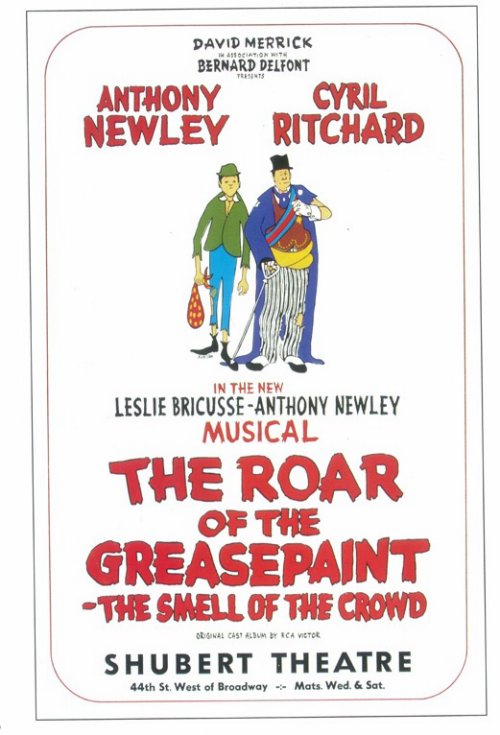 The pair followed this show with another Broadway musical success, 1965's The Roar Of The Greasepaint - The Smell Of The Crowd, a show that was nominated for several Tony Awards that year.


