Showing posts with label 1984. Show all posts

Tuesday, April 4, 2023

T.R.A.C. (Top Risk Action Company) - Nice Up The Nation: The First Demos


Of Schulz... and Strummer... and second acts.

(Just read this over; this is a pretty meandering post... but it gets to the main point soon enough.  Just bear with me...)

I read a lot - that's my thing.  I rarely if ever watch TV; I'd much rather spend the evening with a book in my lap and a drink at my elbow, especially on these warm and fleeting summer nights up here when I can do so on my front porch.  

My tastes are pretty eclectic; in the past couple of months, I've gone through Patti Smith's Just Kids, F. Scott Fitzgerald's first three novels (This Side Of Paradise, The Beautiful and Damned (the ending of which I HATED) and The Great Gatsby (for the first time in more than twenty years)), David McCullough's final book (before his death last year) The Pioneers (which frankly in my opinion wasn't as compelling as any of his previous histories - no offense, but I think he should have hung it up after his second-to-last one, the brilliant The Wright Brothers), Barbara Tuchman's Stilwell and the American Experience In China (superb, although sometimes hard to keep track of all the Chinese names), Nathaniel Philbrick's Battle of the Little Bighorn history The Last Stand, and all three volumes of Edmund Morris' comprehensive biography of Theodore Roosevelt's life and presidency.  While taking in these larger tomes, I usually read other shorter/less-serious books for "dessert", such as obscure Jim Thompson hardboiled crime novels I didn't get through the first time (like A Swell-Looking Babe and Pop. 1280), Wild and Crazy Guys (documenting the rise of comedy mavericks like Steve Martin and Eddie Murphy in the '80s and '90s), and a recent compilation of Shary Flenniken's raunchy and insightful Trots and Bonnie comics from the old National Lampoon magazine.

I buy new books practically every other weekend, and have what I think is a pretty decent home library.  But I rarely if ever buy books just to "buy" them - I read everything I purchase, because something looks interesting and informative to me.

With that being said, there's really only one series that I collect just to "have", due to one of my childhood obsessions - the Charlie Brown cartoon reprints.  In 2004, Fantagraphics Books published the first in a series of books containing the entire print run of Peanuts, Charles Schulz's beloved, long-running and internationally famous comic strip.  Starting with the first strip published in 1950, Fantagraphics released two volumes a year, each volume containing two years of strips.  Over the next twelve years, the publisher put out what ended up being a total of 26 volumes capturing every comic printed between 1950 and 2000, along with a final volume containing collection of Schulz strips, cartoons, stories, and illustrations that appeared outside of the daily newspaper strip.

It's my personal feeling that Peanuts, and Charles Schulz, peaked in the Seventies.  By that time, the cartoonist had been drawing the strip for over two decades, and had all but perfected the complicated interplay of relationships between the characters.  And most importantly during that period, the character Snoopy had yet to take over and dominate the strip - the dog still interacted somewhat with the other characters, and his activities complemented those of (ostensible main character) Charlie Brown and the gang.  

But by the end of that decade, Snoopy's fantasy lives (the WWI flying ace, Joe Cool, novelist, etc.) began to be the focus of the comic.  He no longer needed any of the other strip characters to "be" - he just needed his imagination.  In support of this new focus on Snoopy, Schulz began constructing a entire side life for him existing apart from that of the other Peanuts characters, beginning with the 1970 introduction of Snoopy's bird friend Woodstock... and in the years that followed with beagle members of Snoopy's immediate family, including Spike, Belle, Olaf and the like.  In my opinion, this shift of focus dragged the entire strip down and completely screwed up the overall dynamic.  I was a huge fan of Peanuts when I was a kid, but after around 1980 I ceased to pay very much attention to it.

With that said, over the years I've collected every volume of the Fantagraphics Peanuts series up through the first thirty years or so of the strip, through the early 1980s run - the initial fifteen books.  But I've never felt quite "right" about stopping there.  As you can probably determine from my music posts, I'm a completist, and I like having a full set, whether that's the total discography of a band I like or all the books in a particular collection.  So last year I began a search for the remaining volumes, and found what I thought was the next in the series for sale at a discount on eBay, The Complete Peanuts: 1981 to 1982.  When it arrived the next week, I took the new book down to the section of my library containing the other Peanuts volumes... only to find that I ALREADY had a copy of that particular one, which I must've purchased unconsciously in years prior.

I couldn't return it, and I wouldn't just throw it out, so I did the next best thing; there's a really good used bookstore across town from where I live, which has thousands of volumes in various genres on sale and also runs a decent book-buying program.  I figured I could take my unneeded tome over to the shop and get a few bucks out of it, or possibly swap it out for something on sale there that I might be more interested in.

That weekend, I went over to the bookstore and made a deal with the proprietor for a reasonable price for my book; it was in almost-new condition, so I did pretty well.  Instead of taking the money and running, I took the time to look around while I was there, to see if there was anything that semi-struck my fancy.  And I found it in the "Popular Music" section - Redemption Song: The Ballad of Joe Strummer, a 2007 biography of the Clash frontman, written by his longtime friend, music journalist Chris Salewicz.  As I've mentioned before, The Clash are one of my all-time favorite bands, so I couldn't buy this book fast enough...

...And I found it well worth the acquisition.  Salewicz's excellent book goes through Strummer's life in intricate detail.  I found the following review on the GoodReads.com site - I heartily concur with every word, and can add nothing to this succinct and superb review:

The Clash was--and still is--one of the most important groups of the late 1970s and early 1980s. Indebted to rockabilly, reggae, Memphis soul, cowboy justice, and '60s protest, the overtly political band railed against war, racism, and a dead-end economy, and in the process imparted a conscience to punk. Their eponymous first record and London Calling still rank in Rolling Stone's top-ten best albums of all time, and in 2003 they were officially inducted into the Rock and Roll Hall of Fame. Joe Strummer was the Clash's front man, a rock-and-roll hero seen by many as the personification of outlaw integrity and street cool. The political heart of the Clash, Strummer synthesized gritty toughness and poetic sensitivity in a manner that still resonates with listeners, and his untimely death in December 2002 shook the world, further solidifying his iconic status.
Music journalist Chris Salewicz was a friend to Strummer for close to three decades and has covered the Clash's career and the entire punk movement from its inception. With exclusive access to Strummer's friends, relatives, and fellow musicians, Salewicz penetrates the soul of an icon. He uses his vantage point to write the definitive biography of Strummer, charting his enormous worldwide success, his bleak years in the wilderness after the Clash's bitter breakup, and his triumphant return to stardom at the end of his life. In the process, Salewicz argues for Strummer's place in a long line of protest singers that includes Woody Guthrie, John Lennon, and Bob Marley, and examines by turns Strummer's and punk's ongoing cultural influence.

One of the main areas of Strummer's life I was eager to get to in reading this book was the circumstances behind the dissolution of The Clash in late August 1983, when Mick Jones was summarily dismissed from the group.  Over the years, there have been various conjectures, claims and counterclaims surrounding who exactly pulled the trigger on Mick and why - was it Bernie Rhodes, who reentered the band's orbit as manager in 1981, after being dismissed from that role three years earlier?  Was it a decision by Joe alone, or a joint one with fellow band member Paul Simonon?  The book is sort of wishy-washy in terms of definitively pointing the dirty stick at anyone in particular, and I won't spoil anything for those of you who haven't had the chance to read it yet... although reading between the lines, Strummer does not come off looking particularly well in this episode.

Mick reflected on the internal politics that eventually split up the group during an interview for the BBC 2 programme Def II, circa 1990:

“It all started going wrong actually when Topper left…Topper left and it was never really the same, but we could have carried on, but then I got fired (laughs)…but we’d really stopped communicating by that time. We just managed to maintain a grunting level of civility, you know, before, but it was kind of all set up as well, you know, I was set up really, and that was kind of political, behind the back.

People were moving and trying to be influential, and different people were coming between members of the group, you know, things like that. All the things that start happening, you know, when you become really successful… you become a different kind of asshole. I turned up the day I was fired and got me guitar out, you know, and I think it was Joe it was who managed to muster up the courage to say that he didn’t want to play with me anymore, and when somebody says that to you…I just packed my guitar…just whoa… hey, you know, OK bye, and that was it. I walked, and Bernie came running out after me with a cheque in his hand, you know like a gold watch or something…which added insult to injury, but I took it anyway, and about two days mourning, and I started on the next group.”

The timeline of Jone's immediate post-Clash work has always seemed a bit scrambled to me; memories of participants in that period that I've read are variously contradictory and confused in terms of time periods and activities.  So I've tried on my own to come up with a plausible sequence, based on all of the information I could gather...

I'd always been under the impression/assumption that Jones formed Big Audio Dynamite in the weeks after his departure from The Clash.  But apparently that wasn't quite true.  Jones' initial post-Clash landing spot, within days of his dismissal, was as a member of General Public, Dave Wakeling and Ranking Roger's new project formed in the wake of The English Beat's breakup earlier that year.  With Mick on board as lead guitarist, General Public became a British New Wave/ska 'supergroup' of sorts, containing former members of Dexy's Midnight Runners and The Specials along with The Beat and The Clash.  But Jones' tenure in the group was short-lived; by the late fall of 1983, less than three months after leaving The Clash and halfway through the recording sessions for General Public's debut album All The Rage (where he contributed guitar to "Hot You're Cool", "Tenderness", "Where's The Line?" and many other tracks), he had already moved on.

Jone's next group, Top Risk Action Company (T.R.A.C) came together, it seems, in early 1984.  The story, as told by saxophonist John "Boy" Lennard (ex-Theatre Of Hate - Jones was the producer on that band's only LP, 1982's Westworld), is a bit inaccurate in regards to time, in that Jones had departed The Clash six months earlier - perhaps the 'spliff' smoke mentioned below left him somewhat confused:

"T.R.A.C. came about when I was at Mick's place. He got up to phone the press to confirm he was leaving the Clash... He came back, rolled a spliff and said he wanted to start a band with Topper and I."

As mentioned above, Jones also asked former Clash bandmate Topper Headon and Basement 5 bassist Leo Williams to join the nascent band with Lennard and himself, and the quartet began rehearsing and recording demos in the early spring of 1984.  But in hindsight, I don't believe that Mick was serious about prepping an actual album for release with this group.  He appears to be just exploring and experimenting with different sounds at this time for his own benefit.  In addition, Top Risk Action Company almost immediately faced some band turmoil; Headon's on-again/off-again heroin addition made a serious resurgence during this time.  As per Lennard again:

"I think [Mick] didn’t feel confident Topper could hold it together and was feeling overwhelmed and [therefore] closed it down [by sacking Headon]."

After Headon's firing, rehearsals became more sporadic, and Lennard began drifting away to other projects.  With that, T.R.A.C., as a viable enterprise, was over and done with before the summer of 1984 was out... not that this appeared to be any great loss for Jones.  It seems clear now that Mick himself wasn't too keen on pursuing his evolving musical direction with that group of musicians, and all of the demos the band recorded were shelved.

Into what remained of T.R.A.C. (namely Jones and Williams), Don Letts and Greg Roberts were recruited in July/August of 1984... and from the ashes of that former band rose the phoenix that was Big Audio Dynamite.  BAD's first gigs were in October 1984, and their debut LP This Is Big Audio Dynamite was released in November 1985, sparking off a decade of successful and critically-acclaimed albums and gigs.

That isn't to say that what Top Risk Action Company came up with pre-BAD was a bunch of crap.  What survived of the band's demos were recently recovered, remastered, and released on a bootleg CD.  Stylistically, the songs on this disc are to me somewhere between Mick Jones' genre-hopping dance songs on Combat Rock (e.g. "The Beautiful People Are Ugly Too", "Atom Tan", "Inoculated City") and proto-Big Audio Dynamite post-punk dance/funk/reggae (indeed, the demo version of "The Bottom Line" here was reworked and released on BAD's first album). 

Here's the full tracklist:

1. The Prolific 
2. Winning (Napoleon Of Notting Hill) 
3. Gone To The Dogs 
4. Ringmaster 
5. Astro Turf 
6. Interaction 
7. Nation 
8. Apprentice 
9. Ducane Road
10. Fare Dodgers 
11. The Bottom Line 
12. Euroshima (Edit)
13. Euroshima (Unedited)
 
Lineup: 
 
Mick Jones: Vocals/Guitar 
Topper Headon: Drums 
Leo Williams: Bass 
John "Boy" Lennard: Sax

On the whole, this release may not be everyone's cup of tea.  But at the very least, we can get a glimpse as to what was going in Mick Jones' mind at the time, and get a sense of his music creation process.  

I'll leave John Lennard again with the final word regarding T.R.A.C.:

"I thought it was a creative period for him but Mick is slow to bring it up. Great memories!"

Here for your listening pleasure and to add to your musical memories is Nice Up The Nation: The First Demos, a bootleg compilation of Top Risk Action Company tunes recorded during the summer of 1984.  Enjoy, and as always, let me know what you think.

Please use the email link below to contact me, and I will reply with the download link(s) ASAP:

Send Email

Saturday, July 31, 2021

Various Artists - A Reference Of Female-Fronted Punk Rock 1977-89 (12 Discs)


[I began putting this one together back in mid-2018... but discovered some problems with the discs that took a while to sort out, and by the time I did so, I'd moved on to other write-ups. Guess I'll finish this one up now...]

I found this rarity available for download a couple of months ago [ed. note - early 2018], from an obscure music website, Kangnave (which appears to have been actively added to for a couple of years in the mid-2010s, but hasn't seen a new posting since 2015). Here's the description the blog moderator put up regarding this:

This is a pretty insane project put together by my pal Vince B. from San Francisco a few years back. As the title indicates, this is a homemade 12 x CD-R (!) compilation of punk bands fronted by female vocalists from 1977 to 1989. More like a giant mixtape than a compilation, as he only made 36 copies which he sent to friends and people who submitted material. You may notice that some of the bands didn’t have a steady female vocalist (The Lewd, etc.) but he still included songs that were sung by another member of the band. This is as international as it gets, with stuff ranging from world famous Blondie or Crass to the most obscure Eastern European cassette compilation veterans. The boxset came packaged in a handnumbered fancy translucent lunchbox enclosing all 12 CD-Rs, a stack of full-colored cards featuring comprehensive tracklist and artwork/info, as well as a manga pin-up figure! Talk about a labor of love.

Like the guy above said, this is a pretty incredible worldwide collection of decent to excellent punk vocalized by women - here's the lineup for all twelve discs:

Disc 1:

1. Blutsturz – Schweigen (Demo) (Germany, 198?)
2. Penetration – Money Talks (England, 1977)
3. Pyhäkoulu – Painajainen (Finland, 1986)
4. VulpeSS – Me Gusta Ser Una Zorra (Spain, 1983)
5. The Comes – Panic (Japan, 1984)
6. Suicide Squad – New Kids Army (Australia, 1980)
7. Rivolta Dell’Odio – Altari Del Terrore (Italy, 1984)
8. Sick Things – Anti-Social Disease (England, 1977)
9. Accident (a.k.a Accidents) – True Detective (USA, 1979)
10. Dishrags – I Don’t Love You (Canada, 1979)
11. Último Resorte – Hogar, Dulce Hogar (Demo) (Spain, 1981)
12. The Fastbacks – Someone Else’s Room (USA, 1981)
13. Anorexia – Rapist In The Park (England, 1980)
14. Phobia – Pretend You’re Not Crazy (USA, 1978)
15. Androids Of Mu – Bored Housewives (England, 1981)
16. Sort Sol (With Lydia Lunch) – Boy-Girl (Denmark/USA, 1983)
17. Tappi Tikarrass – Skrid (Iceland, 1984)
18. Flowers – After Dark (Scotland, 1979)
19. The Rentals – I Got A Crush On You (USA, 1979)
20. Pariapunk – Double Face (France, 1987)
21. Amsterdamned – Traditie Amme Balle (Netherlands, 1982)
22. Dr. Zeke – Vild I Skogen (Sweden, 1979)
23. The Lewd – Magnetic Heart (USA, 1982)
24. Au Pairs – Kerb Crawler (England, 1980)
25. Mo-Dettes – White Mice (USA/Switzerland/England, 1979)
26. Stripes – Weekend Love (Germany, 1980)
27. Violators – The Fugitive (England, 1980)

Disc 2:

1. Schund – Schund (Austria, 1982)
2. Wunderbach – Raya (France, 1982)
3. Total Muzak – Någonstans I Sta’n (Sweden, 1980)
4. Liliput – Hitch-Hike (Switzerland, 1980)
5. NJF – Sitting!! Pretty (Canada, 1984)
6. S.I.B. – Listless (Italy, 1981)
7. Manisch Depressiv – Zeitmaschine 1 (Switzerland, 1983)
8. Sheena & The Rokkets – Omae Ga Hoshii (One More Time) (Japan, 1979)
9. Rezillos – Flying Saucer Attack (Scotland, 1978)
10. Sado-Nation – Messed Up Mixed Up (USA, 1982)
11. Lucrate Milk – Fucking Pacifist (France, 1983)
12. Dan – Lust Is Greed (England, 1987)
13. Nasty Facts – Drive My Car (USA, 1981)
14. Life Cycle – Indifference (Wales, 1988)
15. Livin’ Sacrifice – Mentalsjuk (Sweden, 1981)
16. The Brat – Attitudes (USA, 1980)
17. Non Band – Ducan Dancin’ (Japan, 1982)
18. Bizkids – VIPs (Netherlands, 1980)
19. Minus Cway – Gdje Me Vjetar Odnese (Yugolsavia, 1982-88)
20. The Rats – Broken Wire Telephone (USA, 1983)
21. Anouschka & Les Privés – Contrôle (France, 1980)
22. Slits – Vindictive (England, 1977)
23. ICA – Untitled (Netherlands, 1981)
24. Trash – Peace Of What (USA, 1984)
25. Boys Boys – Monley Monkey (Japan, 1980)
26. Honey Bane – Girl On The Run (England, 1979)
27. TNT – Razzia (Switzerland, 1981)
28. Nuns – Wild (USA, 1980)
29. Electric Deads – 30 Years (Denmark, 1982)
30. Conflict – Who Will (USA, 1984)
31. Atims – Women (Netherlands, 1982)

Disc 3:

1. Hans-A-Plast – Polizeiknüppel (Germany, 1979)
2. Usch – LTO (Sweden, 1979)
3. Desechables – El Asesino (Spain, 1984)
4. Ici Paris – Le Centre Du Monde (France, 1980)
5. Action Pact – Suicide Bag (England, 1982)
6. Invaders – Backstreet Romeo (England, 1980)
7. Lepers – Flipout (USA, 1979)
8. Franti – Vento Rosso (Italy, 1983)
9. Out On Blue 6 – Examples (England, 1981)
10. Mr. Kite – Exit B9 (Japan, 1978)
11. De Zweetkutten – Atoomgeweld (Netherlands, 1981)
12. Ideal – Berlin (Germany, 1980)
13. Holly And The Italians – I Wanna Go Home (USA, 1981)
14. Modesty – Kad Srce Radi Bi Bam (Yugoslavia, 1982-88)
15. Delta 5 – Anticipation (England, 1980)
16. Beex – He Obliterates Me (USA, 1981)
17. Kaltwetterfront – Revolverheld (Germany, 1982)
18. Hydra – Ombre (Italy, 1985)
19. Vacum – Är Ungdomar Människor? (Sweden, 1980)
20. Nixe – Man Under My Bed (Netherlands, 1981)
21. Alternative – Seen Through Tear-Filled Eyes (Scotland, 1984)
22. Schematix – Nothing Special (USA, 1980)
23. Eyes – Don’t Talk To Me (USA, 1978)
24. Russians – Anything She Wants (England, 1980)
25. Kontrola W. – Manekiny (Poland, 1982/1998)

Disc 4:

1. Kizza Ping – Den Nya (Sweden, 1982)
2. Strapaze – Tage (Germany, 1983)
3. Glueams – 365 (Switzerland, 1979)
4. Kleenex Aktiv – Hilfe (Germany, 1985)
5. XL Capris – My City Of Sydney (Australia, 1980)
6. Josie Cotton – Johnny, Are You Queer? (USA, 1981)
7. Rakketax – Van Agt (Netherlands, 1980)
8. A-Heads – No Rule (England, 1982)
9. Drustvo Prisjecavalaca Boljih Dana – Sexualna Ovisnost (Yugoslavia, 1982-88)
10. Pink Champagne – Söndagsskolehyckel (Sweden, 1980)
11. Curse – Killer Bees (Canada, 1978)
12. Flirt – Don’t Push Me (USA, 1978)
13. 水玉消防団 (Mizutama Shouboudan) – 真空パック・トラベル (Japan, 1981)
14. Bizon Kidz – Godsdienstwaanzin (Netherlands, 1981)
15. X-Ray Spex – I Live Off You (England, 1978)
16. Reactors – World War Four (USA, 1980)
17. Klasse Kriminale – Construito In Italia (Italy, 1988)
18. Debils – Maso (Switzerland, 1981)
19. Plastix – Geschlechtsverkehr (Austria, 1981)
20. Avengers – Teenage Rebel (USA, 1978)
21. Hagar The Womb – Idolization (England, 1983)
22. Blitzkrieg – Szene (Germany, 1989)
23. DIRT – Hiroshima (England, 1981)
24. Disturbers – KZ Syndroom (Netherlands, 1980)
25. Andreas Dorau Und Die Marinas – Fred Vom Jupiter (Germany, 1981)
26. Pandoras – That’s Your Way Out (USA, 1984)
27. Lost Cherrees – Living In A Coffin (England, 1982)
28. Learned Helplessness – Vegis (USA, 1982)
29. A-Gen-53 – Stalingrad-Stumpfsinn (Austria, 1981)

Disc 5:

1. Crass – Where Next Columbus? (England, 1981)
2. A.P.P.L.E. – If In Heaven (USA, 1985)
3. Sleeping Dogs – (I Got My Tan In) El Salvador (USA/England, 1982)
4. Asbest – Family Care (Netherlands, 1982)
5. FFF – Arbeit Macht Dumm (Germany, 1986)
6. Gas – World Peace (Japan, 1985)
7. Les Calamités – Toutes Les Nuits (France, 1984)
8. Mother’s Ruin – Godzilla (Switzerland, 1979)
9. Toxic Waste – Traditionally Yours (Northern Ireland, 1985)
10. The Ex – Lied Der Steinklopfer (Netherlands, 1989)
11. NBJ – Dead Porker (USA, 1982)
12. Doll – Trash (England, 1978)
13. ST-37 – Unknown Soldier (Germany, 1985)
14. Jetset – Tot Hier En Niet Verder (Netherlands, 1982)
15. Fega Påhopp – Hålla Masken (Sweden, 1980)
16. Alma Y Los Cadáveres – Confidencias de Nutrexpa (Spain, 1982)
17. Da Stupids – Alien (USA, 198?)
18. Essential Logic – Quality Crayon Wax OK (England, 1979)
19. Beardsley – Summer Holiday (Japan, 1986)
20. Lärm – Pigeon (Netherlands, 1982)
21. Fatal Microbes – Violence Grows (England, 1978)
22. Sin 34 – Not (USA, 1983)
23. Vice Squad – Latex Love (England, 1980)
24. Lord Eva Braun – Week-End à Blois (France, 1989)
25. Ätztussis – Bullen (Germany, 1980)
26. Falange – Falange Suburbana (Brazil, 1988)
27. Bags – Survive (USA, 1978)

Disc 6:

1. Conflict – The Guilt And The Glory (England, 1982)
2. Putrid Girls – 1234 (USA, 1983)
3. Nog Watt – Going On (Netherlands, 1984)
4. Suburban Reptiles – 45 Single (New Zealand, 1978)
5. Lost Kids – Alle Taler (Denmark, 1979)
6. Edith Nylon – Edith Nylon (France, 1979)
7. Expelled – No Life, No Future (England, 1982)
8. Tollwut – Seuchen (Germany, 1981)
9. Blondie – Youth Nabbed As Sniper (USA, 1977)
10. Wartburgs Für Walter – More More Anymore (East Germany, 1989)
11. Ref – Soda Bikarbona (Yugoslavia, 1982-86)
12. Chumbawamba – beginning To Take It Back (England, 1986)
13. Mizz Nobody – Smittad (Sweden, 1978)
14. Platzangst – It’s A Light (Germany, 1983)
15. The Pogues – I’m A Man You Don’t Meet Every Day (Ireland, 1985)
16. St. Vitus Dancers – The Survivor (England, 1982)
17. Mary Monday & The Bitches – I Gave My Punk Jacket To Rickie (USA, 1977)
18. DZK – Juventude (Brazil, 1988)
19. Cocadictos – Juan Pablo II Y Amigos (Spain, 1983-84)
20. K.U.K.L. – Dismembered (Iceland, 1984)
21. Petticoats – Allergy (England, 1980)
22. Kalashnikov – Ødelæg Og Hærg (Denmark, 1984)
23. No Thanks – Fuck Everything (USA, 1983)
24. Indirekt – Shell Helpt (Netherlands, 1985)
25. Namenlos – Nazis (East Germany, 1984)
26. UXA – No Time (USA, 1980)
27. Peggy Luxbeurk – Sueur Froide (France, 1982)
28. Flere Døde Pansere – Midedød (Denmark, 1983)

Disc 7:

1. Toxic Shock – Remote Control (England, 1984)
2. Toxic Shock – Riot Riot Riot (USA, 1982)
3. Zelda – [Japanese Title] (Japan, 1981)
4. Total Chaoz – Oh Beatrix (Netherlands, 1981)
5. ZOI – Psaulme 1 (France, 1986)
6. Tozibabe – Moja Praznina (Yugoslavia, 1985)
7. Xmal Deutschland – Qual (Germany, 1983)
8. Ghost Walks – Fallen Angel (USA, 1985)
9. Life In The Fridge Exists – Have You Checked The Children? (New Zealand, 1980)
10. X – Nausea (USA, 1980)
11. Sacrilege – Dig Your Own Grave (England, 1985)
12. Combat Not Conform – Keep Your Head (Germany, 1985)
13. Typhus – ノータッチ (Japan, 1980)
14. Foreign Legion – Trenchline (Wales, 1986)
15. Rough Cut – Danger Boy (USA, 1981)
16. Ludus – Mother’s Hour (England, 1981)
17. The Bastards – Impossibilities (Switzerland, 1978)
18. Rutto – Paha, Kuolema (Finland, 1983)
19. Nikki Corvette – Young & Crazy (USA, 1977)
20. Photos – Skateboard (England, 1980)
21. Last Few – Suicide Commando (Netherlands, 1983)
22. Tyranna – Back Off Baby (Canada, 1980)
23. Screaming Sneakers – Violent Days (USA, 1982)
24. Poison Girls – Statement (England, 1982)
25. Verdun – Günther (France, 1988)
26. Noh Mercy – Caucasian Guilt (USA, 1979)
27. Bow Wow Wow – C30, C60, C90, Go (England, 1980)
28. Götterflies – Empty (Netherlands, 1981)

Disc 8:

1. Post Mortem – The Casualty (England, 1985)
2. Antischism – Evil God (demo) (USA, 1989)
3. Wrong Kind Of Stone Age – Run Amok (Australia, 1984)
4. The Puke – Happy Family (Netherlands, 1981)
5. Teddy & The Frat Girls – Clubnite (USA, 1980)
6. Questions – Take A Ride (France, 1980)
7. 無理心中 (Muri Shinjuu) – 子宮 (Live) (Japan, 1980-82)
8. Rubella Ballet – Something To Give (England, 1982)
9. Die Tödliche Doris – Kavaliere (Germany, 1982)
10. Los Microwaves – Time To Get Up (USA, 1981)
11. Extrém Exém – Eget Liv (Sweden, 1982)
12. Icon A.D. – Fight For Peace (England, 1982)
13. Dago Wops – Big Mac (Germany, 1981)
14. 8-Eyed Spy – Diddy Wah Diddy (USA, 1980)
15. Indian Dream – Insult To Injury (England, 1985)
16. Destroy All Monsters – Bored (USA, 1978)
17. Bluttat – Flying Into Heaven’s Door (Germany, 1985)
18. Raincoats – Adventures Close To Home (England, 1979)
19. Afrika Korps – Buzz Stomp (USA, 1977)
20. M’n’M’s – I’m Tired (USA, 1980)
21. キャ→ (Kyah!) – Slapdash (Japan, 1985)
22. Teenage Jesus & The Jerks – Less Of Me (USA, 1978)
23. Dog Faced Hermans – Balloon Girl (Scotland/Netherlands, 1987)
24. Mydolls – Soldiers Of A Pure War (USA, 1983)
25. Gash – Gash Trash (Australia, 1986)

Disc 9:

1. Berlin – The Metro (USA, 1982)
2. Poles – C.N. Tower (Canada, 1977)
3. Kuolleet Kukat – Vihollinen On Systeemi (Finland, 1984)
4. Joyce McKinney Experience – Armchair Critic (England, 1989)
5. VKTMS – Hard Case (USA, 1979)
6. ゴメス (Gomess) – 地獄へ (Japan, 1986)
7. Charol – Sin Dinero (Spain, 1980)
8. Tragics (a.k.a Misfits) – Mommi I’m A Misfit (USA, 1981)
9. Kandeggina Gang – Sono Cattiva (Italy, 1980)
10. Jingo De Lunch – What You See (Germany, 1987)
11. Vermilion – Angry Young Women (England, 1978)
12. The Maggots – (Let’s Get, Let’s Get) Tammy Wynette (USA, 1979)
13. Brain Death – Personal Affair (Japan, 1987)
14. Squits – Porno Pirate (Netherlands, 1982)
15. Siouxsie And The Banshees – The Staircase (Mystery) (England, 1979)
16. Unwarranted Trust – Honour’s Calling (Canada, 1984)
17. Bulimia Banquet – Scientology Sucks (USA, 1988)
18. Nurse – ナ-ス (Japan, 1983)
19. Secta Suicida Siglo 20 – Virginidad Sacudida (Mexico, 1989)
20. Castration Squad – The X Girlfriend (USA, 1979)
21. Jo Squillo Eletrix – Skizzo Skizzo (Italy, 1981)
22. A5 – Reeperbahn (Germany, 1980)
23. Manufactured Romance – You (England, 1980)
24. Frigidettes – Turmoil (USA, 1982)
25. Capitalist Alienation – Nuclear Trash (Canada, 1987)
26. Sperma – Please Love Me Tonight (Japan, 1985)
27. Mystery Girls – Ego (USA, 1983)
28. Exeroica – Del Apocalipsis (Argentina, 1988)
29. Partners In Crime – I Wanna Drive You (USA, 1984)
30. Dawn Patrol – What My Gonna Do (With Me) (England, 1981)
31. Maps – My Eyes Are Burning (USA, 1979)

Disc 10:

1. Neo Boys – Never Comes Down (USA, 1980)
2. New Walls – No Creation!? (Japan, 1985)
3. Gymslips – Miss Nunsweeta (England, 1982)
4. Loud Warning – Loud Warning (Netherlands, 1986)
5. Vs. – Magnetic Hearts (USA, 1980)
6. Turncoats – Waste Of Time (England, 1987)
7. Agonia – [Unknown title] (Italy, 1985)
8. Demented – Back To The Bed (USA, 1982)
9. PVC – Galehus (Norway, 1980)
10. Girls At Our Best! – Warm Girls (England, 1980)
11. Wilma & The Wilbers – Chronic Alkie (USA, 1980)
12. Cringe – Secretary Spread (USA, 1981)
13. Detectors – La Ciutat No Es Per Mi (Spain, 1987)
14. Suburban Lawns – Gidget Goes To Hell (USA, 1979)
15. Red Scare – Streetlife (USA, 1982)
16. Sofa Head – Invitation To Dinner (England, 1989)
17. 45 Grave – Black Cross (USA, 1980)
18. Plasmatics – Dream Lover (USA, 1979)
19. Not Moving – Behind Your Pale Face (Italy, 1983)
20. Enemy – Want Me (USA, 1978)
21. Potential Threat – Animal Abuse (England, 1982)
22. Anti-Scrunti Faction – Slave To My Estrogen (USA, 1985)
23. Legal Weapon – Hostility (USA, 1981)
24. OXZ – Be Run Down (Japan, 1984)
25. Shivvers – Teen Line (USA, 1980)
26. Donkeys – Wacky Acky I Aye (England, 1978-82)
27. Wrecks – Punk Is An Attitude (USA, 1982)
28. La Souris Déglinguée – Marie France (France, 1983)
29. SST – Autistic (USA, 1977)
30. Anti/Dogmatikss – Estado De Caos (demo) (Spain, 1983)

Disc 11:

1. Abwärts – Bel Ami (Germany, 1980)
2. Even Worse – Illusion Won Again (USA, 1981)
3. F.U.A.L. – Freedom Under Animal Liberation (Northern Ireland, 1989)
4. Nena – Nur Geträumt (Germany, 1983)
5. Gruftrosen – Mörder Von Gestern (Austria, 1985)
6. Sledgehammer – Paramilitary Recruits (Northern Ireland, 1988-ish)
7. Deutscher Abschaum – The German Superman (Germany, 1984)
8. Family Fodder – Debbie Harry (England, 1980)
9. Pink Turds In Space – Eastenders (Northern Ireland, 1988)
10. Die Mimmi’s – Mc Donald (Germany, 1984)
11. No-Song Kutkotz – Telegram (Netherlands, 1984)
12. Ratos De Porão – Nao Me Importo (live) (Brazil, 1985)
13. Martina + Part Time Punx – Mehr Von Dir (Germany, 1987)
14. Frightwig – Only You (USA, 1984)
15. Big In Japan – Big In Japan (England, 1977)
16. Bärchen Und Die Milchbubis – Jung Kaputt Spart Alterscheime (Germany, 1980)
17. Mood Of Defiance – American Love Song (USA, 1983)
18. Virgin Rocks – Get Along With You (Japan, 1987)
19. Ana Hausen – Professionals (England, 1981)
20. Métal Boys – New Malden (France, 1980)
21. Red Cross – Standing In Front Of Poseur (USA, 1980)
22. Dolly Mixture – Been Teen (England, 1981)
23. Morbid Opera – White Flag (USA, 1983)
24. Chin-Chin – We Don’t Wanna Be Prisoners (Switzerland, 1984)
25. Lovedolls – Now That I’ve Tasted Blood (USA, 1986)
26. Compos Mentis – Confused (New Zealand, 1985-ish)
27. Hysteria – Silent Hate (England, 1984)

Disc 12:

1. Pervers – Asozial (Germany, 1984)
2. Hugh Beaumont Experience – Moo (USA, 1983)
3. Inocentes with Meire – Ri Dos Hippies (Brazil, 1984)
4. Ruggedy Annes – Hollow Heroes (Canada, 1985)
5. Blowdriers – Berkeley Farms (USA, 1979)
6. Rap – Accident (Japan, 1985)
7. Decadent – Opposition Proposition (USA, 1982)
8. Warriors – Born To Ride (Japan, 1987)
9. Bambix – Little Miss Sunshine (Netherlands, 1989)
10. Super Heroines – Death On The Elevator (USA, 1981)
11. Cherry Vanilla – The Punk (England, 1977)
12. Hari-Kari – Prey For Peace (USA, 1983)
13. Kleenex – Ü (Switzerland, 1979)
14. Chute De Esperma – No Keremos (Spain, 1984)
15. Revo – Fuck The School (Netherlands, 1980)
16. The Fall – Hotel Blôedel (England, 1983)
17. Der Riß – Images (Germany, 1985)

As the compiler mentioned above, in some ways, the title of this set is a misnomer... although many of the bands featured in this compilation (such as The Raincoats, Kleenex, The Slits, Hans-A-Plast, etc.) are indeed all-woman groups, a good proportion of the songs being offered here are by unisex bands that just happened to have a woman as a lead singer (like X, Teenage Jesus & The Jerks, Chumbawumba and X-Ray Spex) or groups that let one of the female members sing a song or two  (like The Fall, 45 Grave, The Rezillos, and the like).  Perhaps a better name for this would have been A Reference of Female Voices in Punk Rock 1977-89... but maybe I'm just nitpicking. All in all, the selection here is superb...

Unfortunately, the initial set of downloads burned from this blogger's copies were NOT superb. I had a heck of a lot of issues with some of the song files, especially in the last five or six discs - some files were incomplete, others hopelessly corrupted.  So I made the time and took the extra effort to cull out the crap and find replacement files for some of these bands from other sources. Considering the level of obscurity of some of the tunes provided in this set, it goes without saying that it took a while for me to track everything down.   But in the end, I think I did.  So the set I'm offering here is a clean and uncorrupted as you're going to find out there for the time being.

Apparently, this set was featured on the Dangerous Minds website a few years ago - but still linked back to the Kangnave page, with its wonky files. Here for your listening pleasure is my repaired version of A Reference Of Female-Fronted Punk Rock 1977-89, a fan-compiled boot of twelve discs containing over 300 slices of quality punk and post-punk from the heyday of this music.  Enjoy, and as always, let me know what you think.

Please use the email link below to contact me, and I will reply with the download link(s) ASAP:

Send Email

Monday, March 2, 2020

Opal - Early Recordings, Volume 2


Another sad loss to the alternative music world: David Roback, guitarist and founding member of Mazzy Star, died last week in Los Angeles. Here's his obituary in the New York Times.

I was living in New Zealand in 1994, where there was plenty of great local alternative music being played on the country's stations, so I really didn't begin to hear Mazzy Star's "Fade Into You" until more than a year after it came out, when I returned to the States for grad school.


It took me forever to find out who the song was by, as it seemed that every time I heard it during that time, it wasn't identified by artist. I heard the tune on rare occasions playing softly in the background of urban hubbub in cities like Boston and Washington D.C., or would catch the tail end of it once in a while on obscure radio stations with unknown call signs, while walking the streets of other towns I was in in the mid/late '90s... and every time I was too slow to find out any information on this haunting but annoyingly obscure song. Mind you, this was long before the days of song-IDing apps like Shazam, so if you missed the radio DJ providing you with the details, or weren't around enough cool in-the-know people to clue you in, you were pretty much on your own.  But it was maddening.

Finally, while hearing the song while strolling near, of all places,
Fisherman's Wharf in San Francisco while on a visit there in the late 1990s, someone I accosted on the street told me it was a Mazzy Star tune. I immediately ran across town to Amoeba Music near Golden Gate Park and grabbed their album So Tonight That I May See. Amoeba also had the band's full discography there in the stacks under the "Mazzy Star" card; not only the albums that came
before (1990's She Hangs Brightly) and after (1996's Among My Swan) the one I went there for, but also music from bands related to the group. When I saw a copy of Opal's Early Recordings amongst the discs, it was then I knew why "Fade Into You" sounded so familiar; it was through my brief encounter with that band many years earlier that I had first become aware of the genius and songcraft of David Roback.

As per the NYT article:
"David Edward Roback was born in Los Angeles on April 4, 1958, to George and Rosemary (Hunter) Roback...  He studied art at the University of California, Berkeley, and [in 1981] formed the band Rain Parade, which included his brother, Steven.  Rain Parade was one of several bands in what became known as the Paisley Underground, a revival of psychedelic rock in California in the early 1980s. Mr. Roback left the group after it released its first album, Emergency Third Rail Power Trip (1983).

In the mid-1980s he founded the group Opal with Kendra Smith, the bassist from Dream Syndicate, and the drummer Keith Mitchell. Opal, which featured Ms. Smith as lead singer and expanded on the Paisley Underground sound, released the album Happy Nightmare Baby in 1987."
Opal evolved from Clay Allison, the band Roback formed in the immediate aftermath of his departure from Rain Parade. Clay Allison played a handful of obscure gigs across the U.S., but by the time they determined they were ready to record, the name change had already occurred (the new moniker was reportedly derived from ex-Pink Floyd Syd Barrett's 1969 song "Opel"). Opal was together for just three years; in addition to their sole 1987 LP, the group also released a pair of "psych-folk-leaning" late-80s
EPs (Fell From The Sun and Northern Line) that were later collected on the Early Recordings compilation, released on the U.S. incarnation of Britain’s Rough Trade label, which went under in 1990. Neither the album nor the EPs sold very well, which was of absolutely no concern to Roback and his reclusive band mates.  “It doesn’t matter how well our records do,” he told The San Diego Union-Tribune in 1990. “None of that matters, because we’re completely free.”

However, Rough Trade had enough faith and confidence in Opal to utilize some of its remaining limited resources to finance the recording of a simple black-and-white music video for the song "Empty Box Blues", featuring Smith and Roback enjoying a quiet day together in the countryside and on the beach:  As fate would have it, MTV VJ Dave Kendall deigned to air this video on the station's 120 Minutes program (dedicated to alternative music) sometime in mid 1990... and luckily, I happened to be watching the show that night.  Here's what I saw, and fell in love with:


I thought that "Empty Box Blues" was a damn-near perfect song: whimsical, melancholy, and filled with an undefinable sadness and nostalgic yearning. When I ran up to DC later that month (I was living in southeastern Virginia at the time), I found and purchased a cassette copy of Early Recordings containing this song at the old GWU Tower Records. It went with me on my six-month Navy deployment to South America later that year, and I got the opportunity to absorb the group's other wistful tunes, like "Strange Delight", "Northern Line" and my other fave, "My Only Friend".

What I was unaware of was that by the time I got into Opal, the group had already long ceased to exist. The band went out on the road in the fall of 1987 supporting their sole album Happy Nightmare Baby; a final gig that December in England at the Hammersmith Odeon ended with Smith hurling her guitar to the stage and abruptly announcing she was leaving the group.  Roback quickly promoted Opal backup singer Hope Sandoval to lead vocalist and reconstituted the group as Mazzy Star. After producing the three albums I referenced above, Mazzy Star went on a long hiatus beginning in 1997 before reuniting, with an album (Seasons Of Your Day) in 2013 and occasional live concerts over the past three years... right up to Roback's death last week.

Pat Thomas, current manager of Roback's former band mate Kendra Smith (even with all the turmoil surrounding the dissolution of Opal, the two remained good friends), wrote an excellent tribute/remembrance of him in this week's Variety; here it is.

Thomas's article contains the following paragraph:
At the time of his passing, Roback was working with Smith on finalizing the re-release of the [Opal] albums, which will be available digitally and physically via Ingrooves Music Group, Thomas tells Variety. The group’s 1987 opus, Happy Nightmare Baby, will not include any bonus tracks, but a 1989 compilation of earlier material called, naturally enough, Early Recordings, will include five extra songs: “Hear the Wind Blow,” “I Called Erin,” “Don’t Stop the Train,” “Sailing Boats” and an alternate version of “Empty Bottles.” (Some of these songs appeared on a bootleg compilation called Early Recordings Volume 2.)
I've owned this Volume 2 bootleg for years; these recordings are from the early days of Opal, same time frame as the previous compilation, 1983 - 1987. They were never released on any official Opal project.

Here's the complete lineup:
1. My Canyon Memory (5:00)
2. Sisters Of Mercy (4:21)
3. Sailing Boats (6:02)
4. Vespers (0:42)
5. Lisa's Funeral (6:51)
6. This Town (6:02)
7. Freight Train (1:59)
8. Wintertime (3:15)
9. Little Bit Of Rain (2:30)
10. What You've Done (3:37)
11. Cherry Jam (8:27)
12. Indian Summer (3:09)
The sound quality is less than perfect, having been taken from various tape sources, but this set contains some great tracks, songs like "Sailing Boats" (referenced above), and Kendra's take on the Leonard Cohen song "Sisters of Mercy" - a must-hear.  As such, I can't figure out why, in the wake of Roback's death, they just don't release the entire damn thing, instead of onesy-twoseys from the boot.  Therefore, I'm taking it upon myself to release this fine disc from its self-imposed shackles.

So here, for your listening pleasure and in memory of the great David Roback, are the following:
  • Opal - Early Recordings, Volume 2:  A fan-assembled compilation of unreleased band tunes (of various audio quality) put out sometime around 2006; they somehow managed to dig up even more songs for the Early Recordings period, with these previously-unheard songs mixing the acoustic bits with swirling, black-light clouds of Happy Nightmare Baby style jams; and 
  • Clay Allison - King Kong Club, College Park, MD (5-14-1984):  A rare live taping of the proto-Opal group on tour in the spring of 1984 (can't remember where I managed to track this down... but no matter).  Again, somewhat sketchy quality, but this set includes great early versions of songs that ended up on subsequent band recordings.
Enjoy, and as always, let me know what you think. RIP David, and thanks for the music.

I'll close out this tribute with one of my all-time favorite Roback compositions, "Look On Down From The Bridge" from Among My Swan:


Please use the email link below to contact me, and I will reply with the download link(s) ASAP:

Opal - Early Recordings, Volume 2: Send Email
Clay Allison - King Kong Club, College Park, MD (5-14-1984): Send Email


Tuesday, January 19, 2016

David Bowie - Love You Till Tuesday ("Soundtrack" & Film)


It's been a week-plus now since David Bowie's death . . . and it still feels weird. I don't want to overplay the "end of a era" thing, but that's sort of the way his passing feels. And most of the tributes and commentaries that followed in the wake of his death have all, either overtly or not, mentioned the same feeling. The man was one of a kind, and it may be a long time before someone with his creative gifts, innate intelligence, and puckish wit ever passes this way again.

In the past week, Bowie's latest album Blackstar has shot to the top of the U.S. and several international charts, and NINE of his earlier albums also reentered the Billboard 200, including two more in the Top 40: The Best Of Bowie at #4 and The Rise And Fall of Ziggy Stardust & The Spiders From Mars at #21. Radio stations around the world have held week-long tributes - since last Monday, Radio NZ has played nothing but Bowie hits. And music bloggers all over the Internet (myself included) have fallen all over themselves writing about the man and artist and trying to come up with obscure, hard-to-find tidbits of Bowie-ibilia to make themselves stand out from their peers.

I was going to try to avoid doing that . . . but in reviewing the artist's offerings made available on various sites over the past few days, I noted that one interesting artifact appeared to be missing - an artifact that I happen to have in my possession.

In the mid-60s, a teenaged David Jones passed through a series of unsuccessful bands - The Konrads, The King Bees, The Manish Boys, The Lower 3rd, The Riot Squad - most of which recorded non-charting, poorly-received singles. With the emergence of another English David (Davy) Jones, a member of the American pop group The Monkees, Jones
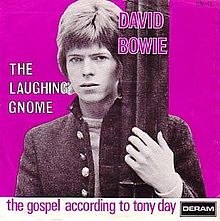
changed his name to David Bowie in late 1966 to differentiate himself. Not that the change in moniker did him any good; he released a solo single in April 1967 (the weird and wonderful/embarrassing (depending on who you ask) children's song "The Laughing Gnome") and his debut album, David Bowie, that June (the same day Sgt. Pepper's Lonely Hearts Club Band was released), both on Deram Records.

The problem with David Bowie especially, in my opinion, is that it's all over the map - on it, Bowie does folk tunes, Anthony Newley-type show tunes, baroque pop, etc.; none of them written especially well. Buyers just didn't know what to make of him; was he 'for real', or just a novelty artist? The result was that they stayed away in droves - neither the single nor the album charted. This would be the last music Bowie released for more than two years (Deram dropped him a couple of months later).

In the interim, Bowie began an intensive course of study in dance and the dramatic arts under renowned choreographer Lindsey Kemp. He immersed himself in lessons in mime, Medieval Italian comedy and avant-garde performance, and began his first serious exploration into creating a distinct persona/personae for himself. David also started performing again, in a folk/Merseybeat combo with mime interludes and poetry readings mixed in, with his new girlfriend Hermione Farthingale (God, how 'English' a name can you get?) and friend John Hutchinson. And through his connection with Kemp, he got a couple of small uncredited parts in British movie and TV productions. Here he is (blink and you'll miss him) as an extra in the 1969 movie The Virgin Soldiers:


Around the same period, Bowie got a new manager, Kenneth Pitt, who believed in David's talent but was annoyed and frustrated by his lack of wider recognition. Pitt wracked his brains to figure out some way to bring Bowie's gifts to the masses. A chance encounter with a West German television producer in late 1968 provided him with what he thought was an answer: Pitt would put together a short promotional film showcasing Bowie's talents. The professionally-produced short would include not only music from David's 1967 album, but also dramatic and mime bits. The German producer broadly hinted that, once completed, he would air the film on Zweites Deutsches Fernsehen (ZDF), the country's public broadcasting station, the equivalent to the American Public Broadcasting Service (PBS). Pitt figured that that sort of exposure might break Bowie out in Europe, with that fame subsequently translating back to Britain. He suggested his plan to Bowie, who also thought it was a boffo idea.

In choosing which songs to feature and dramatize in the film, Pitt and Bowie selected four from David Bowie, along with two new songs David had recently written with Farthingale and Hutchinson, "Ching-A-Ling" and "When I'm Five". Added to these selections was "Let Me Sleep Beside You", a single recorded and rejected by Deram shortly after the 1967 album was released and shortly before the label released him (Bowie wrote this song with a new friend of his, a young American expat record producer named Tony Visconti). Pitt enlisted a Scottish friend who had spent considerable time in the U.S., Malcolm Thomson, as the director, and arranged for a week's shooting at a studio in Greenwich in late January 1969; the schedule was delayed due to Bowie's participation in The Virgin Soldiers, shooting earlier that month.

David arrived at the Greenwich studios that January 26th ready to go in every aspect but one; his hair was unfashionably short, cut to regulation Army length for the war film. Pitt and Thomson were aghast, but quickly improvised by finding a suitable long-haired wig for Bowie to wear throughout the shoot. Bowie also arrived with another piece to include in the production; an unfinished outer space-themed song that he and John Hutchinson had been working on during the prior week called "Space Oddity".

The filming ran into difficulties from nearly the very beginning. Pitt and Thomson began to clash over content, quality and subject matter. I think that Pitt was looking for more of a quickie showreel done relatively cheaply, where Bowie's songs were the standout/featured attraction. Thomson, on the other hand, wanted to add more costumes, camera movement, and artistic nuances into the production. A major point of contention between the two centered on plans for "Space Oddity"; in particular, Thomson wanted to make the part where Major Tom cavorts with the "space maidens" considerably more
sexy and risque than what may have been permitted for German television. Also, a considerable amount of time and effort was expended on Bowie's mime segment, titled "The Mask". As a result of all of this, studio time had to be extended, and the overall cost of the film began to mount.

Finally, after nearly two weeks of filming, the film (entitled Love You Till Tuesday) wrapped on February 7th. Here's a list of the performance pieces on it:
  1. "Love You Till Tuesday"
  2. "Sell Me a Coat"
  3. "When I'm Five"
  4. "Rubber Band"
  5. "The Mask (A Mime)"
  6. "Let Me Sleep Beside You"
  7. "Ching-a-Ling"
  8. "Space Oddity"
  9. "When I Live My Dream"
Pitt immediately contacted his West German friend, to let him know the short was ready for airing . . . but found that the producer had moved on from ZDF, and no one else there was interested in showing a music film by some unknown English artist. Bowie's manager found he had spent all of his money for seemingly nought. Desperate now, Pitt began shopping the showreel around to various British networks and record labels, but no one was interested in anything about it . . .

Well, that is, ALMOST no one.

Ken Pitt was given an audience with representatives from Mercury Records' British subsidiary Philips in the early spring of 1969. The reps found little of interest in the film . . . except for "Space Oddity". From that modicum of interest, Pitt was then able to negotiate a one album deal (with an option for another one or two albums) for Bowie with the label. David was rushed into the studio; "Space Oddity" was recorded that June 20th, and released as a single on July 11th, 1969, just in time to take advantage of the Apollo 11 mission (the first lunar landing) nine days later. The single proved to be a hit in Britain, where after a slow start it peaked at #5 (it did nothing in America on its initial release, stalling at #124 - but on its re-release in 1973 in the wake of Ziggy Stardust, it reached #15, his first U.S. hit single).
This song, and the subsequent album David Bowie (aka Man Of Words/Man Of Music in the States) released in November 1969, launched David's career.

As for the film: apart from its use to secure the Mercury/Philips deal, Pitt found no immediate further use for it and filed it away, where it sat unseen for years. But in the early '80s, with the advent of home video, Bowie's former producer (the two split in 1971) realized he may have something golden on his hands. He contacted Polygram (by
then the holding company for Philips) and made a deal for its release; Love You Till Tuesday went on sale in VHS format in May 1984. Not to be outdone, Deram Records, the label holding most of the material used in the movie, released a "soundtrack album" (actually, just the versions of film songs recorded for David Bowie, along with non-film singles from the same period) that same month. Here's the song lineup:
1. Space Oddity
2. Love You Till Tuesday
3. When I'm Five
4. Ching-A-Ling
5. The Laughing Gnome
6. Rubber Band
7. Sell Me A Coat
8. Liza Jane
9. When I Live My Dream
10. Let Me Sleep Beside You
11. The London Boys
Looking at the film nowadays, it's hard to properly consider it for its standalone artistic and musical merits in the context of its time. It's very much a time capsule of late '60s "Swinging London" styles and attitudes, and as such, in this day and age it's an effort to take it all seriously. For example, it is difficult to watch Bowie, the dapper young puka-beaded gentleman, lounge suggestively on pillows while warbling the title track and resist the urge to shout "Yeah, baby!" in a cheesy Austin Powers accent:

(Did you hear him briefly snicker halfway through the video?  David knew full well what the story was, and what he was doing . . .)
All in all, there's nothing in Love You Till Tuesday, either the album or the film, that's particularly deathless or essential in Bowie's career. Other than "Space Oddity", which was considerably revamped for its summer 1969 release, most of the other tunes here are either lightweight or forgettable. But both works of art stand as interesting artifacts in the early design and development of David's sound and vision of himself to come. The seeds of Major Tom, Ziggy Stardust, Pierrot from Scary Monsters, and the otherworldly/alien Bowie can be found in his performances here.

And what's also great to see and hear here is Bowie as a young man - full of energy, life and happiness, presenting his compositions and ideas to the world with a knowing smile on his face and absolutely no fear whatsoever. No matter what other changes he brought to his act and career, that part of him always stayed consistent and true. Thank God for that.

So, for your consideration, here's:
  • The album Love You Till Tuesday, released by Deram Records on vinyl and cassette in May 1984 (not released on CD until 1991);
  • The film Love You Till Tuesday, produced in 1969 but released by Polygram in May 1984. The complete 30-minute film is exceedingly difficult to find on the Web; so here it is, in .mp4 format.
I promise that this will be my last Bowie post for the foreseeable future. So enjoy, and as always, let me know what you think.

Please use the email link below to contact me, and I will reply with the download link(s) ASAP:
Love You Till Tuesday (album): Send Email

Love You Till Tuesday (film): Send Email

Tuesday, December 22, 2015

Minutemen - Double Nickels On The Dime (RS500 - #411)


Dennes Dale "D." Boon of The Minutemen died thirty years ago today, on December 22nd, 1985. It is truly hard to fathom that it's been that long.


The first Minutemen song I ever recall hearing was "Political Song For Michael Jackson To Sing". I was listening to WHFS, the local alternative station, in my dorm room at Bancroft Hall shortly after the beginning of my youngster (sophomore) year at the Naval Academy in the fall of 1984 when this tune came on:


I don't know what it was about that song that grabbed me; was it the chugging melody? The plaintive, stop-start vocals? Or one of the few lyrics I could make out, "We'd cuss more in our songs and cut down the guitar solos" - followed immediately by a cheeky guitar solo? I didn't know much about The Minutemen prior to 1984; the little I'd heard about them was that they were "just another" California hardcore punk band, which formed my generally negative impression of the group before I'd ever heard a single note of their music. But hearing this weird, complex, melodic, funny song on the radio was a revelation, and completely turned my mind around regarding this band. That weekend, I made my way to Oceans II Records downtown and purchased the cassette version of the album this song was on, Double Nickels On The Dime.

Based upon what I knew of the band's history, I was a little concerned about what I would find on this album. Guitarist Boon and bassist Mike Watt were childhood friends, having met at the age of thirteen in San Pedro, California in 1971, after Watt's military officer dad was transferred to the area from Maryland a couple of years earlier. They started playing music together while still in junior high, playing rock covers and the like until their last year of high school, when they got into punk. The due began writing their own songs, and formed their first punk band, The Reactionaries, in 1978. When that group broke up eighteen months later, Boon and Watt formed Minutemen, with their former drummer from The Reactionaries, Ed Hurley, joining them a few months later.

The Minutemen began releasing records through Long Beach-based SST Records; their first EP, Paranoid Time was out before the end of 1980. Their first effort on vinyl completely lived up the the "loud/fast/hard" punk ethos - Paranoid Time blasts through its seven songs in six and a half minutes, and for the most part the tunes are what you would expect - abrasive guitars, thrashing drums, shouted vocals, everything at top speed. The disc was a minor hit in punk circles, quickly selling out its initial 300-copy pressing. Impressed, SST label head Greg Ginn invited the band to record a full-length album the following year. The Minutemen went into the studio for a single late-night session in the late summer of 1981 and laid down The Punch Line, which was released in November 1981.

Like their debut EP, The Punch Line is notable for the brevity of its songs; the album blazes through eighteen songs in fifteen minutes, with no song running longer than a minute and a quarter. But what's also notable about this release is the remarkable musical development of The Minutemen in the few short months since their first release. There's still some thrashing and shouting on this album, but some songs are melodic, tuneful in almost a prog-rock, free-form jazz sort of way. For instance, check out this song, "The Struggle":


I think that, despite their immersion in the early California punk scene (they were huge Black Flag and Flesh Eaters fans), a lot of what influenced The Minutemen's music came from their time as a rock covers band, playing music from groups they admired like Steely Dan, Creedence Clearwater Revival and Alice Cooper. Of course, coming out openly and admitting that they liked bands like that would have drawn the ire and opprobrium of their rabid punk fan base. So in a sense, Watt, Boon and Hurley "camouflaged" this rock/pop aesthetic with enough punk-y bells and whistles to be palatable for their crowd.

The Punch Line was the first Minutemen release that got some serious notice by the mainstream rock press, many of whom recognized early on that this was no ordinary punk band. The band continued to garner critical praise with their second full-length album, What Makes A Man Start Fires?, released in January 1983. All of this set the stage for their magnum opus, Double Nickels On The Dime.

Like I said above, at the time I purchased this album I didn't know a lot of details of the band's early history that I noted above. I knew that they were on SST, home of Husker Du, another California hardcore punk band. I'd heard a couple of cuts from the latter band's Zen Arcade (released on the same day as Double Nickels) and frankly, they weren't to my taste. So I still thought I was screwing myself over by purchasing an album based on my impression of a single song. As it turned out, I couldn't have been more wrong - Double Nickels On The Dime is a fantastic album, the definitive expression of what The Minutemen were all about - eclectic, thoughtful, tuneful, sharp, funny, introspective. As good as "Political Song . . ." was, there were plenty more on this album that struck my fancy. But probably my favorite tune here is "History Lesson, Part II", where D. Boon sings about how the band came to be, and specifically about his relationship with his band mate and friend Mike Watt:


The first line of this song, "Our band could be your life", is now iconic, along with "Punk rock changed our lives." "History Lesson, Part II" is an ode to a scene that was fast disappearing (in many ways, the release of Double Nickels marked the beginning of the end of the scene the band came up in. According to American Hardcore: A Tribal History author Steven Blush, this album (along with Zen Arcade), was "either the pinnacle or downfall of the pure hardcore scene."). Bands like Black Flag also began to ignore the rigid rules of their genre, and move away more and more from the thrash-and-bang sound. "History Lesson, Part II" is also one of the best friendship songs ever written - Mike Watt wrote the song as a tribute to D. Boon, but Boon ended up singing it and conveying his respect and affection for his old friend back at him.

Double Nickels On The Dime was met with near-universal acclaim upon its release - influential Village Voice critic Robert Christgau gave the album an "A-", then later admitted he underrated it. Even the critics and publications who didn't fully appreciate the disc at the time have made an effort in following years to rectify their error - Rolling Stone originally gave it 3 1/2 stars, but when it was re-reviewed in 2004, the magazine upgraded the album to "classic" status, a full five stars. Even with all of that, Double Nickels wasn't a huge seller; in its first year, only about 15,000 copies were sold (including the one I bought). That wasn't too shabby a result for for an indie band, but not enough to get you onto the Billboard 200. Still, to this day, the album remains The Minutemen's best selling record.

Even with all of the critical acclaim and their relentless touring in support of their record during 1984 and 1985, The Minutemen and its members weren't exactly household names in 1985. So D. Boon's death in a car accident that December wasn't big news in a lot of quarters. I was fairly plugged in to what was happening in the music world then, so I heard about it the day after it occurred, while I was home on Christmas vacation. From what I understand, Boon was sleeping in the back of a van being driven by his girlfriend through Arizona when the rear axle suddenly broke. The van immediately lost control and rolled off the side of the highway; Boon was thrown out the rear door and broke his neck, killing him instantly.

When I got the news, I got the same weird feeling in the pit of my stomach that I'd had a couple of months earlier, when I learned that The B-52's Ricky Wilson had also died unexpectedly (reportedly, at the time, of "cancer"; it was much later that it was revealed he had perished of AIDS). It was odd and sad to see musicians like these at the top of their game succumbing at such early ages to illnesses and accidents. D. Boon had a lot left to offer the music world; Double Nickels was only the band's third album. With every release they were expanding their melodic focus; it would have been cool to see where The Minutemen would have gone, had Boon remained alive.

But all in all, that feeling of loss I had was shared with very few others, just folks who knew and loved the band. The nearest analogy I can think of regarding the reaction to D. Boon's death was when guitarist Dimebag Darrell was shot and killed on stage in Columbus, Ohio in 2004. In certain quarters, Dimebag was a legend, the exciting and innovative musician behind Pantera and Damageplan. But I'll be willing to bet that the average man in the street had little if any idea who Dimebag Darrell was on the night of his death, why he was so important to music, and why his fans reacted with an outpouring of genuine despair and grief at his passing. To most people, he was "just another metal guitarist" . . . just as D. Boon was "just another punk rocker". But they were both much more than that, as understood by their true fans and supporters, and the music world lost something interesting and special with their passing.

Thirty years have now gone by, and for the most part, the memory of D. Boon has faded from general knowledge. But for a few, who still revere the legendary music that The Minutemen left behind, the spirit of Boon still endures. After a period of depression and seclusion in the wake of Boon's death, Mike Watt and Ed Hurley resumed their music careers, first in fIREHOSE, and later with other bands and their own solo work. They are still the keepers of the old band's flame, and in interviews wax nostalgic over the sounds they made together with their long-lost friend. Even after all these years, Watt still calls Double Nickels On The Dime "the best record I ever played on." Damn straight.

I was planning on writing a more in-depth history of the band and their music (especially this album) and a fuller account of the life and death of D. Boon here, but it's already been done, probably better than anything I ever could have written - here it is, if you're interested. It comes highly recommended.

Anyway, in memory of D. Boon, here's the album, released on SST Records in July 1984. Enjoy, and as always, let me know what you think.

Please use the email link below to contact me, and I will reply with the download link(s) ASAP:

Send Email