Random mumblings and mundom ramblings on music (mostly), and whatever else pops into my mind . . .
[The files attached here are for review only, and should be deleted after two weeks. If you like the bands, go buy the albums . . . like I did!] . . .
And yes - EVERYTHING posted here is still available!
...And my last quickie post this week in appreciation for reaching the half-million visitor landmark...
From the old (and long defunct) Kiwi Tapes blog (credit for this narrative to original poster):
The Dunedin Double EP was a seminal record in New Zealand music. An unusual format, it contain two 45rpm 12" discs, and at nearly 50 minutes length, it is longer than many albums. Released in 1982, the compilation was one of the first releases from the newly formed Flying Nun Records label (catalogue number DUN-1), which over the course of the next ten years was to become the biggest independent record label in New Zealand. Many of the label's top groups came from the South Island city of Dunedin, and established that southern city's music scene as the leading source of guitar-based bands in New Zealand throughout much of the decade. The bands from the city which had music released on Flying Nun were grouped under the loose banner of Dunedin Sound, and several of them went on to not only national but also international success. The Dunedin Double EP established the names of four of these groups, each of which was represented on the double EP by one side. The four bands concerned were The Chills, Sneaky Feelings, The Stones, and The Verlaines. The Chills' song "Kaleidoscope World" in particular became very popular, gaining considerable airplay for the band (It later provided the title for the band's first album, a compilation of their early singles and EP tracks. Though the sound quality of the Dunedin Double EP was distinctly lo-fi (it was recorded on portable 4-track), the release of this record provided a major impetus both for Flying Nun records and for the four bands involved, as well as providing inspiration and momentum to the music scene in Dunedin.
For your consideration: Flying Nun's legendary Dunedin Double EP, released on vinyl in New Zealand in June 1982, and to the best of my knowledge never re-released on CD or any other format. Enjoy, and as always... well, you know.
Please use the email link below to contact me, and I will reply with the download link(s) ASAP:
This post will eventually be about Peter Gutteridge, the legendary New Zealand musician who died September 15th, 2014. But first, a few words about a well-respected drummer for my favorite band.
If you’re a fan of The Fall, then you may already know who Simon Wolstencroft is. He was the band’s drummer for more than a decade, and contributed keyboards and computer effects as well, on every Fall album from 1987’s The Frenz Experiment to 1997’s Levitate. In addition, Wolstencroft holds the distinction of co-writing one of the bands only three singles to make the British Top 40, and the only non-cover song, “Free Range” off of 1992’s Code Selfish.
However, in some music circles, Wolstencroft is known for another more dubious reason, and by another name: “The Nearly Man”. Why? Because Simon had the misfortune of being part of or nearly a member of at least three other popular and legendary bands before they hit it big, missing out of their huge success every single time.
As a 17-year-old student in Altrincham, England in 1980, he formed a punk band called The Patrol with two classmates, Ian Brown and John Squire. After much initial enthusiasm and a number of gigs that year, The Patrol just sort of petered out. Simon moved on, and in the following year became drummer for Freak Party, an instrumental funk band that he formed with two other schoolmates, bassist Andy Rourke and a guitarist named Johnny Mahar, who later became known by the name Johnny Marr. Marr quickly grew tired of funk and found a vocalist for the group’s new rock sound, but after a couple of demo recordings, Wolstencroft quit in late 1982, allegedly because he didn’t like the new singer, Steven Morrissey’s, voice and overall attitude. The
band, known as The Smiths, recruited another drummer and released their first single, “Hand in Glove”, six months later. The rest, of course, is part of music history.
He then rejoined his old friends Brown and Squire, who were just starting up a new band and going through months of rehearsals. But Wolstencroft’s reunion with them was half-hearted. During the rehearsal period, he was also auditioning for other groups, and in the summer of 1984 he left his friends to join The Colourfield, ex-Specials frontman Terry Hall’s band, as a touring member. Less than two months later,
Brown and Squire’s band, now known as The Stone Roses, played their first gig and inaugurated the ‘Madchester’ sound.
The Colourfield thing didn’t work out for him, so Simon eventually joined The Fall in the summer of 1987. But while in that band, he was approached by musicians from a local Manchester
band, The Rain, who were looking for a live drummer to replace their drum machine. The group’s lead guitarist, Noel Gallagher, asked Wolstencroft if he would leave The Fall to join their group, but Simon declined. The Rain shortly thereafter evolved into Oasis, one of the most successful British acts of the 1990s.
Why have I spent so much time and space detailing the career of a musician unrelated to this post? Because in many ways, Peter Gutteridge was the Kiwi Simon Wolstencroft . . . the Nearly Man of New Zealand. Gutteridge was involved in the founding of some of the country’s most seminal bands, but in each case never stayed around long enough to enjoy the fruits of the groups’ successes.
Peter Gutteridge was born in the South Island city of Dunedin in 1961. He was the kind of kid who took to music naturally, eschewing formal lessons and just bashing about, learning how to play on his own. His family had a piano that he noodled with at a young age until he got fairly proficient, and when he was in his teens he taught himself to play guitar and bass. While still in high school, he teamed up with two classmates, brothers Hamish and David Kilgour, to form The Clean in 1978. The Clean’s sound – made up of David’s angular guitar notes, Hamish’s simplistic, shambolic beats and Peter’s melodic, throbbing bass lines - was unlike pretty much every other band in New Zealand at the time, and the group became very popular and influential in their hometown. Within a few months, The Clean became proficient enough to play gigs around Dunedin, even opening for the premier punk band in the city, The Enemy, fronted by Chris Knox. The two bands became close, drawing inspiration from each others styles. And their combination of raw punk and ringing guitars, filtered through a Kiwi sensibility, led to the development of the celebrated “Dunedin Sound” of the 1980s.
After less than a year of existence, the Kilgour brothers began to feel that Dunedin was getting too small for them. Envisioning a move up to the ‘big time’ in New Zealand music, in 1979 they decided to relocate The Clean to Auckland, the largest city in New Zealand, where they felt there were more advantages in terms of venues and opportunities for recording contracts. Peter wanted no part of this relocation, however, and quit the band just before the move. However, he did leave with The Clean a riff he created that evolved into one of the bands finest, most popular songs – “Point That Thing (Somewhere Else)”.
Initially, it appeared that Peter made the right move by staying in Dunedin. The Clean’s move to Auckland was, by most accounts, a disaster, and within a year the Hamish brothers came back to the South Island chastened, with their tails between their legs. Meanwhile, Gutteridge hooked up with another musician classmate, Martin Phillips, and in 1980 helped form The Chills. The Chills later became hugely successful and an important part of New Zealand popular music history. But Peter didn’t stick around long enough to revel in the band’s success. In fact, he only played a handful of gigs before leaving the group less than nine months after he joined.
By the time Gutteridge quit The Chills, the Kilgour brothers had reformed The Clean in Dunedin with new bassist Robert Scott, and had released their debut single “Tally Ho!”, one of fledgling indie music label Flying Nun’s first releases. The single became the band’s and label’s first hit, reaching #19 on the national charts. Peter did not have a role in any of this; instead, he spent the next couple of years as a member of various short-lived minor bands, including The Cartilage Family and The Craven A’s.
After a couple of years, The Clean fell apart. Hamish Kilgour moved to Christchurch to work on some of his own acoustic, more folk-focused material, and his brother David came to the city shortly thereafter to help him work on the tracks. The resulting music was released under a new band name, The Great Unwashed (the opposite of The Clean – get it?), and the
brothers went out on the road to support the album, Clean Out Of Our Minds (another pun). Needing some additional musicians for the tour, the Kilgours reunited with Gutteridge, just coming off a brief stint with another aborted band project.
Since the group refused to include Clean songs on their setlist and only had a limited number of songs off of their only album for their gigs, the Kilgours asked Peter if he too had some solo material to add to the sets. He responded enthusiastically – over the years, he had composed quite a few original works somewhat different from what was the New Zealand alternative mainstream at the time, but up until then had no viable outlet to present his music. Gutteridge flourished under his first real taste of artistic freedom; his songs proved to be popular, so much so that for The Great Unwashed’s next release, the 1984
Singles EP, three of the five songs on it were written by Peter. By the time the band broke up at the end of that year, Peter had gained the confidence to go his own way musically.
He moved back to Dunedin and started a new band, The Phromes, all the while looking for the ‘right’ musicians to start a new project he had in mind. After a couple of years, he found the people he was seeking – drummer Alan Haig, guitarist Dominic Stones, and keyboardist/backing vocalist Christine Voice – and formed Snapper in 1987.
In many ways, Snapper was Gutteridge’s protest of and response to the commercialization of New Zealand alternative music, embodied in the movement he had some hand in creating. As he told a national music magazine a few years ago, “When I formed Snapper it was a deliberate reaction against the Dunedin Sound, I couldn’t fuckin’ stand it.” The music he was creating was definitely a far cry from those early days, with a sound more akin to that of The Jesus & Mary Chain, Suicide, and late-80s/early 90s Kiwi noise rock bands like The Dead C and Wreck Small Speakers On Expensive Stereos. A music critic described an early Snapper gig as “a relentless throb… the enormous keyboard sound must be like getting a crew-cut with a Masport… cathedrals of electricity… great swinging mass of harmonics…” However, this journalist was one of the few at the time who understood what Peter was up to, writing that “Gutteridge, who’s finally got a band to play his songs en masse clearly has a wider vision for this band.”
Snapper’s first record, the four-song Snapper EP, was released by Flying Nun in 1988. It was welcomed with rave reviews both at home and abroad. In the UK, the EP was selected as Single Of The Week in the NME and even made John Peel’s playlist. The band continued gigging and prepping songs for an eventual full-length album. But in 1989, Peter couldn’t resist an offer from local independent record label Xpressway to release his demos and solo material under his own name. In 1989, the cassette-only Pure hit the shelves.
Pure was . . . well, I think that music journalist Richard Langston described the album best: “… it shows the full range of Gutteridge’s talents, so besides raw over-loaded guitar-and-keyboard-fed- electro-boogie we get some stuff that treads with the melodic delicacy of your favourite moments from The Chills, yep that damn good…just bloody wonderful …”
And Mr. Langston was right – there’s some brilliant stuff on this disc. Here’s the album lineup:
1. Lonely
2. Exhibition I
3. First Instrumental
4. Hang On
5. Ocean
6. Dead Pony
7. Fuck Your Mother to Hell
8. Suicide
9. Oil
10. Pure (Nr. 1)
11. Thumbaline
12. Cause of You
13. Rubout
14. Planet Phrom
15. Sand
16. Exhibition II
17. Having Fun
18. Bomb
19. Fifty-seven Seconds
20. Chinese Garden
21. Pure (Nr. 2)
Snapper’s first album, Shotgun Blossom, was released the following year. It received superb reviews as well both in New Zealand and in England; Melody Maker called it “a solid-gone, stone-cold, down-under classic.” Gutteridge finally had a winner done his way, and it seemed that he and his band’s star could do nothing but continue to rise.
But shortly thereafter, problems began to arise in Peter’s personal and musical life. Typical of many New Zealand bands of that period, the original Snapper line-up started slowly falling apart. Dominic Stones began having success with his own band The 3Ds, and left Snapper in early 1992. The group managed to release a single in 1993, “Vadar” b/w “Gentle Hour”, but these songs did not have the power or impact to the band’s earlier tunes. It was also around this time that Gutteridge got hooked on some fairly hard-core drugs. His addiction drew his attention away from his group, and as the gigs became fewer and far between and Peter’s health declined, most of the remaining members drifted away.
Snapper released one last full-length album, A.D.M., in 1996, but it was mostly a solo effort, with Gutteridge singing and playing almost all of the instruments. Snapper never really broke up after that – Peter reformed various versions with varying lineups for one-off gigs in 2000 and 2012. But due to his drug problem and resulting reclusive nature, the band was pretty much kaput before the end of the millennium.
While Gutteridge spent most of the 2000s hunkered down, the reputation of Snapper continued to evolve and grow, especially abroad. American bands began covering Snapper songs, and the name “Peter Gutteridge” began being tossed around in some music circles as a symbol and indication of being “with-it” and “in-the-know”. However, only a few people had ever heard the man’s music – the Pure cassette had by then long been out of print, up to that point the only Xpressway release never reissued on vinyl or CD. But a small New York label made a special effort, assisted by David Kilgour, and in 2013 Pure was finally re-released as a double LP.
The release relaunched Peter’s career. By this time, he appeared to have kicked his drug addiction, and was healthy and ready for action. He reformed another version of Snapper with Dominic Stones and a new keyboardist and drummer, and went on a much-celebrated tour of New Zealand’s North Island in early 2013. While the band’s glory days were far behind them, most people were glad to see Peter up on stage again where he belonged, doing what he loved. It seemed that he was back, and this time for good.
In the summer of 2014, he made his first trip to the States, spending time in New York seeing the sights and visiting his old friend Hamish Kilgour, who’s now a resident of Brooklyn. He even got the opportunity to perform his first American show that September 1st, at Palisades in Brooklyn, where he played his Pure album in full to a packed house. He was billed that night as "The man who launched a thousand Flying Nun bands."
No one knows what may have been going through Peter’s mind when he returned to New Zealand a week later, where he saw his future or envisioned what his legacy really was. Would he be known as the innovative, visionary musician behind Snapper and Pure . . . or as just the guy who missed his chance, over and over again? That’s a question that he will never answer . . . since shortly after arriving back home, Peter Gutteridge died. Details on the circumstances of his death are still sketchy, but it appears he took his own life.
Below, I’ve provided a copy of the liner notes from his solo album. I find the last line very poignant . . .
Compiled by Peter Gutteridge & Peter Jefferies Mastered by Peter Jefferies Remastered by Tom Bell and John Golden, 2013. PETER GUTTERIDGE vcls/gtr/kydgs on all the above. CHRISTINE VOICE gtr/vcls on 7, 8 & 14. ALAN HAIG drms on 4, 6, 7, & 14. DOMINIC STONES gtr on 7, 13 & 20. RUSSELL MOSES drm mchns on 2. GEORGE HENDERSON gtr on 15. BRUCE MAHALSKI vcls on 18. (c) and (p) PETER GUTTERIDGE 1989. ALL TRACKS RECORDED ON PORTA-STUDIO BY PETER GUTTERIDGE, 1986-87. More to come. Peter Gutteridge has been making music for ten years or so now. A former member of various Dunedin bands (the CLEAN, GREAT UNWASHED, CHILLS and PUDDLE, to name a few), his musical and compositional talents currently form the nucleus of SNAPPER. However, while all the members of SNAPPER (as well as several other friends) contribute to the music on this tape, the total result is not the work of a band. It is, as the title suggests, 'Pure Peter Gutteridge', 4-track prota-studio demos covering a two year span, compiled from his work-tapes. Peter's songs are here presented 'in the raw;, just as they came to him, from the first piece he ever recorded on his 'Fostex', through to early versions of some SNAPPER material. This collections presents the widest variety of Peter's music yet to reach the public, and we think some of the best too. What's more, there's at least as much again currently recorded, and more going down all the time - so look out for vol. 2!
Volume 2 never arrived, and never will; sometimes in life you don't get those second chances. There will be no more new music from him. . . but I am very happy that he did manage to leave us with what he did. R.I.P., Peter.
So, for your listening pleasure, here is Peter Gutteridge’s Pure, released on cassette by New Zealand’s Xpressway Records in 1989 and re-released by American label 540 Records on double vinyl discs in 2013. This copy was burned off of my mint-condition LPs, and is impossibly hard to find on the Web; as far as I can tell, this is the only digital source for this album currently available. Anyway, enjoy, and as always, let me know what you think.
Please use the email link below to contact me, and I will reply with the download link(s) ASAP:
Finally, here's a live version of "Point That Thing Somewhere Else" performed by the reformed Clean during a New Zealand gig in early 2014, with Peter guesting - kinda nice that he finally got to play his song with his old bandmates:
24 May 2015 - I've recently received a message from Mr. Zach Burba, who played bass for Peter Gutteridge at his last show in Brooklyn last September. Here's what he had to say regarding the Palisades gig:
"My band had a show in Brooklyn booked and the people that were setting it up ran into Peter at The Clean's reunion show. He told them he was trying to play a show in NYC and they asked him if he would want to play at Palisades with us. I was a fan of Kiwi music and The Clean and had heard some of Peter's music but wasn't deeply familiar. At the show I started talking to him back stage. He was helping me fix a Casio keyboard, he mentioned he wanted to play with a band and my friend Erin and I stepped in. He showed us his songs in the bathroom of the venue and then we just went for it. It was a lot of fun, I hope we did the songs justice. I'm about to upload our version of 'Born in The Wrong Time' which, for me, was the highlight of the show. We some how managed to play for 2 hours. IT seemed like 15 minutes. After the show we were all buzzing with excitement. Peter was SO HAPPY. He just kept going on and on about how much fun it was to play with a band again. He got our phone numbers and mentioned that we should try and record together sometime. Erin was texting him every now and again until the end. We were shocked to hear only a few weeks later about his death."
Here's the show video Mr. Burba mentioned above and so kindly provided - enjoy:
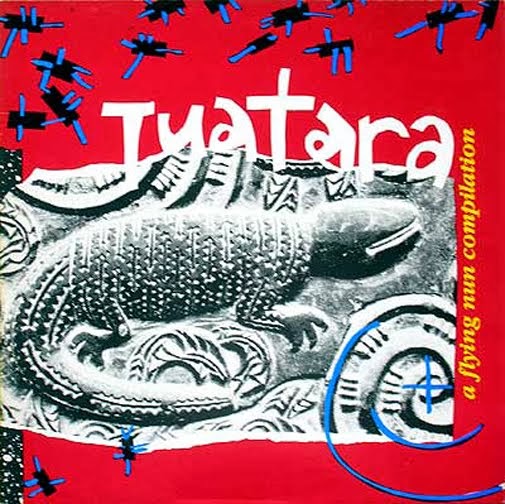
After their early wave of success producing and distributing the first records by The Clean, The Chills and Sneaky Feelings, New Zealand's Flying Nun Records released a couple of compilation albums in the early 1980s. These collections showcased the burgeoning underground/alternative sound emerging in various locations around the country, especially in the South Island cities of Dunedin and Christchurch. These early comp
releases (which included the seminal Dunedin Double EP in 1982 and the live recording The Last Rumba in 1983) had fairly limited distribution - essentially only within New Zealand, where they both were popular and influential albums. But it was the 1985 release of the label's Tuatara compilation that gave the rest of the world the first real indication that there was something special happening musically in Aotearoa.
During 1984-85, Flying Nun entered into limited distribution deals with a number of small international labels, including Normal Records in Germany and Strange Weekend Records in North America. They also established their own overseas subsidiary, Flying Nun Europe, for distribution on that continent. Tuatara was their first test of that international network, and for all intents and purposes it was a resounding success. By 'success', I don't mean that it was a huge seller. It was successful in that here in America, it was pushed along via college radio and word-of-mouth, and the 'right' people got exposed to it. I found a quote from Nils Bernstein, current Director of Publicity at Matador Records (and former owner/operator of the legendary Seattle music store Rebellious Records in the '80s) which sums up the impact of Tuatara here in the States:
“People were really floored by songs like "Death and the Maiden" and "Pink Frost". It was an album that new-wave girls, brainy pop geeks and noise rock fans all loved. You know how they say about the first Velvet Underground album: it sold terribly, but everyone who bought a copy started a band. It’s kind of like that with the Tuatara comp.”
High praise indeed.
As mentioned above, this album contains "Pink Frost", probably The Chills' most famous song, along with cuts by Tall Dwarfs, The Clean and The Verlaines. But there is also gold here in the tracks by the more obscure, less heralded Kiwi bands, including Look Blue Go Purple and Marie & The Atom. Pretty much every song on here is a winner, and in total they provide a superb overview as to what sort of cool stuff was happening in the New Zealand music world of the early '80s.
This thing is hard as heck to find online, so here's a copy burned off of my meticulously maintained CD. For your throwback listening pleasure, here's Tuatara: A Flying Nun Compilation, released by said label on 1985. Enjoy, and as always, let me know what you think.
Please use the email link below to contact me, and I will reply with the download link ASAP:
I'm disgusted with myself that I didn't get into this band when I first went to New Zealand.
I didn't know anything about The Chills until I returned to the U.S. from Christchurch and entered grad school in Virginia. One of my classmates there, Stuart, was a native New Zealand who was born and bred in Christchurch, but who had spent several years living and working in the U.S. Word had gotten around the school that there were "two Kiwis" enrolled (one real, one adopted), and after being introduced, Stuart and I discovered that we had several mutual friends in and around Canterbury. We became fast friends.
One day, Stuart (knowing what a Kiwi music fan I was) brought a couple of CDs to school for me to sample and evaluate. One was by the Bats, which really didn't do anything for me, I must say. But one of the others was Heavenly Pop Hits, a greatest hits compilation by The Chills. That was the one that really hit home for me.
The Chills were formed in Dunedin, New Zealand (home of the aforementioned Chug and The Clean) in 1980 by Martin Phillips, a talented musician and songwriter who formed his first band, The Same, in 1978 (his other claim to pre-Chills fame was that he played the organ on The Clean's 1981 debut single "Tally Ho", Flying Nun Records' first New Zealand hit song). The Chills cranked out several memorable singles in the early 1980s, including "Pink Frost" and "Rolling Moon" (both included here), but the band didn't release a proper album until 1986.
The band's long delay in putting out an LP can be attributed to two things: lack of money (Flying Nun wasn't exactly rolling in dough in the early '80s) and, more significantly, the failure to maintain a consistent lineup. Dunedin bands are notorious for this (see my earlier entry for Chug), but The Chills were the poster child for this type of band turnover. Since its inception, the band has gone through (at last count) nineteen different lineup changes, with Martin Phillips being the only constant member (sounds a lot like The Fall, eh? Although I understand that Phillips isn't nearly the tyrant and band dictator that Mark E. Smith is reputed to be . . .). Former Chills members have pollenated several other bands throughout New Zealand (including Straitjacket Fits, The Clean and The Verlaines) and the rest of the world (Justin Harewood ended up in Luna, and Martin Kean resettled in England and became an early member of Stereolab).
Such band turmoil, of course, led to sporadic releases, which is why Heavenly Pop Hits is so great, and so important. It collects all of the band's best songs in one place, a one-stop shop for a concentrated dose of what makes The Chills so superb.
Like I said, after listening to this album, I was kicking myself for not getting into them sooner. I could go through and tell you, song for song, why every tune is so outstanding. I'll let you find that out for yourself.
However, the thing I want to convey to you about these songs, and The Chills in general, is that they SOUND like New Zealand . . . It's hard to explain, really, unless you've lived there or spent any significant time in the country. But to me, every song brings back a time, or a place, or a feeling I had when I lived there. Listening to "Double Summer" reminds me of summers I enjoyed there; in "Doledrums", I can relate to some of the lethargic Sunday afternoons I spent in town.
I know I'm not explaining this well . . . But it seems that the essence of the country is contained in the words and music of this album. I consider The Chills to be the definitive New Zealand band.
But I'll let you listen for yourself and decide. Also posted here is the Ice Picks EP that was included with select editions of Heavenly Pop Hits - good songs here as well.
Cheers.
Please use the email link below to contact me, and I will reply with the download link(s) ASAP:
Saying "Thanks" for the music you receive from here costs you absolutely nothing, and yet is worth quite a bit to me… If you can't bother leaving a comment on this blog for the first album/set we send you, don't bother making a request For a second album…